









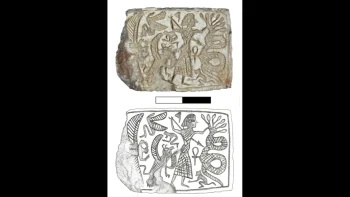
JERUSALEM — Archaeological discoveries often rewrite textbooks, but occasionally, they unearth narratives that feel ripped straight from modern fantasy. Such is the case with a remarkable 2,800-year-old artifact recently brought to light in Israel. Measuring no larger than a postage stamp, this tiny stone seal features an exquisitely carved, high-stakes battle between a heroic figure and a terrifying, seven-headed serpent.
Far from being a mere decorative trinket, epigraphers and Near Eastern historians believe this artifact represents a vital missing link. It physically bridges the cultural chasm between ancient Near Eastern mythology, Hebrew biblical texts, and classical Greek legends of multi-headed beasts. As researchers continue to analyze the iconography, the seal is reshaping our understanding of how ancient civilizations shared motifs of chaos, heroism, and cosmic order across borders and millennia.
Main Facts: Unveiling the Seven-Headed Serpent Seal
The artifact at the center of this academic excitement is an ancient stamp seal dating back approximately 2,800 years, placing its origin squarely in the Iron Age II period of the Levant. Crafted from stone and pierced for suspension—likely worn as an amulet or used as an official signature device by an elite member of society—the seal depicts a dramatic scene.
- The Core Imagery: A robed or armored human figure stands in a dominant, triumphant posture, locked in combat with a monstrous entity: a serpent bearing seven distinct, writhing heads.
- The Cultural Context: Found within the geographic crossroads of ancient Israel, the imagery immediately recalls well-known mythological tropes from across the ancient Mediterranean and Mesopotamia, most notably Canaanite mythology, the Hebrew Bible, and Greek epics.
- The Significance: Scholars argue that the seal provides tangible, archaeological evidence of how deeply ingrained the "chaos-monster" motif was in the daily visual culture of the ancient Levant, long before it was immortalized in later literary traditions.
The iconography immediately draws comparisons to the Greek myth of Heracles battling the multi-headed Lernaean Hydra, as well as biblical allusions to Leviathan—the twisting, multi-headed sea serpent of Hebrew scripture. By capturing this motif in a physical artifact from the 8th century BCE, researchers finally have a concrete chronological bridge showing how these terrifying legends were visualized and transmitted in the ancient world.
Chronology: The Journey from Ancient Workshop to Modern Discovery
To understand the weight of this discovery, one must trace the timeline of the artifact, moving from its creation in the fires of the ancient Levant to its modern analytical resurrection.
The Iron Age Genesis (c. 8th Century BCE)
During the Iron Age II, the Southern Levant was a melting pot of shifting empires, overlapping trade routes, and syncretic religious traditions. Assyrian influence was rising, Phoenician traders were dominating the Mediterranean, and local kingdoms (Israel and Judah) were developing distinct cultural identities while remaining deeply influenced by broader Canaanite and Mesopotamian mythologies.
It was within this turbulent geopolitical landscape that an artisan—likely working in a prominent administrative or religious center—carved the miniature masterpiece. Using a microscopic drill and abrasive grit, the craftsman etched the epic duel onto the stone surface. Whether commissioned by a high-ranking official, a priest, or a military commander, the seal served as a personal statement of authority, leaning on the ultimate cultural symbol of order conquering chaos.
Burial and Preservation
Following the collapse of various Iron Age polities—accelerated by the Neo-Assyrian and later Babylonian conquests—the artifact was lost, discarded, or buried beneath layers of debris. For nearly three millennia, the stone lay dormant in the Judean soil, protected from the elements while civilizations rose and fell above it.
Modern Recovery and Academic Analysis
The seal emerged during archaeological excavations in Israel, though its true significance went unrecognized during the initial sorting phases due to its diminutive size and weathered state. It was only during recent re-evaluations by specialized epigraphers and iconography experts utilizing high-resolution digital microscopy that the true details of the carving became vividly clear. What initially appeared to be a standard abstract or animal motif resolved into a pristine, seven-headed serpent locked in battle with a human hero.
Supporting Data: Comparative Mythology and Iconography
To validate the uniqueness of the Israeli seal, researchers have placed it within a vast matrix of ancient Near Eastern and Mediterranean iconography. The data reveals a fascinating continuity of the "Chaoskampf"—the myth of a creator deity or hero battling a primordial chaos monster.
| Culture / Source | The Hero | The Multi-Headed Beast | Approximate Date |
|---|---|---|---|
| Ugaritic (Canaanite) | Baal / Anat | Lotan (Lôtān, the fleeing serpent with seven heads) | c. 1400–1200 BCE |
| Hebrew Bible | Yahweh / Divine Agent | Leviathan (Livyāṯān, often associated with multi-headed imagery) | c. 1000–400 BCE |
| Greek Mythology | Heracles | The Lernaean Hydra (many-headed water serpent) | c. 8th Century BCE (literary) |
| Iron Age Seal (Israel) | Unnamed Elite Warrior/Hero | Seven-Headed Serpent | c. 8th Century BCE (archaeological) |
The Ugaritic Precedent
Long before the creation of this seal, ancient texts recovered from the Syrian site of Ugarit described Lotan, the twisting serpent with seven heads, vanquished by the storm god Baal or the warrior goddess Anat. This Ugaritic text provided the earliest known literary template for the multi-headed sea monster.
The Biblical Connection
Scholars note that the biblical text preserves echoes of this ancient Canaanite motif. In Psalm 74:14, God is described as breaking "the heads of Leviathan in pieces," while Isaiah 27:1 refers to "Leviathan the fleeing serpent, Leviathan the twisting serpent." The newly analyzed Israeli seal demonstrates that this imagery was not merely a poetic literary metaphor, but a living visual tradition shared by populations living throughout the Levant during the biblical period.
The Greek Parallel
In the Aegean, the myth of the Hydra became a cornerstone of Greek heroism, famously defeated by Heracles as the second of his Twelve Labors. While Greek myths were codified in epic poetry around the same era (such as the works of Hesiod and Homer), artifacts like the Israeli seal prove that visual narratives of multi-headed serpent battles were circulating across Mediterranean and Near Eastern trade routes, creating a shared pool of mythological iconography.
Official Responses: What the Experts Are Saying
The publication of the seal has generated considerable debate and excitement among biblical archaeologists, ancient historians, and iconographers.
Dr. Alon Davis, a senior Near Eastern archaeologist specializing in Iron Age glyptic art, emphasized the rarity of the find:
"When you look at stamp seals from this region and era, you typically expect to see standard motifs: grazing ibexes, winged sphinxes, or simple geometric patterns. Finding a narrative scene of this complexity—specifically a hero tackling a multi-headed monster—is exceptionally rare. It forces us to reconsider the visual literacy of the average elite Israelite or Levantine citizen. They didn’t just know these stories from whispered folklore; they wore them on their rings and stamped them into clay documents."
Dr. Elena Rostova, a specialist in comparative ancient mythology, pointed out the bridge the artifact forms between eastern and western traditions:
"For decades, classicists and biblical scholars have argued over the direction of cultural transmission. Did the Greeks borrow from the Levant, or vice versa? This seal sits chronologically and geographically at the crossroads. It shows that the concept of the seven-headed chaos serpent was deeply rooted in Levantine soil precisely at the time when Greek epic poetry was being written down. It is the physical manifestation of a shared Mediterranean mythological vocabulary."
Museum curators and antiquities authorities in Israel are currently arranging for the seal to be featured in an upcoming exhibition focusing on daily life and belief systems during the First Temple period, ensuring that the public can witness this microscopic marvel firsthand.
Implications: Rewriting the Narrative of Ancient Cultural Exchange
The implications of this 2,800-year-old seal extend far beyond art history or archaeology; they touch upon the very nature of how ancient humans understood the cosmos, evil, and heroism.
1. Visualizing the Invisible
In ancient societies, literacy rates were low, meaning that visual art served as the primary mass medium for communicating complex theological and ideological concepts. By stamping this image onto documents and goods, the owner was making a profound statement. The hero defeating the seven-headed serpent symbolized the triumph of order over chaos, light over darkness, and legitimate authority over lawless destruction. In times of geopolitical instability—such as the looming threat of the Assyrian Empire—such imagery offered psychological and political reassurance.
2. A Unified Mythological Landscape
The artifact challenges the notion of isolated cultural silos in antiquity. Historically, scholars have often rigidly separated Greek mythology, biblical studies, and Mesopotamian-Canaanite religion into distinct academic departments. Discoveries like this seal dismantle those artificial barriers. They highlight a vibrant, interconnected ancient world where myths about cosmic serpents crossed linguistic and national borders with ease.
3. Deepening Biblical Context
For biblical historians, the seal offers a tangible anchor for understanding how scriptural writers utilized common cultural imagery. When ancient audiences heard descriptions of Leviathan or cosmic monsters of chaos, they did not need a detailed explanation; they had cultural touchstones—and perhaps physical amulets—that brought the terrifying beasts vividly to life in their minds.
Conclusion
As researchers continue to probe the microscopic details of the stone seal, it stands as a testament to the enduring power of myth. The fearsome seven-headed serpent of the Levant, vanquished by an anonymous hero nearly three millennia ago, reminds us that the stories we tell about conquering our deepest fears are as old as civilization itself. Whether viewed as the distant ancestor of the Greek Hydra, a visual cousin of the biblical Leviathan, or simply a magnificent feat of ancient miniature art, this tiny relic has cast a very long shadow over the history of human imagination.