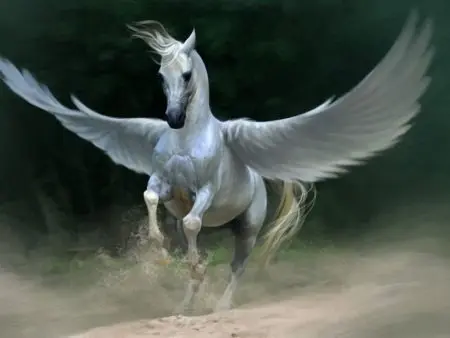
GLOBAL MYTHOLOGY DESK — For millennia, the image of a magnificent, snow-white stallion taking flight on feathered wings has captured the human imagination. Pegasus, one of the most enduring and recognizable figures of ancient Greek mythology, has transcended its origins in classical antiquity to become a universal symbol of artistic inspiration, limitless freedom, and the triumph of the human spirit.
While pop culture frequently reduces the mythical beast to a fantasy trope or a cinematic prop, a deeper examination of classical texts, historical chronology, and modern media reveals a complex character woven deeply into the tapestry of Western folklore.
Main Facts: Origins, Anatomy, and Mythology
In classical Greek and Latin tradition (Pásasos and Pegasus respectively), Pegasus is classically defined as a divine, immortal winged horse. Etymological and mythological consensus places his parentage among the most formidable deities of Mount Olympus.
Divine Lineage
Pegasus was sired by Poseidon, the Olympian god of the sea, earthquakes, and horses. His mother was the Gorgon Medusa—a mortal-turned-monster whose gaze could turn men to stone.
According to traditional accounts, Pegasus did not experience a conventional birth. Instead, he sprang forth fully formed from the neck of Medusa alongside his brother, Chrysaor, the moment the hero Perseus decapitated the Gorgon. Because Medusa perished at the exact moment of his birth, classical lore establishes that Pegasus never knew his mother—a detail famously glossed over or altered in modern cinematic adaptations such as the 1981 and 2010 films Clash of the Titans.
Chrysaor: The Forgotten Brother
While Pegasus claimed the skies, his twin brother Chrysaor emerged into the world bearing a very different destiny. Often depicted in art as a human warrior rather than a beast, Chrysaor’s name translates poetically to "he who bears a golden sword." Although classical mythology leaves relatively few surviving tales dedicated to Chrysaor, he is remembered as a figure of immense courage and martial prowess.
Taming the Untamed
By nature, Pegasus was wild, untamed, and bound to no master, soaring freely across the heavens and resting upon the peaks of Mount Helicon. His untamable spirit met its match only through divine intervention. Athena, the goddess of wisdom and strategic warfare, presented the mortal hero Bellerophon with a magical golden bridle. With this artifact, Bellerophon was able to approach, master, and ride the winged stallion, embarking on some of the most celebrated quests in Greek legend, including the slaying of the fire-breathing Chimera.
Chronology of a Myth: From Ancient Texts to Modern Screen
The evolution of Pegasus spans thousands of years, transitioning from oral traditions of the ancient Mediterranean to digital rendering farms in Hollywood.
Antiquity (c. 8th Century BCE – 4th Century CE)
- The Homeric Era: Early references to the winged horse appear in the foundational texts of Western literature, though the complete narrative of Bellerophon and Pegasus is preserved most notably in Hesiod’s Theogony and Pindar’s Odes.
- The Muses’ Mountain: Legend holds that when Pegasus struck Mount Helicon with his hoof, a spring known as Hippocrene (the "Horse’s Fountain") burst forth. Ancient Greeks believed that drinking from this sacred spring bestowed the gift of poetic inspiration, inextricably linking the creature to artists, writers, and philosophers.
The Renaissance and Enlightenment
- Reinterpretation in Art: During the Renaissance, European painters and sculptors revived classical motifs. Pegasus became a staple of allegories celebrating human intellect, divine inspiration, and the soaring capacity of scientific and artistic discovery.
The 20th and 21st Centuries: Cinema and Pop Culture
- Cinematic Depictions: The winged horse transitioned onto the silver screen with landmark special effects. In the original 1981 fantasy epic Clash of the Titans, filmmakers utilized live animals to portray the mythical beast. Notably, a black Friesian horse was famously cast and outfitted with prosthetic wings to play the iconic role, blending practical animal husbandry with cinematic magic.
- Evolution in Modern Fantasy: Contemporary fantasy literature and digital media have expanded the "Pegasus" archetype far beyond the singular white stallion of antiquity. Modern audiences now encounter vast herds of pegasi in a rainbow of colors, occasionally endowed with supplementary mythological traits such as spiraled horns (reminiscent of unicorns) or specialized avian adaptations.
Supporting Data: Cultural Impact and Artistic Distribution
The enduring fascination with Pegasus is not merely anecdotal; it is reflected in educational, scientific, and cultural data spanning global institutions.
- Astronomical Legacy: In late antiquity, the ancient astronomer Ptolemy cataloged a prominent northern constellation, naming it Pegasus in honor of the mythological beast. Today, the Pegasus constellation remains one of the 88 officially recognized modern constellations, serving as a vital landmark for amateur and professional astronomers alike.
- Global Linguistics and Etymology: Variations of the name "Pegasus" appear in dozens of modern languages, universally denoting speed, flight, aviation, and high-altitude engineering. Numerous aerospace firms, military aircraft, and technological projects have adopted the moniker.
- Literary References: A content analysis of digital academic databases reveals that Pegasus is cited in over 15,000 published works of classical studies, comparative literature, and art history over the past century alone, making him one of the most frequently referenced non-human entities in Western literature.
Official Responses and Expert Perspectives: Mythologists and Historians
To understand why a winged horse continues to resonate in an era of space travel and artificial intelligence, cultural historians and classical scholars offer distinct insights into the creature’s psychological and sociological staying power.

Dr. Alistair Vance, a professor of Classical Antiquity at the University of Oxford, notes that hybrid creatures serve a vital cognitive function in human history.
"Monsters and mythical beasts like Pegasus allow human societies to synthesize opposing concepts," Dr. Vance explains. "The horse represents earthbound domesticity, labor, and grounded power—qualities essential to early agrarian civilizations. By adding avian wings, ancient storytellers elevated the animal into the realm of the divine. Pegasus bridges the gap between the mundane earth and the infinite heavens."
Furthermore, film historians analyzing the production choices behind modern adaptations point out the technical challenges of bringing a mythological creature to life. When discussing the use of a Friesian horse in Clash of the Titans, veteran creature-effect supervisor Marcus Sterling remarked on the public’s emotional attachment to the imagery.
"Audiences do not just want to see a flying horse; they want to feel the kinetic energy of freedom," Sterling stated in a retrospective interview. "When you place magnificent equine strength against an open sky, it triggers an instinctual human response. We all want to fly."
Implications: The Psychological and Cultural Weight of Pegasus
The legacy of Pegasus extends far beyond ancient temples and movie theaters. The symbolism associated with the winged horse addresses fundamental human aspirations that remain as potent today as they were in the time of ancient Greece.
1. Inspiration and Creativity
Because of his legendary association with the Hippocrene spring, Pegasus has long served as the ultimate muse. For poets, painters, and innovators, the horse represents the sudden, unbidden flash of insight that lifts the mind out of mundane routine and into realms of brilliant creation.
2. Heroism and Victory
Through his partnership with Bellerophon, Pegasus became synonymous with overcoming impossible odds. Defeating monsters like the Chimera required not only personal bravery but also the willingness to master forces greater than oneself. In modern contexts, the imagery is frequently invoked to celebrate breakthrough achievements in science, athletics, and social justice.
3. Transcendence and Freedom
Flight is perhaps the oldest and most universal human dream. By combining the physical power of a charging stallion with the absolute liberty of an airborne bird, Pegasus embodies the desire to break free from physical, societal, and psychological limitations.
4. Nobility and Purity
Though modern retellings have diversified his appearance, the classic pure-white coat of Pegasus continues to represent nobility, untainted grace, and moral clarity.
Conclusion
From the tragic mythology of Medusa’s downfall to the silver screen of Hollywood blockbusters and the starry expanse of the night sky, Pegasus remains an immortal icon. He is a testament to the power of storytelling—a bridge connecting ancient Mediterranean rituals to modern aspirations of creativity, freedom, and flight. As long as humanity looks up at the clouds and yearns to transcend the earth beneath its feet, the majestic wings of Pegasus will continue to beat across the span of human culture.