






HONOLULU — In the Hawaiian Islands, where the fragrance of blooming plumeria mingles with the sulfurous breath of active volcanoes, the boundary between the physical world and the realm of the supernatural is notoriously thin. Beyond the world-class surf breaks, luxury resorts, and postcard-ready sunsets lies a profound, living tapestry of folklore. Hawaiian mythology is not merely a collection of dusty tales relegated to the history books; it is an active, breathing cultural framework that explains the formation of the archipelago, dictates behavioral taboos (kapu), and continues to command deep reverence from residents and visitors alike.
From the volatile, creative destruction of the fire goddess Pele to the clandestine nighttime engineering of the diminutive Menehune, the islands pulse with a rich pantheon of demigods, shapeshifting guardians, and spectral forces. As contemporary interest in cultural preservation grows alongside a thriving tourism industry, the ancient legends of Polynesia remain as potent and magnetic today as they were centuries ago.
Main Facts: The Pantheon of the Islands
To understand the cultural landscape of Hawaii, one must first examine the principal entities that populate its traditional cosmology. Hawaiian mythology categorizes supernatural forces into distinct tiers, ranging from major deities (akua) and demigods (kapua) to localized guardians and ancestral spirits.
Pele: The Fiery Architect of the Archipelago
At the center of the Hawaiian pantheon stands Pele, the volatile and majestic goddess of volcanoes, lightning, wind, and fire. Believed to make her eternal home within the Halemaʻumaʻu crater at the summit of Kīlauea on the Big Island, Pele is revered as both a creator and a destroyer. She sculpted the very earth upon which millions walk, pouring molten rock to expand the islands’ landmasses, yet she retains the terrifying capability to obliterate settlements in a matter of hours. Modern accounts—often reported by park rangers, residents, and visitors—continue to document unexplained encounters with an elderly woman hitchhiking along Chain of Craters Road, only to vanish into thin air before her vehicle can be stopped.
The Shapeshifting Demigods: Maui and Kamapuaʻa
The kapua—the half-divine offspring of gods and mortals—frequently bridge the gap between heaven and earth. Among them, the trickster demigod Maui stands out for his audacity. Driven by deep filial devotion to his mother, Hina, who struggled to dry her traditional tapa cloth due to the sun racing too quickly across the sky, Maui engineered one of mythology’s most famous cosmic heists.
Equipped with an enchanted net and a heavy club, Maui scaled the dormant crater of Haleakalā on Maui. As the sun crested the horizon, he snared the celestial body and beat it until it begged for mercy. The ensuing compromise slowed the sun’s rotation for half the year, permanently altering the length of Earth’s days and granting humanity vital hours for agriculture and navigation.

Equally prominent in island lore is Kamapuaʻa, the "Hog Child." Associated with fertility, wild boars, and agriculture, Kamapuaʻa possesses immense shapeshifting capabilities, transforming fluidly between human and animal forms. He is most famously remembered for his tempestuous, mythic romance and fierce clashes with Pele—a relationship that mirrors the geological interplay between cooling, life-giving rain and subterranean fire.
Guardians of the Deep: The Moʻo
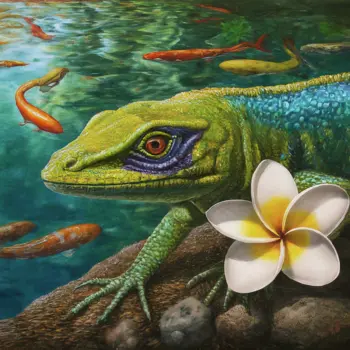
Guarding the freshwater springs, ancient fishponds, and deep river valleys are the Moʻo, powerful shapeshifting reptilian entities that can appear as harmless geckos, massive eels, or terrifying dragons. The Moʻo are intimately tied to the survival of the islands, serving as custodians of the fresh water supply. Traditional protocol demands deep respect when entering their domains; travelers crossing pristine mountain streams are still cautioned to make silent offerings or ask permission to pass, ensuring they do not invite the wrath of these aquatic sentinels.
Chronology: From Ancient Oral Tradition to Modern Encounters
The transmission and evolution of Hawaiian mythology span three distinct historical phases:
- Pre-Contact Era (Prior to 1778): Stories were meticulously preserved and transmitted orally through ʻōlelo (language), rhythmic chanting (oli), and dynamic hula. Mythology served as the foundational legal, spiritual, and scientific code for Native Hawaiians, governing everything from resource management to social hierarchy.
- The 19th and Early 20th Centuries: Following the arrival of Western missionaries and the subsequent overthrow of the Hawaiian Kingdom, traditional religion was officially suppressed. However, scholars like Abraham Fornander and King David Kalākaua raced to document oral histories, ensuring that the pantheon was preserved in print rather than lost to time.
- The Modern Era (Late 20th Century to Present): A renaissance of Native Hawaiian culture (Ke Ala Hou) has led to a renewed reverence for traditional deities. Concurrently, paranormal tourism and digital folklore have exploded, bringing tales of Pele and island ghosts to a global audience via internet forums, podcasts, and travel documentaries.
Supporting Data: The Architecture of the Unseen
While Western science attributes Hawaii’s topography to tectonic plate movement and basaltic volcanism, indigenous science views these geological marvels through a relational and spiritual lens.
- Archaeological Footprints: The Menehune—legendary dwarf-like people standing two to three feet tall—are credited in folklore with constructing complex agricultural terraces, rock-walled fishponds, and ancient heiau (temples) overnight. While historians point to the organized labor of early Native Hawaiian societies, the mythic attribution to the Menehune underscores the incredible engineering prowess of ancient Polynesian builders, who moved massive stones without the use of metal tools or beasts of burden.
- Geological Metrics: Kīlauea volcano, Pele’s traditional domain, remains one of the most active shield volcanoes on Earth. Continuous eruptions throughout the 21st century—including the catastrophic 2018 lower Puna eruption—keep the goddess firmly embedded in the daily consciousness of local emergency responders, geologists, and residents.
The Paranormal Realm: Night Marchers and Ancestral Spirits
Beyond the major deities, the islands are famously haunted by a distinct class of spectral entities known collectively as Akua and ʻUhane (spirits).
The Huakaʻi Pō (Night Marchers)
Perhaps the most chilling paranormal phenomenon in Hawaii is the Huakaʻi Pō, or the Night Marchers. These are the ghosts of ancient Hawaiian warriors, chiefs, and nobles who march in single file under the cover of darkness, carrying torches and chanting ancient war cries or beating spectral drums.

According to local lore, encountering the Night Marchers is a terrifying omen. Tradition dictates that if a living person crosses their path, they must strip naked and lie face down on the ground, pretending to be dead, while averting their eyes. To look a chief directly in the eye is said to invite certain death, as the spirits will rip the soul from the body. Countless modern residents across Oahu, Maui, and Kauai report hearing rhythmic chanting and the crackle of torchlight echoing down darkened valleys long after midnight.
Implications: Cultural Preservation in a Globalized World
The persistence of these myths in the 21st century carries profound implications for tourism, land development, and cultural identity in the Aloha State.
As millions of tourists flood the islands annually, state agencies and cultural practitioners face the challenge of educating visitors on how to respectfully interact with sacred sites. For instance, removing volcanic rocks from Kīlauea is strictly taboo; every year, the Hawaii Volcanoes National Park receives hundreds of packages containing returned lava rocks accompanied by handwritten letters from tourists begging Pele for forgiveness after experiencing a streak of severe bad luck.
Furthermore, indigenous communities utilize these myths to advocate for environmental conservation. By framing natural resources—such as fresh water springs, native forests, and volcanic craters—as living deities or the homes of powerful guardians (Moʻo, Akua), traditional land stewardship finds powerful alignment with modern ecological preservation.
Ultimately, Hawaii’s mythology is not just a relic of the past; it is the beating heart of the islands. Whether one approaches these stories as literal truths, psychological archetypes, or captivating folklore, the allure of the paranormal ensures that the veil between worlds will continue to enchant all who set foot upon the golden shores of the Aloha State.