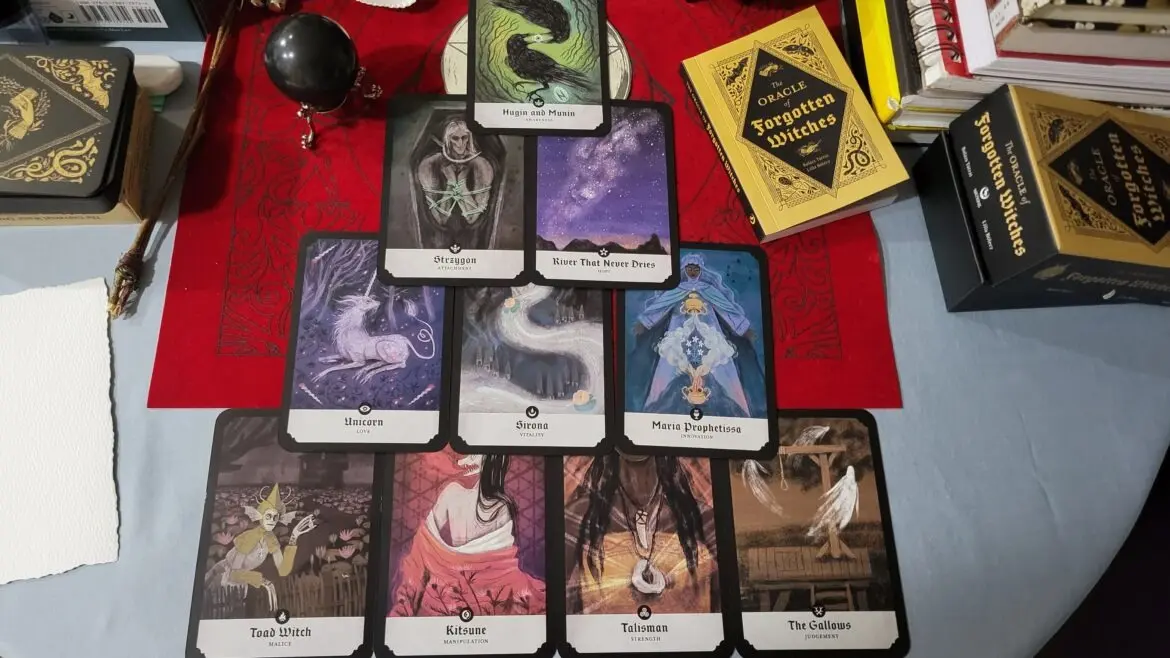
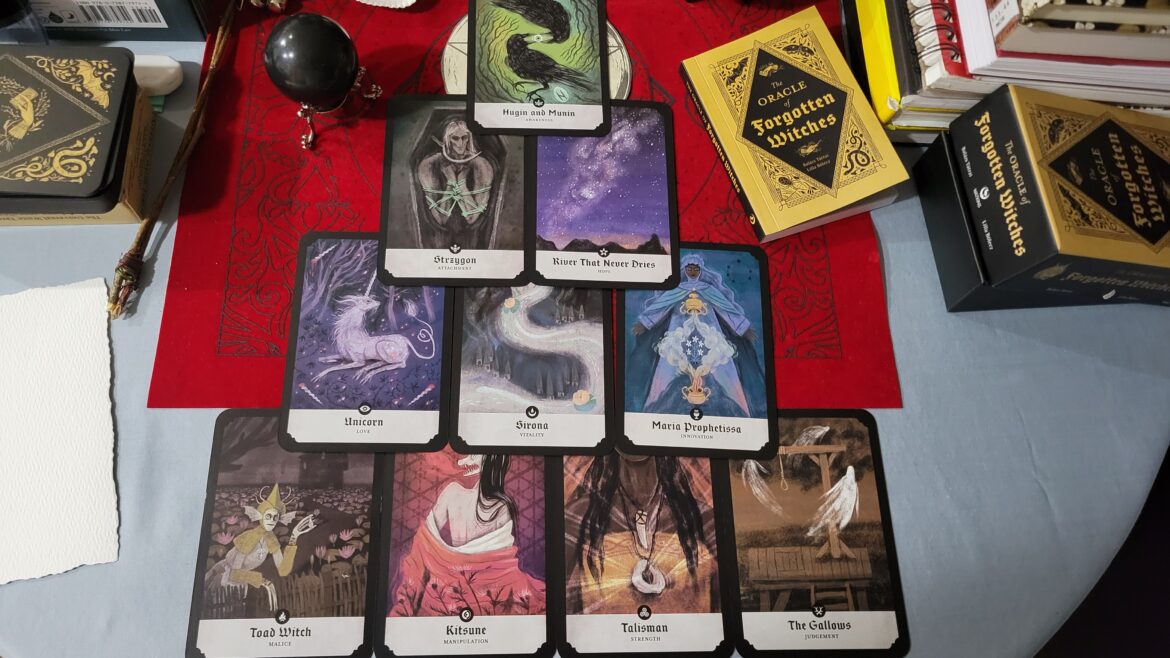
The landscape of modern divination and esoteric arts has recently welcomed a compelling new addition: The Oracle of Forgotten Witches, published by Watkins Publishing. Created by author Balázs Tátrai and illustrator Lilla Bölecz, this 60-card oracle deck serves as a structural and thematic expansion of the creators’ critically acclaimed 2024 collaborative book, The Book of Forgotten Witches.
Designed to draw upon global mythology, folklore, and oral traditions, the deck introduces users to a pantheon of historical and mythical figures ranging from curse-bringers to fate-turners. Alongside these practitioners of old, the cards incorporate illustrations and guidance regarding mystical familiars, ancestral spirits, deities, sacred magical items, and forgotten magical locations.
Structured around the esoteric principles of spiritual alchemy—specifically mirroring the transformative journey of turning base metals into gold—the deck utilizes ten distinct suits to represent progressive stages of personal and spiritual growth. Complete with four unique card spreads, including the intricately designed "Magnum Opus" and an innovative "Storyweaving Spread," the deck positions itself not merely as a tool for divination, but as an immersive portal into the narrative history of global witchcraft and folk magic.
Chronology of the Project
The journey toward The Oracle of Forgotten Witches began long before its physical cards were printed and distributed to bookshelves worldwide.
The Genesis (2024): Balázs Tátrai and Lilla Bölecz established their collaborative footprint in the contemporary pagan and magical community with the release of The Book of Forgotten Witches. The text aimed to resurrect the narratives of women and practitioners marginalized or erased by mainstream historical texts.
The Expansion (2025–2026): Recognizing the rich reservoir of visual and narrative material left unexplored in their initial research, Tátrai and Bölecz partnered with Watkins Publishing to conceptualize a companion piece that would transition their written universe into an interactive, visual medium.
The Endorsement and Release (September 2026): Ahead of its public debut, select reviewers and esoteric practitioners—including this publication’s reviewer, Alan U. Dalul—were given advanced access to the deck. Official endorsements highlighted the deck’s rare ability to blend academic folkloric research with deeply personal, resonant spiritual guidance. By mid-September 2026, The Oracle of Forgotten Witches officially launched, quickly gaining traction among modern practitioners of witchcraft, tarot readers, and folklore enthusiasts alike.
Supporting Data and Deck Architecture
To fully understand the value of The Oracle of Forgotten Witches, one must examine the mechanical and structural architecture that Tátrai and Bölecz implemented. Standard oracle decks frequently rely on generalized spiritual concepts or elemental archetypes; however, this 60-card creation operates on a rigorously developed system.
1. The Alchemical Framework
Rather than grouping cards by traditional suits (such as cups, wands, swords, and pentacles), the deck is structured around ten suits rooted in the philosophy of spiritual alchemy. This framework mirrors the Magnum Opus (the Great Work), taking the reader on a psychological and spiritual transmutation. As a user draws cards throughout their daily practice or deep ritual spreads, the thematic movement of the suits reflects personal evolution, shadow work, and the refinement of the self.
2. Card Diversity and Components
The sixty cards encompass a vast spectrum of magical elements, categorized into:
Practitioners: Historical, mythic, and folkloric witches from diverse global cultures.
Entities: Familiars, local spirits, and ancient deities.
Materia: Sacred magical items, talismans, and ritual tools.
Geographies: Forgotten magical locations and liminal spaces tied to oral history.
3. Spread Mechanics
The accompanying guidebook offers four distinct layouts designed to test and expand the reader’s intuitive capabilities:
The Magnum Opus Spread: A deep, multi-layered layout tailored for profound spiritual transformation and psychological introspection.
The Pentagram Spread: A balanced foundational layout focused on elemental alignment and immediate practical guidance.
The Hecate Spread: A liminal layout designed for crossroads decisions and shadow work.
The Storyweaving Spread: A unique narrative-driven spread that allows practitioners to synthesize the cards into cohesive folk tales, bridging the gap between divination and creative storytelling.
Official Responses and Critical Reception
The critical reception of The Oracle of Forgotten Witches has been overwhelmingly positive, marked by praise from both literary critics and practicing esotericists. Publishers, authors, and early reviewers have emphasized the rare harmony between scholarly historical appreciation and visceral, no-nonsense spiritual feedback.
In the official promotional material provided by Watkins Publishing, the editorial stance highlights the transformative nature of the product:
"Listen to the whispers of forgotten witches from myth and legend, embark on a journey of self-discovery, and weave your own folkloric tales with this stunning sixty-card oracle deck… What will the forgotten witches whisper to you?"
Early reviewers have noted a distinct deviation from the traditional paradigm of oracle decks. While cultural tropes often dictate that tarot cards provide harsh truths ("roast" the reader) while oracle decks offer exclusively gentle, comforting affirmations, The Oracle of Forgotten Witches carves out a unique middle ground.
As noted in initial personal assessments of the deck:
"Despite the common discourse of tarot decks roasting you and oracle decks being sweet and kind, The Oracle of Forgotten Witches was the exception. I felt called out, even if still completely understood. I could compare this to when you speak to a friend that doesn’t hold back and doesn’t sugar coat anything as an expression of love."
Furthermore, early endorsements integrated into the guidebook emphasize its cross-cultural resonance:
"With captivating prose and charming art, this deck brings the wisdom of yesterday into today’s world with the warmth of an old friend. Both Balázs and Lilla have crafted a unique oracle deck that honours the power in folklore found in diverse cultures."
Implications for Modern Esotericism and Folk Magic
The release of The Oracle of Forgotten Witches marks a broader, ongoing shift within contemporary witchcraft and paganism toward historical recovery, narrative reconstruction, and localized folklore. For decades, popular occultism was dominated by standardized systems like the Rider-Waite-Smith tarot or generalized New Age oracle philosophies. However, works like those of Tátrai and Bölecz demonstrate a growing hunger among practitioners for localized, culturally diverse, and historically grounded magical frameworks.
Reclaiming Marginalized Narratives
By centering figures who were historically demonized, marginalized, or erased entirely by institutional authorities, the deck acts as an active tool of reclamation. When a practitioner pulls a card representing a lesser-known folk practitioner from Eastern European, Mediterranean, or indigenous lore, they are not merely receiving advice on their career or relationships; they are engaging in an act of cultural remembrance.
Bridging Scholarship and Practice
The integration of rigorous folklore research with intuitive divination creates a bridge that benefits both academics and esoteric practitioners. Readers are encouraged to move past surface-level divinatory meanings and investigate the real-world historical contexts, oral histories, and socio-political pressures that shaped the lives of the "forgotten witches."
The Evolution of Oracle Design
Finally, the inclusion of tools like the Storyweaving Spread points toward a future where divination decks double as engines for creative expression and personal myth-making. By allowing users to construct their own folk tales out of the cards, the deck acknowledges that magic and storytelling have always been inextricably linked. Oral traditions survived not because they were rigidly codified in textbooks, but because communities reshaped, retold, and lived inside those narratives.
Ultimately, The Oracle of Forgotten Witches stands as a triumph of artistic collaboration and magical design. Whether utilized for a quick daily draw, an intense shadow-work session via the Magnum Opus spread, or as a companion to The Book of Forgotten Witches, the deck offers a rich, sensory-heavy experience that lingers long after the cards are put away. For modern witches, folklorists, and seekers of hidden history, it is a formidable, highly recommended addition to the sacred workspace.