By The Wild Hunt | August 19, 2026
Recent archaeological discoveries across Europe are casting new light on the complex religious behaviors, ritual offerings, and sacred landscapes of antiquity. From an ancient Cretan sanctuary yielding hundreds of rodent remains to a deliberate Bronze Age metal deposit in a Czech wetland and a newly mapped ceremonial complex hidden within an English forest, researchers are uncovering fresh evidence of how ancient societies interacted with their deities, the natural world, and the dead.
These findings—compiled from recent excavations in Greece, the Czech Republic, and the United Kingdom—suggest that ritual deposition and sacred landscape management played deeply integral roles in prehistoric and classical life, challenging modern assumptions about how ancient sacred spaces evolved over time.
Main Facts
The latest wave of archaeological insights spans three distinct geographic locations and thousands of years of human history:
- Gortyna, Crete: Excavations at an ancient sanctuary of Apollo have revealed the intentional deposition of more than 450 house mouse (Mus musculus) remains within a seventh-century B.C. structure. This unexpected cache suggests that the sanctuary may have originally been dedicated to Apollo Smintheus—an epithet connecting the god of light and music to mice, agriculture, and pest control—before evolving into a center for Apollo Pythios.
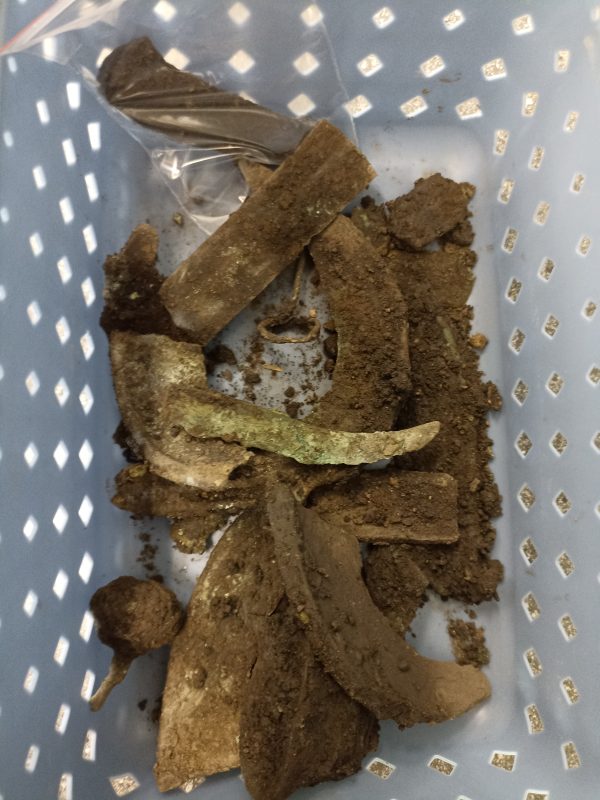
- Kojetín, Czech Republic: Railway construction monitoring in central Moravia led to the discovery of a Late Bronze Age "fragment hoard" in a wetland. The assemblage includes nine sickles (most intentionally bent), a broken sword blade, ornament fragments, and bronze ingots, pointing toward a ritual votive offering rather than hidden scrap metal.
- Derbyshire, England: A lone standing stone in Farley Wood, long believed to be an isolated prehistoric marker, has been identified as part of a much larger 3,700-year-old ceremonial landscape. Excavations led by Forestry England and featured alongside the Time Team television crew revealed an oval arrangement of at least six stones built above an ancient ceremonial platform and natural spring.
Chronology of Discoveries and Excavations
To understand the trajectory of these investigations, it is helpful to examine the timeline of how these subterranean and surface mysteries came to light.
- c. 1700 B.C. (Bronze Age): Communities in what is now Derbyshire, England, construct a ceremonial platform over a natural spring feeding Bentley Brook, eventually erecting an oval ring of standing stones at Farley Moor. Roughly a millennium later, Urnfield culture communities in central Europe similarly deposit damaged metal tools and weapons into watery wetlands near modern-day Kojetín.
- 7th Century B.C. (Archaic Greece): Worshippers at the Cretan city of Gortyna deposit hundreds of house mice within a sacred architectural structure, aligning with early agrarian and plague-warding venerations of Apollo. Over subsequent centuries, as Gortyna grows in political and religious prominence, the site’s primary focus shifts toward the pan-Hellenic cult of Apollo Pythios.
- Late May (Recent Years): Archaeologists from the Archaeological Centre Olomouc utilize metal detectors alongside conventional monitoring during the Brno–Přerov railway modernization project in the Czech Republic, unearthing a flooded Bronze Age hoard.
- Recent Months: Inspired by an initial observation by 24-year-old archaeology student George Bird, Forestry England partners with specialists to excavate Farley Wood, confirming the existence of the Farley Moor stone circle and spring platform.
- August 2026: Researchers from the Italian School of Archaeology at Athens and the University of Padua publish findings on the Gortyna mouse deposits, tying together a sweeping narrative of ritual archaeology across Europe.
Supporting Data and Archaeological Analysis
The material evidence recovered from these sites offers a window into the psychological and spiritual frameworks of ancient populations.
The Gortyna Rodent Cache
At the sanctuary in Gortyna, the sheer volume of 450-plus mouse bones—recovered from a securely dated seventh-century B.C. votive context—rules out natural mortality or predator pellet accumulation. In classical studies, Apollo’s role as Smintheus (derived from sminthos, the local word for mouse in certain dialects) is well documented.
In Homer’s Iliad, the priest Chryses prays to Apollo Smintheus to avenge him against the Achaean army, resulting in a devastating plague. Conversely, communities facing agricultural blights caused by rodents would propitiate the god to stay the pests. The Gortyna discovery provides rare physical proof of this cultic practice, demonstrating that early Cretan worshippers physically incorporated the sacred animal into their ritual architecture before the pan-Hellenic, Delphic iteration of Apollo (Pythios) took total precedence.

The Kojetín Wetland Hoard
The collection of bronze artifacts found near Kojetín belongs to the Urnfield culture of the Late Bronze Age. Rather than pristine status symbols, the items display clear signs of pre-deposition trauma. Out of nine sickles, eight were deliberately bent rendering them useless. A sword blade was violently snapped with a heavy impact.
Archaeologists emphasize that this is a classic signature of ritual "killing" of objects. In many European Bronze Age societies, high-value bronze objects were systematically deformed and cast into lakes, bogs, and rivers. This act removed valuable metal from circulation permanently, offering it up to chthonic or water-associated deities as an irrevocable sacrifice.
The Farley Moor Monument Architecture
At Farley Moor, archaeological trenching revealed an oval monument measuring roughly 82 by 75 feet, consisting of six standing stones. Beneath or adjacent to this stone architecture lies a deliberate platform constructed over a natural spring. Radiocarbon dating places the inception of these features firmly in the Middle Bronze Age (circa 1700 B.C.). The strategic placement over a water source highlights how prehistoric architects deliberately tied their monumental architecture into hydrological features, creating a multi-generational sacred space.
Official Responses and Expert Perspectives
The academic and institutional response to these findings highlights a growing appreciation for hidden, complex landscapes and nuanced ritual behaviors.

Lawrence Shaw, Forestry England’s lead historic environment advisor, noted that the Farley Moor excavation fundamentally changes how experts view prehistoric land use in forested regions. Rather than viewing standing stones as lonely, disconnected anomalies, heritage managers must now look at them as anchor points within expansive ceremonial networks.
Dr. Derek Pitman, Associate Professor of Archaeology and Anthropology at Bournemouth University, underscored the broader significance of uncovering monuments hidden beneath modern woodlands:
"It’s a dream come true to get to work on such a significant prehistoric monument. The scale of activity that likely existed in that landscape highlights the impact of Bronze Age ritual life far beyond headline sites like Stonehenge. This project also showcases the value of investigating sites that have been hidden in the nation’s forests for the last few decades and implies a wealth of archaeology still waiting to be explored."
Similarly, European classical and prehistoric specialists point out that these discoveries collectively reinforce the reality that ancient religious practices were dynamic, evolving alongside political centralization (as seen in Gortyna) and deeply rooted in localized interactions with the environment (as seen in Kojetín and Derbyshire).

Implications for Future Research
The convergence of these archaeological insights points toward several vital takeaways for the study of ancient religion:
- Fluidity of Cults: The Gortyna sanctuary evidence proves that major classical deities underwent structural shifts in identity and patronage at local levels. Future excavations of early Greek shrines may need to re-examine minor fauna deposits as indicators of earlier, localized epithets rather than anomalous refuse.
- The Archaeology of Water and Destruction: The deliberate mutilation of bronze tools in Czech wetlands and the integration of springs into English stone circles confirm that water was universally regarded as a liminal boundary—a threshold between the human world and the divine. Archaeologists are increasingly utilizing environmental archaeology to map ancient water tables and wetland edges for undiscovered hoards.
- Hidden Landscapes: The success of student-led observations at Farley Moor demonstrates that significant prehistoric monuments remain obscured beneath modern topsoil, agricultural fields, and commercial forests. LiDAR mapping, metal-detecting integration, and student-professional partnerships will continue to rewrite the archaeological maps of Europe.
As conservation and laboratory analysis continue on these artifacts—from the fragile bones of Cretan house mice to bent Bronze Age sickles and Derbyshire stone monoliths—scholars anticipate an even clearer picture of the diverse ways our ancestors sought to negotiate order, protection, and divine favor across the ancient world.
The Wild Hunt is not responsible for links to external content. To join the conversation on this and other archaeological discoveries, visit the official The Wild Hunt Reddit community.