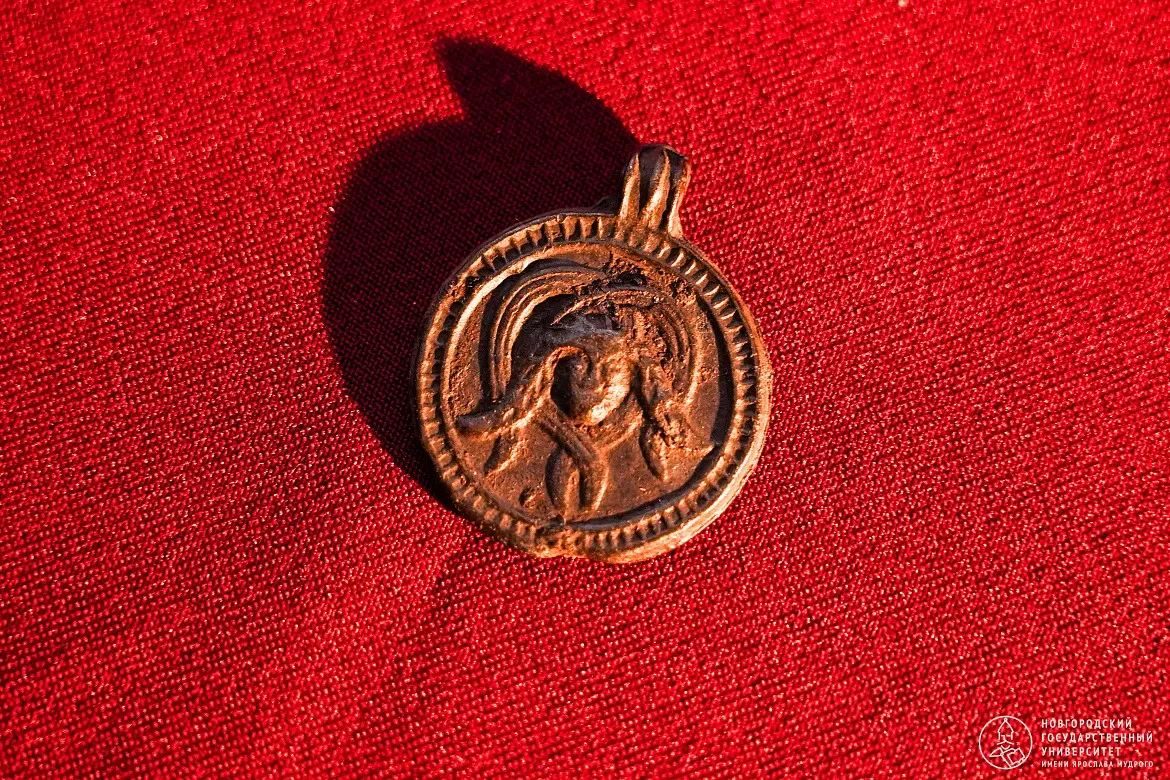
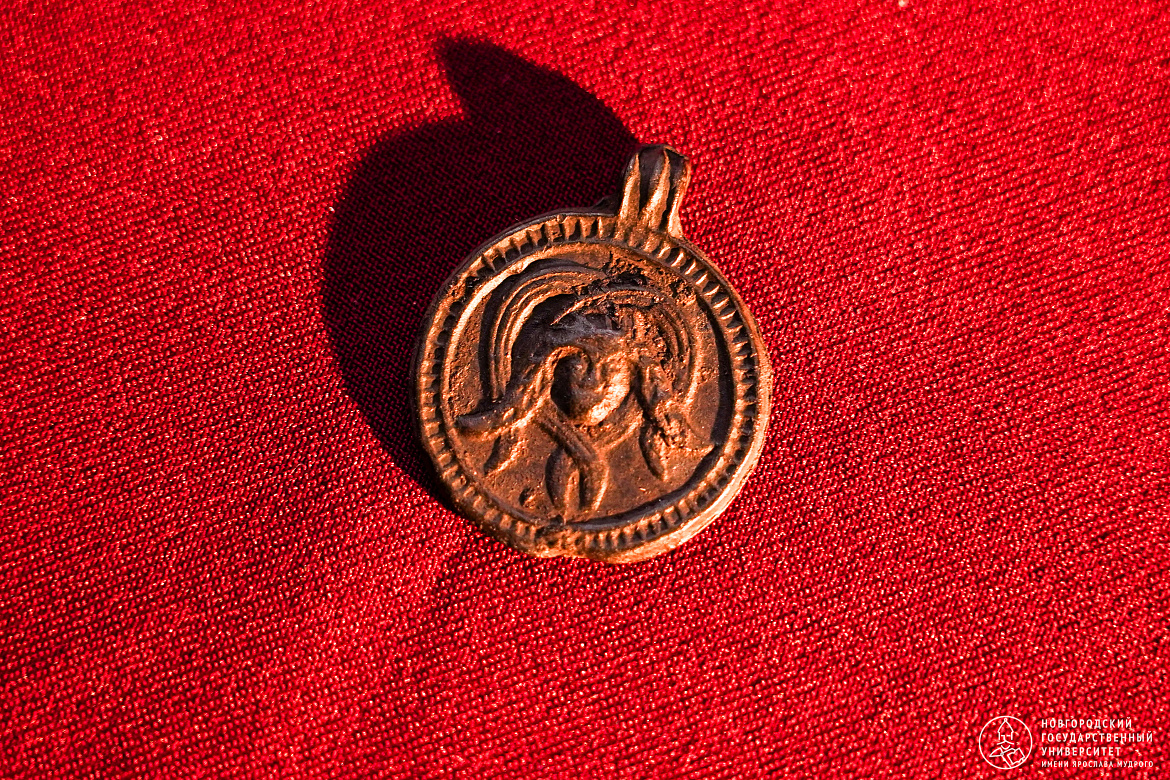
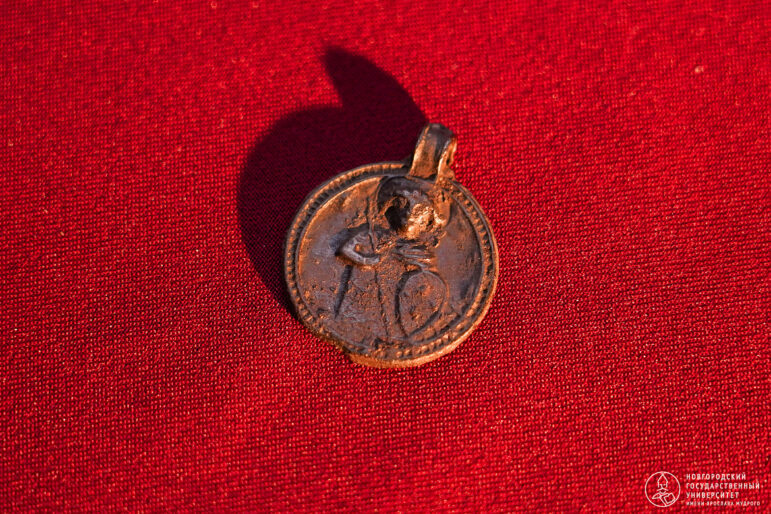
STARAYA RUSSIA, RUSSIA — Deep within the damp, dark-earth layers of the Pyatnitsky archaeological site in northwestern Russia, researchers have unearthed a rare and fascinating artifact that offers an intimate glimpse into the spiritual dualism of medieval life. The object, an 11th-century copper-alloy pendant known as a zmeevik (serpent pendant), bridges two seemingly irreconcilable worlds. On one side, it bears the heroic, protective image of a Christian warrior saint; on the reverse, it features a snake-haired female visage rooted deeply in the ancient Greco-Roman Gorgon tradition.
Announced by Novgorod State University, the discovery pushes back the timeline for this unique class of amulets in the region by at least a century. While Staraya Russa had previously yielded four other serpent pendants, those examples dated safely within the 12th to 14th centuries. This new find, recovered from an urban estate layer that was only beginning to be settled during the 11th century, demonstrates that the syncretic spiritual practices of early medieval Rus’ took root much earlier—and ran far deeper—than historians previously understood.
Main Facts: The Staraya Russa Zmeevik
The newly discovered artifact is a double-sided copper-alloy amulet measuring a modest yet striking size, designed to be worn close to the body for apotropaic (protective) purposes.
The Obverse (Front): Features a crisp, stylized relief of a Christian warrior saint equipped with a spear and shield. Archaeologists have tentatively identified the figure as Saint Theodore Stratelates, a revered military martyr in the Eastern Orthodox tradition known for slaying dragons and protecting the faithful from evil.
The Reverse (Back): Displays a woman’s head surrounded by writhen, snake-like appendages. While instantly evocative of Medusa and the Gorgon tradition of classical antiquity, researchers stress that the image had evolved far beyond simple pagan worship of a Greek mythological monster by the 11th century. Instead, it functioned as an abstract, visual personification of malevolent forces, disease, and chaos.
Context of Discovery: Unearthed at the Pyatnitsky excavation site in Staraya Russa by the Novgorod State University Center for Archaeological Research. Experts believe the pendant was not a high-status import from Constantinople, but rather a local product cast within a workshop operating directly on the urban estate, copied from an earlier Byzantine prototype.
Chronology: From Mediterranean Myth to Kievan Rus’
To understand the significance of the Staraya Russa pendant, historians must trace a long cultural trajectory that spans centuries and continents.
Antiquity (Pre-Christian Era): The iconography of the snake-haired Gorgon originates in the Mediterranean, where images of Medusa were widely used across the Greek and Roman worlds as protective apotropaic devices to ward off evil eyes, enemies, and misfortune.
988 CE – The Christianization of Kievan Rus’: Prince Vladimir the Great officially adopts Eastern Orthodoxy for Kievan Rus’, initiating a massive, state-sponsored transition away from Slavic paganism toward Christianity. However, the conversion of the populace is a slow, generational process.
11th Century (The Staraya Russa Find): The newly discovered zmeevik is cast in Staraya Russa. At this point, the region is newly settled, and Byzantine cultural influence is filtering up trade routes like the Volkhov-Lovat river systems. The artifact reflects a society actively synthesizing orthodox dogma with enduring folk protective magic.
12th to 14th Centuries (The Established Tradition): Four previously discovered serpent pendants from Staraya Russa date to this later medieval period, indicating that the use of zmeeviki persisted across generations as Christian institutions solidified their grip on the region.
September 2026 (Current Discovery): Novgorod State University formally announces the excavation and analysis of the 11th-century pendant, instantly updating the timeline of local metalworking and syncretic folk religion.
Supporting Data: The Archaeology of Zmeeviki
Serpent pendants represent a distinct, highly specialized category of medieval portable art. Historically tied to elite or ecclesiastical circles with direct access to Byzantine trade goods, these amulets reveal a fascinating tension between official Church doctrine and popular superstitious practices.
According to archaeological surveys of medieval Rus’, zmeeviki are exceedingly rare. They typically feature an orthodox saint, Christ, or the Virgin Mary on the front, while the back is dominated by a serpentine, Gorgon-like composition, often ringed by protective incantations or magical formulas written in corrupted Greek or Cyrillic letters.
The following data points highlight the context of the Staraya Russa discovery:
Feature
Archaeological Detail
Material
Copper-alloy (local casting, likely adapted from a foreign mold)
Estimated Date
11th Century (pushing local timeline back by 100+ years)
Site Location
Pyatnitsky excavation site, Staraya Russa, Novgorod region
Front Iconography
Christian Warrior Saint (likely St. Theodore Stratelates with spear and shield)
Back Iconography
Gorgon-derived serpentine female head (symbolizing darkness/disease)
Previous Local Finds
4 pendants (all dated between the 12th and 14th centuries)
Scholars note that while the Greek inscriptions found on other zmeeviki frequently invoke Christian formulas combined with magical wards against fevers and plagues, the Staraya Russa pendant relies purely on its visual program to achieve the same apotropaic effect.
Official Responses and Expert Analysis
The discovery has generated considerable excitement among Russian historians and medievalists, shedding light on the mechanics of cultural transmission and religious adaptation on the frontier of Kievan Rus’.
Sergei Toropov, director of the Novgorod State University Center for Archaeological Research, emphasized the ideological paradox inherent in the artifact.
"The main characteristic of the serpentine pendant is its combination of images that are incompatible, from a strictly dogmatic standpoint," Toropov stated in the university’s official announcement.
"The obverse always features a canonical Christian image: Jesus Christ, the Virgin Mary, Archangel Michael, or serpent-fighting saints, such as St. George the Victorious. The reverse features a non-Christian serpentine composition, which harks back to Medusa the Gorgon, a character from ancient Greek mythology."
Toropov was quick to clarify that the presence of the Gorgon-like figure did not indicate pagan worship or a literal belief in Greek deities among the medieval inhabitants of Staraya Russa. Instead, the motif had been thoroughly co-opted.
"Some of these pendants bear incantations in Greek, suggesting that the serpentine pendants were likely worn as a talisman against illness," Toropov explained. "And the ‘incompatible’ images in this case could symbolize the victory of the forces of light over the forces of darkness."
Elaborating on the specific imagery of the find, Toropov added: "On its front is a relief image of a warrior saint with a spear and shield—presumably Saint Theodore Stratelates. On the back is a woman’s head with snake-like hair. This likely represents not a specific mythological creature, but a collective image of dark forces."
Implications: Syncretism, Gender, and Medieval Identity
The implications of the Staraya Russa pendant extend far beyond local metallurgy or art history, touching upon deep questions of medieval psychology, religious syncretism, and gendered symbolism.
1. The Reality of Dvoyeverie (Double Belief)
For decades, historians of Slavic religion have debated the concept of dvoyeverie—the idea that newly Christianized populations maintained a simultaneous, dual adherence to both Christian doctrines and older pagan worldviews. While modern historians often prefer terms like "cultural synthesis" or "vernacular Christianity," artifacts like the Staraya Russa zmeevik prove that the boundary between orthodox faith and magical protection was remarkably porous. To the wearer of this pendant, there was no contradiction: invoking a Christian warrior saint while simultaneously brandishing an abstract, serpentine ward against disease made pragmatic spiritual sense in an unpredictable medieval world.
2. Local Production and Cultural Adaptation
The fact that this pendant appears to have been cast locally within an urban workshop—rather than imported directly from Constantinople—reveals that Byzantine motifs were actively indigenized in northwestern Russia. Craftsmen in Staraya Russa were not merely copying foreign luxury goods; they were reproducing powerful apotropaic technologies tailored to the local market, making elite Byzantine iconography accessible to regional populations during the foundational century of the city’s settlement.
3. Gendered Coding of Light and Darkness
Cultural analysts have also pointed out the striking gender dynamics at play on the amulet’s dual faces. A male Christian warrior saint, embodying order, divine authority, and martial protection, occupies the public, outward-facing obverse. Conversely, a female-coded, serpent-haired figure occupies the reverse as a collective representation of threatening chaos, illness, and dark forces. This juxtaposition taps into a long-standing cultural tradition within Western and Mediterranean thought that associates female monstrosity, chthonic power, and the serpentine with danger—while positioning male orthodox authority as the ultimate force of subjugation and salvation.
As excavations continue at the Pyatnitsky site and conservation work on the Staraya Russa pendant proceeds, researchers hope to uncover further clues about the individuals who wore, traded, and forged these remarkable amulets. What is already clear, however, is that the 11th-century inhabitant who wore this copper-alloy disk navigated a spiritual universe far richer, more complex, and more wonderfully syncretic than standard ecclesiastical histories have traditionally let on.