









By Global Culture & Science Desk
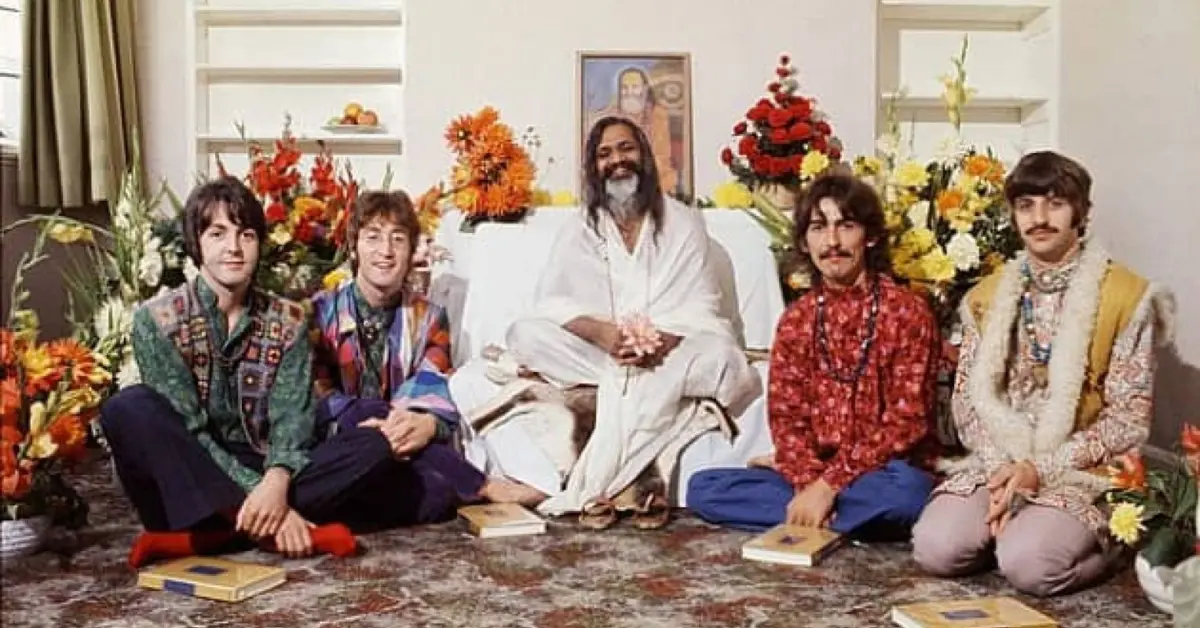
In the late summer of 1967, the biggest band in the world walked into a lecture hall at the London Hilton Hotel, unknowingly stepping onto a path that would permanently alter modern music history. John Lennon, George Harrison, and Paul McCartney sat shoulder-to-shoulder in the front row, utterly transfixed by a charismatic Indian sage named Maharishi Mahesh Yogi. Their drummer, Ringo Starr, was notably absent, kept away by the birth of his second child, but the remaining trio was so thoroughly captivated by the philosophy of transcendental meditation that they made an extraordinary decision: they canceled their upcoming recording sessions and packed their bags for Bangor, Wales.
What followed was a profound spiritual and artistic journey that birthed roughly 40 songs in a matter of weeks, cemented the therapeutic value of mindfulness in the public consciousness, and provided a textbook case study on the neurological and psychological mechanics of artistic genius.
Main Facts: The Indian Retreat and the Genesis of the White Album
The catalyst for the Beatles’ immersion into Eastern philosophy began as an academic curiosity but quickly evolved into an intensive lifestyle shift. Following their initial meeting in August 1967, the band intended to complete a 10-day transcendental meditation training course in Wales. However, the tragic, sudden death of their manager, Brian Epstein, cut the trip short as the shaken musicians rushed back to London to navigate the sudden vacuum in their management.
Undeterred by the tragedy, and following the completion of their psychedelic film and accompanying project Magical Mystery Tour, all four Beatles—reunited with Ringo—traveled to Rishikesh, India, in February 1968. They settled into the Maharishi’s ashram for an extended meditation retreat.
Though short in duration relative to traditional monastic retreats—Ringo stayed for two weeks, Paul for a month, and John and George for a grueling seven weeks—the impact on their individual and collective songwriting was seismic. As Paul McCartney would later dryly and understatedly observe in his 2021 book The Lyrics, the period was "oddly productive."
The sheer volume of material generated in the ashram formed the foundational backbone of the 1968 double-LP masterpiece colloquially known as The White Album. Songs conceived or written during this serene mountain sanctuary included enduring classics like "Dear Prudence," "Julia," "Child of Nature" (later resurrected as "Jealous Guy"), "Circles," "Cosmically Conscious," and even Ringo Starr’s long-gestating first solo songwriting effort, "Don’t Pass Me By."
Chronology: From the Hilton to the Ganges
To understand the trajectory of the Beatles’ spiritual awakening, it is essential to trace the timeline of their engagement with the Maharishi and the practice of meditation:
- August 1967: John, George, and Paul attend a public lecture by Maharishi Mahesh Yogi at the London Hilton Hotel, prompting the immediate cancellation of recording sessions and a hasty retreat to Bangor, Wales.
- August 27, 1967: The sudden death of manager Brian Epstein forces the band to abruptly cut short their Welsh retreat and return to London.
- Late 1967 – Early 1968: The band finishes the Magical Mystery Tour project while maintaining correspondence with the Maharishi, preparing for a deeper journey.
- February 1968: All four Beatles arrive in Rishikesh, India, to embark on an intensive transcendental meditation course.
- March – April 1968: Ringo leaves after two weeks; Paul departs after a month; John and George remain for a full seven weeks, churning out dozens of tracks.
- Late 1968: The release of The White Album, heavily dominated by acoustic, introspective songs penned in India.
- Post-1968 Onward: The band members maintain lifelong or periodic meditation practices, influencing their post-Beatles solo output well into their golden years.
Supporting Data: The Psychology of Meditation and Creativity
While pop culture folklore often attributes the Beatles’ creative burst to the exoticism of their surroundings, modern psychological and neurological research points to a more rigorous scientific explanation: meditation actively restructures cognitive pathways to foster divergent thinking.
Recent academic literature underscores a direct correlation between short-term meditation practices and enhanced creative performance. A landmark 2014 study by Ding and colleagues demonstrated that brief meditative interventions significantly improve creative task execution. Furthermore, psychological traits such as openness to experience and cognitive flexibility—both heavily augmented by mindfulness training—are recognized by researchers like Scott Barry Kaufman as primary predictors of creative achievement in the arts and sciences.
Meditation clears cognitive clutter. By quieting the relentless internal monologue—the "thought-chatter" that dominates daily waking consciousness—meditators experience a quieting of the mind, likened by cognitive scientists to the settling of a wind-whipped lake. When the mind settles, ego boundaries soften and become more permeable. This allows suppressed emotional insights, latent memories, and unconventional conceptual associations to bubble up from the subconscious into waking awareness.
The Phenomenon of "Transpersonal Creativity"
From a philosophical standpoint, the most profound artistic breakthroughs rarely feel as though they are manufactured through sheer force of will. Instead, true inspiration often feels received rather than constructed.
This can be understood as transpersonal creativity—creation that originates beyond the narrow confines of the personal ego. When an artist achieves deep mental stillness, they cease trying to "force" a song or a poem into existence. Instead, they act as a conduit. The conscious mind steps aside, transforming the artist into a transparent vessel through which ideas flow spontaneously.
The songwriting statistics from the Rishikesh ashram validate this concept. During his seven-week stay, John Lennon wrote at least 14 songs. Among them were some of his most deeply vulnerable, acoustic compositions, including "Dear Prudence" (written to coax Mia Farrow’s sister out of her isolation in the ashram) and "Julia," a heartbreaking tribute to his late mother that intertwined imagery of the ocean with the teachings of the Maharishi. Another standout, "Child of Nature," was later stripped of its ashram-specific lyrics to become Lennon’s iconic 1971 solo anthem, "Jealous Guy."
Official Responses and Reflections: Decades of Practice
Unlike many fleeting pop-culture fads of the 1960s, the Beatles’ commitment to meditation survived the breakup of the band, the passing of decades, and the inevitable shifts in global musical tastes.
George Harrison remained a devout practitioner of transcendental meditation and Eastern spirituality for the remainder of his life. Following his tragic death from cancer in 2001, his family honored his spiritual wishes: his ashes were flown to India and scattered privately at the confluence of the sacred Ganges and Yamuna rivers, accompanied by traditional readings from the Bhagavad-Gita.
John Lennon, though famously disillusioned with the Maharishi later in 1968 (which inspired the scathing track "Sexy Sadie"), returned to quiet meditation during his late-career five-year sabbatical from the music industry in the late 1970s, choosing instead to focus on domesticity and raising his son, Sean.
In contemporary interviews, both Paul McCartney and Ringo Starr have openly confirmed that they continue to maintain regular meditation practices. Cultural historians and music critics frequently point to this enduring habit as the secret engine behind their remarkable longevity. Both octogenarian legends continue to write, record, and release new music well into their 80s, proving that the mental clarity found on the banks of the Ganges in 1968 continues to pay creative dividends more than half a century later.
Implications: What the Beatles Teach Us About Modern Mindfulness
The story of the Beatles in India transcends rock-and-roll mythology; it serves as a profound blueprint for modern mental health, workplace productivity, and creative problem-solving.
In an era dominated by relentless digital stimulation, burnout, and sensory overload, the modern creative workforce faces the exact opposite of the conditions required for transcendent work. Constantly plugged into the grid, contemporary professionals suffer from the very "thought-chatter" and rigid ego boundaries that meditation is scientifically proven to dissolve.
By examining the 1968 Rishikesh retreat through the dual lenses of cultural history and cognitive psychology, several vital implications emerge:
- Intentional Disconnection as a Prerequisite for Innovation: Just as the Beatles had to abandon London, their recording contracts, and their public personas to find their artistic voice, modern knowledge workers require deliberate digital and environmental detachment to access deep-focus states.
- The Biological Roots of Inspiration: Creativity is not a mystical, unreachable lightning strike reserved exclusively for the eccentric; it is a cognitive state that can be deliberately cultivated by lowering psychological barriers through breathwork, mindfulness, and mental quietude.
- Long-Term Artistic Sustainability: The enduring careers of McCartney and Starr suggest that contemplative practices act as a stabilizing psychological anchor, protecting artists against the cyclical burnout that claims so many pop-culture icons.
Ultimately, when the Fab Four sat cross-legged on the floor of an Indian ashram in the spring of 1968, they were looking for inner peace. What they found instead was a wellspring of universal resonance—proving that sometimes, to create the loudest and most enduring noise in cultural history, one must first learn how to sit entirely in silence.
References
- Ding, X., Tang, Y.-Y., Tang, R., & Posner, M. I. (2014). Improving creativity performance by short-term meditation. Behavioral and Brain Functions, 10, Article 9. https://doi.org/10.1186/1744-9081-10-9
- Kaufman, S. B., Quilty, L. C., Grazioplene, R. G., Hirsh, J. B., Gray, J. R., Peterson, J. B., & DeYoung, C. G. (2016). Openness to experience and intellect differentially predict creative achievement in the arts and sciences. Journal of Personality, 84(2), 248–258. https://doi.org/10.1111/jopy.12156
- McCartney, P. (2021). The lyrics: 1956 to the present. Allen Lane.