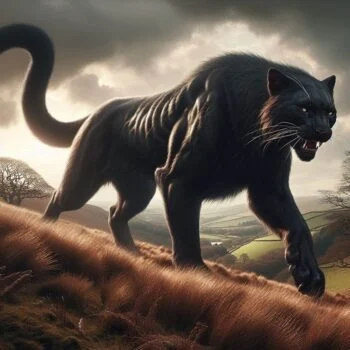
EXMOOR, England — For more than half a century, the rugged, windswept expanse of the Exmoor National Park—straddling the counties of Devon and Somerset in South West England—has nurtured one of the most enduring and fiercely debated cryptozoological legends in British history. Known simply as "The Beast of Exmoor," this phantom predator has cemented itself in the national consciousness as a quintessential modern cryptid. Described variously as a sleek, panther-like big cat, an escaped exotic pet, or a biological anomaly, the creature has haunted the imaginations of locals, folklore enthusiasts, and cryptozoologists alike.
Despite decades of sporadic eyewitness accounts, mutilated livestock, and official investigations, definitive proof of the animal’s existence remains elusive. Yet, the legend persists, capturing a unique intersection of rural folklore, ecological curiosity, and the human fascination with the untamed unknown.
Main Facts: Anatomy of a Phantom Predator
To understand the enduring grip of the Beast of Exmoor, one must examine the consistent details provided by those who claim to have crossed paths with it. Over the decades, descriptions of the beast have maintained a striking uniformity, painting a picture of an apex predator utterly alien to the native British fauna.
Physical Characteristics
Witnesses frequently describe the creature as possessing the hybrid characteristics of a panther and a puma. Key physical traits include:
- Size: Estimated to be anywhere from five to over seven feet in length from nose to tail tip.
- Stature: Built low to the ground while stalking or hunting, yet capable of displaying immense explosive power.
- Coat: Invariably described as jet-black, dark brown, or slate-grey, absorbing the mist and shadow of the moors.
- Behavior: Possessing an unnatural agility, capable of clearing stone walls and deep gullies with a single bound, and exhibiting extreme wariness of human contact.
The Livestock Toll
The most compelling—and economically damaging—aspect of the Beast of Exmoor legend is its alleged appetite for local livestock. Farmers across Devon and Somerset have reported mysterious animal deaths for generations. Unlike the clean kills typically associated with domestic dogs or foxes, the attacks attributed to the beast often involve bizarre trauma: massive internal injuries without external skin breaches, clean slashes reminiscent of surgical precision, and, most chillingly, livestock found drained of blood or stripped of flesh in patterns inconsistent with local scavengers.
While skepticism remains high regarding the exact nature of the predator, the financial and emotional toll on the rural farming community has been a persistent reality, lending a dark gravity to what might otherwise be dismissed as local folklore.
Chronology: A Timeline of Terror and Sightings
The modern era of the Beast of Exmoor is generally acknowledged to have begun in the 1970s, though rumors of strange, large felines roaming the British countryside date back centuries.
The 1970s: The Genesis of Modern Sightings
As rural Britain saw changes in land use and the popularization of exotic pet ownership—frequently fueled by wealthy eccentrics before the implementation of stricter legislation—reports of unidentifiable large cats began to trickle into local constabularies. Farmers in isolated pockets of Exmoor reported fleeting glimpses of dark shadows moving across the heather, but these accounts were largely treated as aberrations or misidentified domestic dogs.
The 1983 South Molton Crisis
The legend truly exploded onto the national stage in the winter of 1983. In the region surrounding South Molton, Devonshire, a local farmer suffered a devastating and catastrophic loss: over 100 sheep were found dead within a span of just two and a half months.
The nature of the kills horrified the local community. Many of the sheep had their throats torn out or suffered massive crushing injuries to the neck and spine. The sheer volume and method of the slaughter defied explanation by ordinary predators. The national press descended upon Devon, turning Exmoor into a media circus and cementing the "Beast of Exmoor" as a household name.
The 1990s to Present: Continued Encounters and Cultural Permanence
Throughout the 1990s and into the 21st century, sightings continued in waves. Notable spikes in reports often correlated with harsh winters or increased media attention. Even as decades passed—far longer than the natural lifespan of any escaped captive big cat from the 1970s or 80s—motorists, hikers, and farmers continued to report sudden, terrifying glimpses of a massive black cat crossing rural lanes before vanishing into the fog.
Supporting Data: Theories and Ecological Realities
When examining the phenomenon of the Beast of Exmoor, researchers and scientists generally divide the supporting data into three primary hypotheses: escaped exotics, feral adaptation, and psychological projection.
1. The Dangerous Exotic Pet Trade
Prior to the passage of the Dangerous Wild Animals Act 1976, it was remarkably easy for individuals in the United Kingdom to purchase and keep exotic felines—such as pumas, leopards, and jaguars—as status symbols. A popular and persistent theory suggests that when the 1976 Act came into force, making permits expensive and difficult to acquire, some owners illegally released their pets into the wild rather than surrender or euthanize them.
While zoologists note that a single escaped cat would likely have succumbed to the elements, starvation, or disease within a few years, the possibility of a small, breeding population cannot be entirely discounted by cryptozoologists.
2. Native Lynx and Feral Hybrids
Another biological hypothesis posits that the creature may not be an exotic import at all, but rather a descendant of native predators—such as the Eurasian lynx, which once roamed the British Isles before being hunted to extinction centuries ago—or extremely large feral cat hybrids. Over generations of natural selection in the wild, domestic-wildcat mixes could theoretically develop larger statures, thicker coats, and heightened survival instincts, allowing them to thrive in the remote valleys of Exmoor.
3. Pareidolia and Misidentification
Mainstream science and wildlife authorities lean heavily toward a more mundane explanation: misidentification. A combination of perspective distortion in dim lighting, the psychological phenomenon of pareidolia (the mind’s tendency to perceive meaningful patterns—like a big cat—in random stimuli like rocks or tree stumps), and the genuine presence of unusually large feral domestic cats or large dogs (such as German Shepherds or Rottweilers) can easily account for the vast majority of sightings. Furthermore, the UK is home to a robust population of red deer and foxes, which can produce eerie, unearthly vocalizations and silhouetted shapes in the mist.
Official Responses: The Stance of Authorities
For decades, local law enforcement, government ministries, and wildlife experts have been forced to respond to the public panic and media frenzies surrounding the Beast of Exmoor. Their approach has historically walked a fine line between public reassurance and professional skepticism.
Government and Military Inventions
During the height of the 1983 panic in South Molton, public concern reached such a pitch that the British government took the unprecedented step of deploying the Royal Marines to Exmoor. Armed and equipped for a manhunt, the marines scoured the moorland in search of the beast. However, after days of exhaustive sweeps, the mission was called off empty-handed. The official conclusion offered little comfort to terrified locals: while no big cat was captured, officials acknowledged that something unusual was killing livestock, though whether it was a rogue dog or an exotic cat remained unproven.
The Ministry of Agriculture and Fisheries
Official bodies, such as the former Ministry of Agriculture, Fisheries and Food (MAFF), investigated numerous sheep carcasses over the years. While acknowledging the severity of the livestock losses, official autopsy reports frequently pointed the finger back at domestic dogs, foxes, or badgers, noting that the bite marks and trauma patterns—while severe—did not definitively require a panther-sized predator to inflict.
Modern Conservation Perspectives
Today, organizations like Natural England and the Exmoor National Park Authority view the beast through a lens of folklore and ecological reality. While they do not actively hunt for a big cat, they maintain an open-minded approach to wildlife monitoring. Interestingly, the enduring legend has occasionally served as a backdrop for broader discussions regarding the rewilding of the British countryside, with some environmentalists arguing that if apex predators like lynx or wolves could survive in the UK, it would benefit local ecosystems—even if the current "Beast" remains a ghost of rumor rather than a scientific reality.
Implications: Folklore, Tourism, and the Human Need for Mystery
The persistence of the Beast of Exmoor transcends mere zoological curiosity; it touches on deeper sociological and cultural themes.
The Commercialization of Cryptid Culture
In the towns and villages surrounding Exmoor, the legend of the beast has woven itself into the local economy. Pubs, gift shops, and tourist boards eagerly embrace the folklore, offering everything from "Beast Ale" to guided mystery tours of the moors. The cryptid serves as a powerful tourist draw, transforming what could be an economically isolated rural region into a destination for thrill-seekers, paranormal investigators, and nature enthusiasts.
The Psychological Appeal of the Unknown
In an increasingly monitored, mapped, and industrialized world, the Beast of Exmoor represents a stubborn holdout of the unknown. Despite satellites, GPS tracking, and round-the-clock news cycles, the idea that a massive, dangerous predator can roam undetected through the misty hills of Southern England appeals to a primal human desire for mystery. It reminds modern society that nature still holds secrets, and that not everything can be neatly categorized, explained, or controlled.
Conclusion
Whether the Beast of Exmoor is a flesh-and-blood panther evading capture for half a century, a population of feral predators adapting to the British wilderness, or simply a collective ghost born of fear, imagination, and misidentified wildlife, its place in history is secure. As long as the fog rolls in over the heather and sheep graze in the shadow of the hills, the legend of the phantom predator of Exmoor will continue to prowl the borders of reality and myth.