







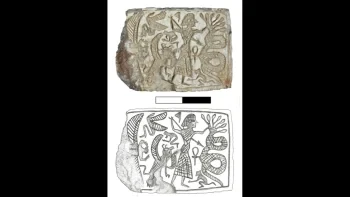
JERUSALEM — Deep within the dusty archives of archaeological history, a tiny, unassuming artifact has emerged to challenge our understanding of how ancient civilizations shared their most enduring myths. Measuring just centimeters across, a newly highlighted 2,800-year-old stamp seal unearthed in Israel depicts an epic and unmistakable struggle: a heroic mortal engaged in combat with a fearsome, seven-headed serpent.
Far from a mere decorative flourish, leading epigraphers and Near Eastern historians suggest this artifact serves as a crucial missing link. It physically bridges the cultural chasms between ancient Canaanite oral traditions, biblical literature, and the classical monster-slaying epics of ancient Greece, such as the Labors of Hercules.
Main Facts: The Discovery and Iconography
The artifact in question is an Iron Age stamp seal, a small carved stone object historically used by administrators, merchants, or elites to stamp wet clay and authenticate documents or property. However, the iconography carved into the flat face of this particular seal transcends administrative utility, entering the realm of profound theological and mythological expression.
Visual Elements of the Seal
- The Heroic Figure: The dominant human figure is depicted in a posture of dynamic aggression, wielding a weapon against the central beast. Stylistically, the posture mirrors typical Neo-Assyrian and Levantine artistic conventions of the 8th century BCE, blending local artistic flair with imperial iconography.
- The Seven-Headed Serpent: Emanating from a single serpentine body are seven distinct, menacing heads. This specific motif immediately invokes comparative mythological frameworks across the ancient Near East.
- Material and Craftsmanship: Carved from durable semi-precious stone, the seal demonstrates advanced micro-engraving techniques common during the Iron Age II period in the southern Levant.
According to researchers analyzing the piece, the depiction is not an isolated artistic anomaly. Instead, it forms part of a broader, pan-Mediterranean tapestry of dragon-combat myths—narratives where a champion of order confronts and slays a chaotic, multi-headed water monster.
Chronology: Tracing the Evolution of the Multi-Headed Beast
To understand the weight of the 2,800-year-old Israeli seal, one must trace the deep chronological roots of the multi-headed serpent motif across the ancient world. The narrative of the chaoskampf—the "struggle against chaos"—is one of humanity’s oldest literary and visual tropes.
1. Third Millennium BCE: Mesopotamian Origins
The earliest roots of the multi-headed serpent trace back to ancient Mesopotamia. Texts from Sumer and Akkad describe deities like Ninurta or Marduk battling monstrous serpents and dragons. The Tiamat of Babylonian mythology and associated serpentine adversaries like Bashmu (a horned, multi-headed snake) established the archetype of the primordial monster representing watery chaos, which the gods or divine champions must subdue to create an ordered cosmos.
2. Second Millennium BCE: The Ugaritic Texts
Moving closer geographically and culturally to ancient Israel, the Late Bronze Age archives of Ugarit (modern-day Syria) yielded clay tablets featuring the Baal Cycle. These texts explicitly name Lotan (the linguistic and thematic root of the biblical Leviathan), describing him as a "fleeing serpent" and a "twisted serpent, the close-coiling one of seven heads." This proves that the specific trope of a seven-headed aquatic monster was deeply embedded in Canaanite culture centuries before the Iron Age seal was carved.
3. Iron Age II (circa 8th Century BCE): The Israeli Seal
It is within this historical continuum that the newly discussed stamp seal emerges. Dated to approximately the 8th century BCE—a period of intense geopolitical shifting, Assyrian expansion, and cultural exchange in the southern Levant—the seal captures the Canaanite-Mesopotamian motif frozen in stone on the ground of ancient Israel.
4. First Millennium BCE to Classical Antiquity: Greek and Biblical Parallels
As trade routes flourished and empires expanded, these motifs migrated westward into the Aegean world. By the time classical Greek poets and mythographers codified their tales, the multi-headed serpent crystallized into figures such as the Lernean Hydra—slain by Hercules as his second labor. Simultaneously, Hebrew scribes were incorporating the imagery of the multi-headed Leviathan into biblical poetry (such as Psalm 74:14, which speaks of God breaking the heads of Leviathan), adapting familiar ancient Near Eastern mythological imagery to monotheistic theology.
Supporting Data: Comparative Mythology and Archaeological Context
The significance of the 2,800-year-old seal is best understood through comparative analysis with contemporary artifacts, textual databases, and archaeological strata from the Levant.
Comparative Iconographic Matrix
| Region / Culture | Primary Text or Artifact | Serpent Description | Approximate Date |
|---|---|---|---|
| Ugarit (Canaan) | The Baal Cycle | "Seven-headed" (ltn) | c. 1400–1200 BCE |
| Levant (Israel) | Iron Age Stamp Seal | Seven-headed serpent vs. hero | c. 8th Century BCE |
| Mesopotamia | Cylinder Seals / Epics | Bashmu (multi-headed dragon) | c. 2000–1000 BCE |
| Greece | Classical Vase Paintings | Lernean Hydra (many heads) | c. 700–500 BCE |
Archaeologists note that seals bearing combat motifs were frequently used as protective amulets or symbols of divine favor. The owner of the 8th-century BCE seal would have viewed the image not merely as an entertaining story, but as a potent apotropaic device—a ward against evil, chaos, and destruction. By placing the image of the hero conquering the multi-headed beast onto a personal object, the bearer invoked cosmic victory over daily chaos.
Furthermore, the stylistic execution points to local workshops operating under mixed influences. During the 8th century BCE, the Kingdom of Israel and the Kingdom of Judah maintained complex diplomatic, economic, and military relationships with Phoenicia, Aram, and the Neo-Assyrian Empire. Artistic styles flowed fluidly across borders, allowing traditional Canaanite mythology to be reinterpreted through contemporary Iron Age visual idioms.
Official Responses and Scholarly Perspectives
The publication and re-examination of artifacts depicting ancient mythological combat have sparked lively discussions within the international archaeological and biblical studies communities.
Dr. Alon Shavit, a Near Eastern archaeologist specializing in Iron Age iconography, notes that small finds like stamp seals often tell a more intimate story about popular belief than monumental architecture.
"When we look at royal inscriptions or temple reliefs, we see state-sanctioned propaganda," Shavit explains. "But personal seals reflect the mental landscape of the everyday elite. The fact that an ordinary administrator or landowner chose a seven-headed serpent battle scene for his signature token tells us that these grand cosmological myths were alive, vibrant, and personally meaningful to people living in the southern Levant during the monarchy period."
Meanwhile, classical mythologists emphasize the unbroken chain of transmission that such artifacts represent. Professor Elena Vance of the Institute for Mediterranean Antiquity points out that scholars have long debated whether Greek monster myths were direct borrowings from the Near East or independent parallel developments.
"Artifacts like this Israeli seal provide the tangible, material glue holding the diffusionist theory together," Vance states. "We know the literary links existed—the linguistic and structural similarities between the Baal-Lotan epics and the Greek Typhon or Hydra traditions are too close to ignore. Finding this iconography embedded in the material culture of the Levant demonstrates that the shared pool of Mediterranean and Near Eastern mythology was continuously accessed, adapted, and visualized by local artisans."
Biblical historians also weigh in on the cultural milieu of Iron Age Israel. The convergence of Canaanite mythological motifs within an Israelite-controlled or influenced geographic zone reinforces the understanding that ancient Israelite culture did not develop in a vacuum. Instead, it was deeply conversant with the broader literary and visual vocabulary of the ancient Near East, frequently adopting, reframing, or polemically subverting these regional tropes.
Implications: Rewriting the Narrative of Cultural Transmission
The implications of this 2,800-year-old artifact extend far beyond academic debates over provenance and iconography. They alter how we perceive the interconnectedness of ancient civilizations and the longevity of human storytelling.
1. Re-evaluating the Spread of Mythological Motifs
For decades, cultural transmission was often viewed as a slow, unidirectional trickle from dominant empires (like Egypt or Assyria) to peripheral provinces. This seal suggests a more dynamic, multi-directional network of shared motifs. The myth of the multi-headed serpent was not the exclusive property of any single empire; it was a universal currency of the ancient Mediterranean and Near Eastern world, traded as freely as olive oil, wine, and textiles.
2. Deepening the Context of Biblical and Classical Literature
For modern readers, ancient texts can feel isolated, locked behind centuries of linguistic and cultural translation. Discoveries like this seal pull those texts back into a vivid, multi-sensory physical world. When ancient audiences read or heard accounts of cosmic battles against serpentine monsters, they were not engaging with abstract concepts; they were interacting with a well-established visual culture that decorated their jewelry, stamped their documents, and defined their understanding of order versus chaos.
3. The Timelessness of the Hero’s Journey
Ultimately, the survival of this tiny stone seal across nearly three millennia speaks to the fundamental human fascination with the struggle against overwhelming odds. Whether it is a Mesopotamian god slaying Tiamat, a Canaanite deity subduing Lotan, a Hebrew prophet invoking Leviathan, or Hercules battling the Hydra, humanity has continually returned to the image of the heroic champion facing the many-headed beast.
As researchers continue to catalog, digitize, and re-examine museum collections worldwide, artifacts like the 8th-century BCE Israeli seal serve as a powerful reminder: the stories that captivate our modern imagination—of monsters, heroes, and epic trials—are echoes of an ancient human dialogue that has been unfolding for thousands of years.