







Introduction and Main Facts
For over half a century, the rugged, windswept expanse of Exmoor—stretching across the picturesque counties of Somerset and Devon in southwest England—has been haunted by a phantom. Known colloquially as the Beast of Exmoor, this elusive entity fits the quintessential profile of a modern cryptid: a large, predatory anomaly that defies conventional zoological explanation, captured only in fleeting glimpses, grainy photographs, and the terrified accounts of local farmers.
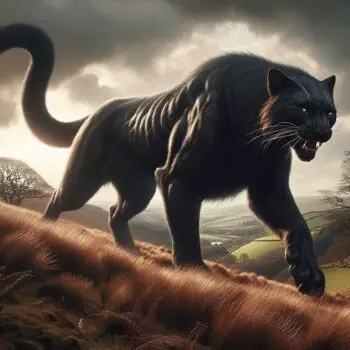
Described by eyewitnesses as a massive, dark-furred feline bearing a striking resemblance to a panther, leopard, or puma, the creature is said to measure upwards of seven feet from nose to tail. Observers frequently note its powerful, muscular build, its stealthy, low-to-the-ground hunting posture, and a chilling agility capable of clearing impossibly wide chasms and high stone walls with effortless grace.
While cryptozoologists and folklore enthusiasts view the Beast of Exmoor as a fascinating modern myth, local agricultural communities view it through a lens of profound economic anxiety and fear. The creature has long been blamed for the mysterious, brutal slaughter of hundreds of farm animals—predominantly sheep—over the decades. Throats torn open with surgical precision, heavy carcasses dragged across impassable terrain, and inexplicable panic among livestock herds have cemented the creature’s reputation in the West Country as an apex predator operating outside the bounds of known British wildlife.
Despite decades of intensive searches, government investigations, and public fascination, concrete physical evidence remains frustratingly scarce. Yet, the Beast of Exmoor stubbornly refuses to fade into the realm of folklore. Sightings continue to be reported with regularity, baffling scientists, captivating the public imagination, and keeping rural communities on high alert for the shadow that stalks the moors.
Chronology of Terror: A Timeline of Sightings and Incidents
To understand the enduring legacy of the Beast of Exmoor, one must trace its path through the decades. What began as isolated whispers in the early 1970s quickly escalated into a widespread phenomenon, punctuated by waves of livestock depredation and high-profile search operations.
The 1970s: The Whispers on the Moor
The earliest organized reports of a large, anomalous cat roaming the Exmoor region began to surface in the early 1970s. Initially, these accounts were dismissed by local authorities as the misidentifications of large domestic dogs, feral felines, or the product of rural folklore. However, as independent sightings accumulated—frequently reported by reputable locals, including hunters, shepherds, and police officers—the agricultural community began to realize that something unusual was traversing the mist-shrouded hills.
1983: The South Molton Massacre
The legend transformed from regional curiosity to national headline material in 1983. A wave of terror struck the farming community around South Molton in Devonshire. Over a staggering period of just two and a half months, a local farmer suffered the catastrophic loss of more than 100 sheep.
The nature of the attacks stunned local veterinarians and agricultural experts. The sheep were not merely killed; many exhibited signs of having their throats ripped out with immense force, while others were found piled neatly or dragged considerable distances. The sheer volume of livestock lost in such a short window ruled out routine predation by local foxes or domestic dogs, focusing intense public scrutiny squarely on the moorlands.
The 1990s: Heightened Hysteria and Official Intervention
Throughout the 1990s, reported sightings surged. Tourists and locals alike claimed to have locked eyes with a massive black cat resting in fields or crossing rural roadways. The panic reached such a pitch that in 1995, the British government took the unprecedented step of authorizing the deployment of the Royal Marines to Exmoor. Armed with thermal imaging equipment and specialized tracking gear, the elite soldiers scoured the terrain. While they failed to capture or definitively sight the creature, their involvement validated the gravity of the public concern and catapulted the Beast of Exmoor into international folklore.
The 2000s to Present Day: Modern Encounters and Media Focus
In the 21st century, the legend has experienced a technological renaissance. While physical evidence remains elusive, modern technology has provided new avenues for documentation. Dashcams, trail cameras, and smartphone video have occasionally captured fleeting shapes moving through the fog. Documentaries, such as investigative segments featured on programs like MonsterQuest, have revisited the mystery, applying modern forensic tracking techniques and interviewing original witnesses to re-examine the physical plausibility of a big cat population thriving in the British countryside.
Supporting Data and Ecological Analysis
When examining the phenomenon of the Beast of Exmoor, investigators must balance eyewitness testimony against the realities of ecology, zoology, and geography.
The Ecological Puzzle
From a purely biological standpoint, the presence of an apex feline predator in rural England presents significant logistical questions. Can a large cat survive undetected in the British countryside for fifty years?
Exmoor provides an ideal sanctuary for an elusive animal. Spanning over 267 square miles of varied terrain—including dense woodlands, deep river valleys, steep coastal cliffs, and vast open moorland—the national park offers abundant cover and a rich food supply. The region is heavily populated by red deer, wild rabbits, hares, and thousands of grazing sheep, providing more than enough caloric intake to sustain a solitary large predator or even a small, isolated breeding population.
The Exotics Pet Trade Connection
The most widely accepted rationalization among zoologists involves the Dangerous Wild Animals Act of 1976. Prior to the passage of this legislation, it was entirely legal in the United Kingdom to purchase and keep exotic animals—including pumas, leopards, and lynx—as private pets.
Cryptozoologists and animal welfare experts alike theorize that when the 1976 law came into effect, introducing stringent licensing fees, strict housing requirements, and potential legal liabilities, a number of exotic pet owners illegally released their animals into the wild rather than surrender or euthanize them. If a small number of panthers or pumas were released onto the moors of Devon and Somerset, it is ecologically plausible that they could have survived for years, given the mild maritime climate and abundant prey.
The Lifecycle Paradox
While the escape or release of adult exotic cats in the 1970s explains initial sightings, it introduces a biological paradox regarding sightings that persist decades later. Pumas and panthers typically have a maximum lifespan of 12 to 15 years in the wild. Therefore, any cat released in 1976 would have naturally perished by the late 1980s or early 1990s.
For sightings to continue into the 2000s and 2020s, one of two things must be true:
- Generational Breeding: A population of big cats must have successfully adapted, mated, and reproduced in the wild, establishing a secretive, self-sustaining breeding colony.
- Continued Releases: Unscrupulous exotic animal owners have continued to illegally dump unwanted pets into the countryside over the subsequent decades.
To date, mainstream zoological organizations remain skeptical of the breeding colony hypothesis, noting the absence of roadkill specimens, clear paw-print casts, DNA evidence from scat, or verified dens—all of which would inevitably accompany an established population of large felines.
Official Responses and Investigative Efforts
The mystery of the Beast of Exmoor has not been ignored by the authorities. Over the decades, local councils, agricultural ministries, and military branches have launched numerous inquiries, mounting operations to resolve the public safety and economic concerns.
The Ministry of Agriculture and Fisheries (MAFF) Inquiries
During the peak of the 1980s panic, the Ministry of Agriculture, Fisheries and Food (now DEFRA) received hundreds of reports from distressed farmers. Ministry officials conducted field inspections, examined livestock carcasses, and interviewed witnesses. While official reports frequently concluded that many livestock deaths could be attributed to domestic dogs, wild foxes, or natural causes, the MAFF quietly acknowledged that a small percentage of the attacks displayed characteristics inconsistent with standard UK predators.
The Royal Marines Deployment (1995)
Perhaps the most dramatic official response occurred in 1995 when the British government authorized a detachment of Royal Marines to track and locate the beast. Operating in treacherous weather conditions across the Exmoor terrain, the troops utilized advanced military-grade night vision and thermal imaging equipment. Although the mission ultimately concluded without a capture or a definitive sighting, the deployment demonstrated the government’s willingness to take the rural panic seriously, addressing the psychological strain placed on local livestock farmers.
Veterinary and Forensic Findings
Local veterinarians called upon to examine mauled livestock have often expressed divided opinions. Some note that the sheer crushing power required to break the necks of mature sheep and the precision of the bite marks point toward a large, non-native predator. Conversely, others argue that feral dogs—particularly large mastiff crosses or escaped hunting hounds—are fully capable of inflicting identical damage when operating in packs, often leaving behind misleading forensic trails.
Implications: Cultural Legacy, Agriculture, and Tourism
The enduring myth of the Beast of Exmoor extends far beyond the boundaries of zoological debate, casting a wide net over the economy, culture, and daily life of southwest England.
Economic Impact on Agriculture
For the farming community of Somerset and Devon, the Beast of Exmoor is no laughing matter. Even if a fraction of the livestock losses attributed to the phantom cat were actually caused by feral dogs or disease, the psychological and financial toll on farmers is profound. Livestock represents a fragile livelihood; unexpected losses running into the dozens can devastate a family-run farm. The persistent fear of the beast forces farmers to invest in enhanced, cost-prohibitive security measures, such as reinforced fencing, night patrols, and indoor housing for flocks during vulnerable lambing seasons.
Tourism and Local Lore
Conversely, the tourism industry has enthusiastically embraced the legend. Pubs, bed-and-breakfasts, and local tour operators weave the tale of the Beast of Exmoor into their marketing, drawing curious travelers, paranormal enthusiasts, and cryptozoology buffs to the region. Gift shops sell memorabilia, books, and artwork—such as AI-rendered interpretations of the shadowy feline—cementing the creature as a central pillar of regional folklore.
The Broader Cultural Significance
Ultimately, the Beast of Exmoor speaks to a fundamental human desire for mystery in an increasingly mapped and monitored world. In an era where satellites track our movements and every corner of the globe is scrutinized by digital lenses, the idea that an apex predator can hide in plain sight just miles from British civilization is perversely comforting. It serves as a reminder that the wild is never truly conquered, and that untamed spaces still hold secrets capable of capturing our collective imagination.
Whether it is a cunning lineage of surviving exotic cats, a phantom born of collective hysteria, or a combination of misidentified domestic predators and folklore, the Beast of Exmoor remains an indelible part of the British countryside—a silent, stalking shadow on the edge of the mist.