





Introduction
In the vast and frost-bitten tapestry of Norse mythology, few figures command as much fascination, debate, and enduring cultural relevance as Loki. Often immortalized in modern pop culture as a smooth-talking cinematic anti-hero, the true mythological Loki is a far more layered, darker, and unpredictable entity. He is neither a straightforward villain nor a benevolent protector; instead, he exists in a precarious moral gray area. As both a catalyst for divine crises and the clever troubleshooter who rescues the Æsir from their own blunders, Loki remains one of the most compelling archetypes in world folklore.
This comprehensive examination delves into the roots, mythology, and psychological weight of Norse legend’s ultimate trickster. By exploring his linguistic origins, his complex relationships with the gods of Asgard, his pivotal role in the cosmos, and his lasting footprint on modern media, we uncover why this god of wind and fire continues to captivate the human imagination centuries after the oral traditions of Scandinavia fell silent.
Main Facts: Who Was Loki in Norse Tradition?
To understand Loki, one must first deconstruct his identities, titles, and elemental associations. Unlike Thor, the stalwart defender of thunder, or Odin, the one-eyed seeker of wisdom, Loki defies easy categorization.
Names, Etymology, and Elemental Ties
In traditional Norse sources, Loki is occasionally referred to as Lopt or Loptr, names derived from Old Norse roots meaning "air" or "sky." However, his most common moniker is tied to combustion. Scholars generally link the name "Loki" to the Germanic root for "flame" (logi), reinforcing his deep association with fire.
Because of these linguistic markers, historians and mythologists frequently classify Loki as a God of Wind and Fire. This elemental duality makes profound symbolic sense: fire and wind are both volatile, difficult to contain, essential for survival, and devastating when unleashed without restraint. Fire warms the hearth, forges weapons, and cooks food, but it also reduces glorious halls to ash. Wind carries seeds to fertile soil, powers longships across treacherous seas, and fuels raging wildfires. Loki embodies this exact paradox.
The Outsider Among the Æsir
Loki is not technically one of the Æsir, the primary pantheon of Norse gods residing in Asgard. Instead, he is the son of the giant Fárbauti and the giantess Laufey (sometimes called Nál). Through a blood-pact (fóstbrœðralag) forged with Odin in the mists of antiquity, Loki gained entry into the halls of Asgard and a seat among the high gods.
Yet, this outsider status never truly leaves him. He walks among the divine aristocracy as an adopted equal, but he perpetually retains the cunning, survivalist instincts of the Jötunn (giants). This duality allows him to serve as a bridge between the ordered world of the gods and the chaotic, primordial wilderness of the giants—a position that enables him to solve problems no other god can touch, while simultaneously engineering the very doom that the Æsir fear most.
Chronology: Key Myths and the Arc of Loki’s Legend
Loki’s narrative trajectory in Norse literature—primarily preserved in the Poetic Edda, compiled in the 13th century from earlier traditional material, and Snorri Sturluson’s Prose Edda—traces a fascinating arc from clever troubleshooter to cosmic architect of destruction.
Phase 1: The Mastermind and Problem Solver
In the early epochs of Asgardian lore, Loki’s cunning is frequently deployed to save the gods from existential threats or to procure legendary treasures through his quick wits.
- The Construction of Asgard’s Walls: When a disguised giant offers to build impenetrable walls around Asgard in record time in exchange for the sun, the moon, and the goddess Freyja, the panic-stricken gods turn to Loki. It is Loki who devours his own pride, transforms into a mare, distracts the giant’s magic stallion Svaðilfari, and ruins the builder’s timeline. This intervention saves Freyja from an unwanted marriage and spawns Sleipnir, Odin’s eight-legged steed, whom Loki bears himself.
- The Procurement of Divine Treasures: Following a prank in which he shears the golden hair of Thor’s wife, Sif, a furious Thor forces Loki to make amends. Loki travels to the subterranean realm of the dwarfs, successfully commissioning magnificent gifts for the gods: Sif’s golden hair, Odin’s spear Gungnir, and Freyr’s magical ship Skidbladnir. He even secures Mjölnir, Thor’s devastating war hammer, alongside the golden-bristled boar Gullinbursti and the self-multiplying ring Draupnir.
Phase 2: The Escalation of Malice
As time progresses, Loki’s playful or self-serving mischief darkens into genuine malice. The turning point of his mythological trajectory is unquestionably the murder of Baldr, the radiant, beloved son of Odin and Frigg.
Blinded by jealousy and spite, Loki learns from Frigg that every living and inanimate thing in creation—except for the unassuming mistletoe—has sworn an oath never to harm Baldr. Crafting a dart from this single overlooked plant, Loki tricks Baldr’s blind brother, Höðr, into throwing it. The dart strikes true, plunging Asgard into profound grief and signaling the beginning of the end for the cosmos.
Phase 3: Captivity and the Twilight of the Gods
Following the murder of Baldr, the gods can no longer tolerate Loki’s betrayals. He flees into the mountains, building a house with four doors to watch for pursuers and inventing the world’s first fishing net. When the gods finally capture him, they subject him to a brutal punishment designed to last until the end of time.
Loki is bound to three sharp rocks using the entrails of his own son, Narfi (while his other son, Vali, is transformed into a wolf and tears Narfi apart). Above Loki’s face, the giantess Skaði places a venomous serpent, dripping burning acid onto his skin. Loki’s loyal wife, Sigyn, stands by his side holding a bowl to catch the venom. However, whenever she must step away to empty the overflowing basin, the burning venom drips onto Loki’s face, causing him to writhe in agony. In Norse belief, these convulsions of the earth god are the true meteorological and geological cause of earthquakes.
Phase 4: Ragnarök and the Final Battle
Loki’s story does not end in chains. According to the prophecies of Ragnarök—the apocalyptic battle that consumes the old world—the bonds holding Loki will shatter.
Freed from his subterranean torture, Loki takes his place at the head of an army of the dead, sailing to the battlefield aboard Naglfar, a ship constructed entirely from the unpared fingernails of dead men. In the final clash, Loki faces his ultimate nemesis, the guardian god Heimdallr. In a brutal, poetic duel, the god of light and the trickster god slay one another, bringing down the curtain on the first iteration of the cosmos so that a greener, fairer world may rise from the ashes.
Supporting Data: Archaeological and Historical Evidence
While literary sources like Snorri Sturluson’s works provide the narrative framework for Loki, scholars continually search for archaeological and historical evidence to understand how pre-Christian Scandinavians truly perceived him.
The Archaeological Record
Physical depictions of Loki in pre-Christian Scandinavia are remarkably rare compared to figures like Thor (whose hammer pendants are found across Northern Europe) or Odin. However, a few notable artifacts exist:
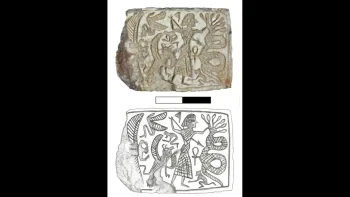
- The Kirkby Stephen Stone: Located in Cumbria, England, this 10th-century stone cross features a carved male figure bound with chains, horns sprouting from his head, and a snarling expression. Many historians interpret this as a rare Christian-era depiction of a bound Loki, reflecting the spread of Norse mythology into the British Isles during the Viking Age.
- The Snaptun Stone: Discovered in Denmark in 1950, this hearth stone features a carved face with scarred lips—a direct reference to the myth where Loki’s mouth is sewn shut by the dwarf Brokkr after a lost wager. The stone was used in a smithing forge, a fitting placement for a god tied closely to fire and metallurgy.
- The Tjängvide Image Stone: Located on the Swedish island of Gotland, this 8th-century stone features a figure riding an eight-legged horse, which many scholars identify as Odin riding Sleipnir, whose birth was orchestrated by Loki.
Linguistic and Folklore Continuity
Beyond hard stone and metal, comparative mythology reveals that the archetype of the trickster is universal. In pan-Germanic and broader Indo-European folklore, figures who bridge the gap between order and chaos, serving as both creator and destroyer, are vital to maintaining the cosmic balance. Without Loki to challenge the complacency of the Æsir, Norse mythology would lack the dramatic tension that drives its most memorable tales.
Official Responses and Modern Interpretations
How do modern historians, religious scholars, and cultural critics view Loki today? The scholarly consensus has shifted dramatically over the past century.
The Nineteenth-Century "Interloper" Theory
In the 19th and early 20th centuries, romantic nationalist scholars often attempted to sanitize Norse mythology, projecting Victorian moral standards onto Viking Age religion. Figures like Jacob Grimm and early mythologists occasionally struggled with Loki, sometimes attempting to argue that he was a late-invented corruption or an import from Christian traditions (drawing superficial parallels between Loki and Satan).
Modern Scholarly Consensus
Today, mainstream academic consensus categorically rejects the idea that Loki is a Christian import. Modern historians view him as an authentic, foundational component of pre-Christian Germanic polytheism. Scholars emphasize that pre-Christian religion did not demand moral perfection from its deities; gods were personifications of natural forces, human psychology, and existential realities. In that light, Loki represents necessary chaos—the creative spark, the disruptive innovation, and the inevitable decay that must precede renewal.
The Cinematic Revolution
It is impossible to discuss Loki without acknowledging his massive contemporary footprint in global media, largely spearheaded by Tom Hiddleston’s critically acclaimed portrayal in the Marvel Cinematic Universe (MCU). While Marvel’s Loki diverges significantly from the Eddic texts—transforming him from a blood-brother of Odin into the adopted brother of Thor, and shifting his parentage from Fárbauti to Laufey (utilized here as a maternal rather than paternal name)—the cinematic adaptation captured the core psychological appeal of the character: charm, vulnerability, deep-seated insecurity, and unpredictable theatricality. This cultural phenomenon has introduced millions of new readers to the rich primary sources of Norse literature.
Implications: The Legacy and Cultural Meaning of Loki
What does the enduring obsession with Loki tell us about human nature? Why do we continue to celebrate a deity whose defining legacy is betrayal and destruction?
The Necessity of Chaos in Order
Human societies have always wrestled with the tension between order and chaos. Order provides safety, law, agriculture, and civilization—represented in Asgard by the golden halls and structured governance of the Æsir. Yet, pure, unyielding order easily stagnates into tyranny and complacency.
Loki represents the volatile spark that shatters stagnation. Whether through his malicious acts or his reluctant problem-solving, Loki forces the gods out of their comfort zones. He exposes the flaws in Asgardian defenses, reveals the hypocrisy of the divine elite, and ultimately clears the slate for a new, cleaner beginning. Without Loki, the Norse universe would remain frozen in an unchanging, sterile status quo.
The Archetype of the Outsider
Loki also speaks profoundly to the human experience of marginalization and identity. As an eternal outsider living among a ruling class that never fully accepts him as one of their own, Loki’s bitterness, cynicism, and desperate need for validation resonate deeply with modern audiences. He is the ultimate anti-hero—flawed, brilliant, resentful, and utterly unforgettable.
Frequently Asked Questions (FAQ)
1. Is Loki the son of Odin in Norse mythology?
No. In traditional Norse mythology, Loki is not Odin’s son or adopted brother. He is the son of the giant Fárbauti and the giantess Laufey. He becomes Odin’s blood-brother through a sacred ritual performed before the events recorded in the Eddas.
2. Who are Loki’s children?
Loki is the father of some of the most extraordinary and terrifying creatures in Norse mythology. With the giantess Angrboða, he fathered three monstrous children: Jörmungandr (the Midgard Serpent), Fenrir (the giant wolf), and Hel (the ruler of the underworld). Additionally, as noted earlier, he famously gave birth to Sleipnir, Odin’s eight-legged horse, while transformed into a mare.
3. Was Loki worshipped by the Vikings?
Unlike Thor, Odin, or Freyja, there is virtually no historical evidence that ancient Norsemen built temples to Loki or offered sacrifices to him. He was a mythological character central to their storytelling, cosmology, and dramatic arts, rather than a figure of active cultic worship.
4. What is the meaning behind Loki’s punishment?
Loki’s binding beneath a venom-dripping serpent is a classic mythological motif of cosmic justice. It symbolizes the temporary containment of chaos. The venom represents the corrosive nature of his betrayal, while the earthquakes caused by his convulsions remind mortals and immortals alike that chaos can never truly be destroyed—only restrained until its inevitable hour arrives.
Conclusion
Loki remains a towering titan of world mythology because he refuses to fit into a neat box. He is creator and destroyer, savior and traitor, beautiful and grotesque, male and female, god and giant. In the flickering light of an ancient Scandinavian hearth, tales of Loki’s quick wits and terrible betrayals reminded listeners that the cosmos is a fragile, dangerous place where order and chaos are locked in an eternal, breathtaking dance. Today, whether studied by historians or celebrated by millions of fans worldwide, Loki endures as the ultimate testament to the captivating power of a well-told story.