









Main Facts: The Intersection of Economics, Technology, and Liberal Learning
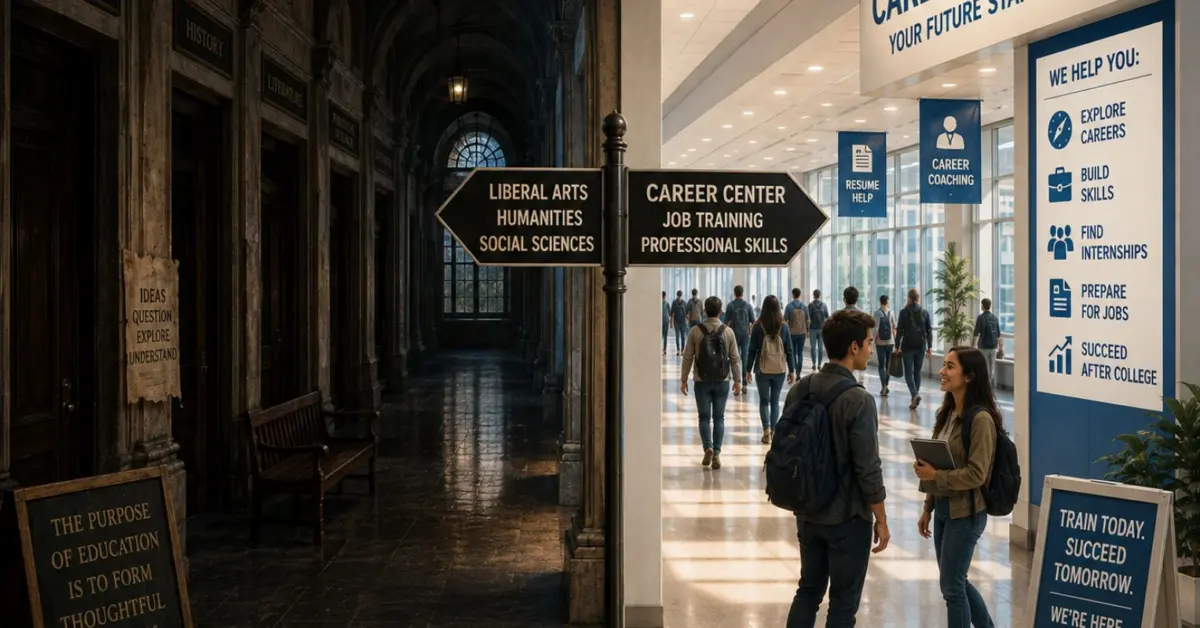
American higher education stands at a historic crossroads, squeezed between rapid technological disruption, shifting federal oversight, and a profound crisis of institutional solvency. For generations, universities and colleges have served a dual purpose: a signaling function that verifies a student’s competence, knowledge, and grit to prospective employers, and a civic function dedicated to transmitting a society’s cultural inheritance, cultivating independent thought, and preparing active participants in democratic life.
Today, that civic function is facing an existential threat. Driven by plummeting enrollments, mounting student debt, eroding public trust, and a hyper-polarized political climate, institutions are racing to restructure themselves around immediate workforce alignment. Concurrently, technological developments—most notably the explosive growth of generative artificial intelligence (AI)—threaten to upend the labor markets that colleges are trying so desperately to serve.
As federal policy increasingly ties financial aid eligibility to the immediate post-graduation earnings of students, traditional liberal arts and humanities programs are being systematically marginalized. The central question facing educators, policymakers, and citizens is stark: If universities abandon their role as cultivators of citizens in favor of narrow vocational training, who will preserve the intellectual, historical, and moral foundations of our society?
Chronology: From John Adams’ Vision to the 2026 Higher Education Crunch
To understand the magnitude of the current crisis, it is helpful to trace the evolution of educational philosophy and the cascading events leading to the present solvency crunch:
- 1780: While serving as an American diplomat in Paris, John Adams writes a famous letter to his wife, Abigail. He outlines a generational progression: "I must study Politicks and War that my sons may have liberty to study Mathematics and Philosophy," envisioning a future where descendants could ultimately pursue the fine arts, poetry, and the liberal arts once foundational security was established.
- Late 19th and Early 20th Centuries: Thinkers such as John Dewey and W.E.B. Du Bois champion the civic and democratic purposes of education, arguing that schools must do more than train workers—they must shape human consciousness, habits, and social capacity.
- The 2010s–Early 2020s: Humanities and liberal arts majors experience a sharp, continuous decline across American universities. Economic pressures, rising tuition, and a cultural shift toward hyper-pragmatic career preparation cause enrollment in literature, history, and philosophy programs to plummet.
- August 2026: Technology pioneer Bill Gates publishes an essay warning that AI could transform the labor market faster than any previous technology, disrupting white-collar and professional sectors—including law, medicine, and software development—within a decade.
- Late August 2026: Former presidential candidate Andrew Yang highlights the deepening crisis in higher education, noting on social media that regional colleges are experiencing catastrophic enrollment drops (such as Midwestern institutions losing 50 percent of their student body over a decade), forecasting widespread campus closures.
- Fall 2026: The Trump administration advances the "Do No Harm" earnings standard, requiring undergraduate programs to prove their graduates out-earn the typical high school diploma holder, or risk losing federal student loan eligibility.
Supporting Data: Enrollment Declines, Economic Pressures, and the AI Disruption
The pressures bearing down on colleges and universities are supported by a convergence of alarming quantitative and qualitative metrics:
- Enrollment Freefall: Small and mid-sized private and regional public colleges are bearing the brunt of demographic shifts. Over the past decade, hundreds of institutions have watched enrollment figures drop by double-digit percentages, driven by a declining pool of college-age Americans (the "enrollment cliff").
- The Humanities Retreat: According to data tracking higher education trends over the past ten years, humanities majors have suffered unprecedented contraction. Programs once considered foundational to a well-rounded education are being downsized or eliminated entirely to balance institutional budgets.
- The AI Labor Threat: In interviews with The New York Times and public essays, tech leaders concede that artificial intelligence will compress decades of workforce evolution into a few short years. Sectors historically viewed as safe havens for college graduates—such as software engineering, legal compliance, customer support, and administrative medicine—face profound automation risks.
- Federal Accountability Metrics: Under the proposed "Do No Harm" standard spearheaded by the Department of Education, programs failing to demonstrate positive earnings outcomes relative to high school graduates face immediate financial penalties, directly targeting low-earning majors like the arts, sociology, and history.
Official Responses and Expert Perspectives
As institutions struggle to stay afloat, academic leaders, policymakers, and industry observers are reacting to the crisis with a mixture of pragmatic surrender and urgent warning.
The Institutional Realpolitik
At a recent convening of higher education leaders, researchers, and financial strategists focused on institutional solvency, the message was uniform: patchwork fixes are no longer viable. Panelists emphasized that universities must pivot rapidly toward "workforce alignment" and "vocational partnerships."
Advocating for a model where the line between higher education and the workplace vanishes, administrators noted a preference for flexible, stackable certificates over traditional, multi-year degrees. As one expert summarized, institutions must increasingly "invite employers to tell us what we’re doing well and what we’re not," leading to the pruning of underperforming, low-enrollment academic programs.
Federal Policy Justification
Defending the administration’s push for strict financial accountability, Department of Education officials, including Under Secretary Nicholas Kent, framed the policy in terms of taxpayer fairness. The explicit rationale is that federal subsidies and student loan programs should not underwrite degree paths that fail to deliver a clear, measurable financial return on investment for the student.
The Counter-Perspective: Protecting the Civic Soul
In contrast, public intellectuals, sociologists, and humanities advocates argue that tying educational value exclusively to near-term labor market demands is self-defeating. Referencing educational philosopher John Dewey—who maintained that true education continually shapes individual powers, habits, and civic emotions—critics of hyper-vocationalism argue that market incentives alone cannot sustain a healthy democracy.
Proponents of this view have called for a renewed national commitment to public financing of higher education. Such funding models would theoretically allow institutions to maintain rigorous humanities and civic education programs without forcing every department to justify its existence through the narrow lens of immediate employability.
Implications: What Happens When the University Becomes a Corporate Training Center?
The systematic dismantling of the civic function of higher education carries profound long-term consequences for democratic society.
- The Rise of Education as a Luxury Good: If foundational disciplines—such as history, philosophy, literature, and the fine arts—are starved of resources and restricted primarily to elite institutions, deep critical thinking and historical memory risk becoming luxury goods reserved exclusively for the wealthy.
- Erosion of Civic Cohesion: A society that abandons formal civic education struggles to maintain social trust, navigate complex public policy challenges, or foster national cooperation. Technical competence without humanistic grounding leaves citizens ill-equipped to evaluate ethical dilemmas, particularly those posed by emerging technologies like advanced AI.
- Vulnerability to Economic Shocks: If universities tether their curricula entirely to the current demands of the labor market, they risk training students for jobs that automation may eliminate before graduation day. A flexible workforce requires adaptable minds shaped by liberal learning, not merely narrow technical specialists vulnerable to technological displacement.
Ultimately, a society gets the educational system it is willing to fund. As American higher education navigates the turbulent waters of the mid-2020s, the challenge is clear: balancing the immediate economic needs of students with the enduring imperative to cultivate informed, reflective, and engaged citizens.