








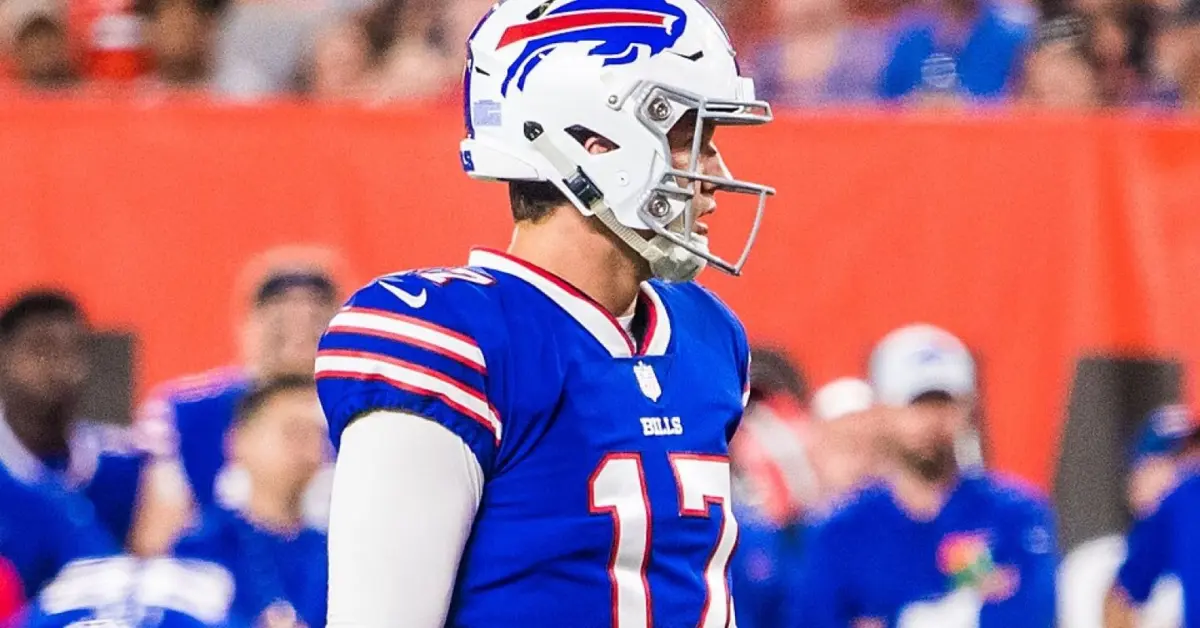
BUFFALO, N.Y. — At a solemn local wedding or a quiet funeral in upstate New York, you will search in vain for mourners or celebrants dressed in the royal blue jersey emblazoned with the number 17. Yet, step just a few feet outside those somber doors, and a different reality takes hold.
In neighborhood supermarkets, crowded sports bars, suburban cul-de-sacs, and even inside corporate boardrooms on casual Fridays, the omnipresence of Josh Allen’s jersey acts as a uniform of civic religion. Fans honor the Buffalo Bills quarterback not merely by watching him on Sundays, but by wearing his name on pullovers, hoodies, t-shirts, and coffee mugs. They celebrate his stellar performances as if they were personal triumphs, cheering his prospects with one unified, collective voice.
As the autumn air cools and another NFL season kicks off, the prevailing sentiment across the region is simple, ecstatic, and communal: We are winning, and we are doing it spectacularly.
Main Facts: The Science of Shared Glory
This casual use of the first-person plural pronoun—claiming ownership over the athletic exploits of multimillion-dollar professionals—is one of the most powerful and enduring psychological phenomena in modern culture.
Fifty years ago, a young social psychologist named Robert B. Cialdini, alongside his academic colleagues, set out to investigate the underlying emotional mechanics of sports fandom. What they discovered fundamentally changed how behavioral scientists view identity, ego, and group association.
Cialdini and his team observed that human beings possess a deep-seated psychological drive to personally associate themselves with a successful entity, even when they have had zero direct input or control over that success. While a roaring stadium crowd might generate a tangible "home-field advantage" by drowning out an opposing quarterback’s snap count, no spectator in the stands gets to throw a 50-yard touchdown pass. No fan sitting in a living room recliner will leap into the secondary to secure a game-changing interception.
Despite this absolute disconnect in agency, devotees proudly and intensely bask in the reflected glory of their team’s victories.
On the Monday morning following a hometown win, workplaces and coffee shops are noticeably more buoyant. Conversations naturally drift into tactical assessments framed around collective ownership: We looked sharp on offense, didn’t we? Our defense executed the blitz package flawlessly. We stayed resilient on crucial third-down conversions.
To describe this psychological reflex, sports psychologists coined a precise acronym: BIRG-ing, which stands for "basking in reflective glory."
Chronology: Half a Century of Studying the Fan Psyche
To understand how BIRG-ing operates in the wild, it is helpful to look back at the foundational field experiments conducted by Cialdini and his research team exactly fifty years ago. Their groundbreaking work was executed in three distinct phases, moving from obvious behavioral displays to much subtler psychological maneuvers.
Phase One: The Apparel Audit
The first phase of the research was straightforward and observational. Investigators tracked how often university students wore apparel bearing their school’s name and insignia on regular campus days. The results were entirely predictable: following a major weekend athletic victory, university-branded sweatshirts and jackets appeared in significantly higher numbers across campus compared to Mondays following a heartbreaking loss. The clothes acted as an immediate, visible billboard for collective triumph.
Phase Two and Three: The Linguistic Shift
The subsequent field trials yielded far more nuanced and fascinating data. Researchers noted that when students discussed a victorious game, they systematically altered their linguistic habits. They personalized the team dynamic, dramatically increasing their use of the first-person plural ("we," "us," "our") when speaking about a win.
Conversely, when discussing a loss, the same students instinctively pivoted to the third-person plural ("they," "them").
Cialdini’s team concluded that this linguistic sleight-of-hand served a distinct psychological purpose: to enhance and protect the speaker’s public image. By saying "we won," the student was subtly borrowing the prestige, competence, and success of the athletes on the field, applying those positive attributes to their own self-esteem. As the researchers noted, a simple affiliation proved to be more than enough impetus for everyday citizens to trumpet success and publish their swelling pride—pride that frequently crossed the line into unabashed gloating.
Supporting Data: The Dividends of Communal Identity
While the psychological mechanics of fandom might occasionally look amusing from an objective standpoint—particularly given that fans are taking emotional credit for physical labor executed by others—the social dividends of this shared devotion are profound.
The Power of Communitas
Sociologist and play theorist Thomas Henricks describes the unique feeling of equalizing togetherness generated by sports as communitas. In an era marked by deep political polarization and societal fragmentation engineered to keep populations divided, sports carve out a rare, non-partisan circle of shared spirit. This communal passion gathers individuals together and bolsters their emotional resilience.
Even families separated by geography find themselves tethered by the ritual of the game. A Sunday afternoon brings far-flung relatives together over FaceTime during halftime, bridging geographic divides through mutual devotion to a common cause.
Resilience and the Buffalo Tradition
In regions like Western New York, fandom is more than a pastime; it is a masterclass in resilience. Fans who routinely weather brutal lake-effect winter whiteouts and heartbreaking on-field losses understand that sports serve as an analog for life’s broader hardships. When a Bills fan shouts "Go Bills!", the phrase often carries a deeper, unspoken subtext: We’re hanging in there, and we will weather the storm.
This deep-rooted loyalty is not universal across the sporting landscape. While some franchises see ticket sales plummet the moment a team drops below a .500 record—such as in historically transient sports markets like Los Angeles, Miami, or Phoenix—other fan bases exhibit legendary, generational patience.
The Cleveland Browns famously packed their stadium’s end zones with body-painted zealots known as the "Dog Pound" through decades of dismal seasons. Similarly, despite enduring four consecutive Super Bowl losses in the early 1990s followed by an agonizing 17-season playoff drought, the fan base of the Buffalo Bills never wavered, maintaining an ironclad, intergenerational loyalty that astonished sports observers nationwide.
Implications: When "We" Suddenly Becomes "They"
Just as psychologists documented the sunny, optimistic phenomenon of BIRG-ing, they also uncovered its dark, defensive counterpart. When a team’s fortunes sour, fans employ a psychological defense mechanism known as CORF-ing, or "cutting off reflective failure."
Former, fair-weather, or deeply protective fans will aggressively distance themselves from a chronically losing franchise to shield their egos from association with failure. The yard signs are pulled from the lawn, the team jerseys are shoved back into the darkest corners of the dresser, and the novelty buttons are swept into junk drawers alongside unlabeled keys and expired grocery coupons.
Tellingly, this defensive distancing is immediately reflected in speech patterns. When a team enters a prolonged losing streak, the linguistic landscape of the fan base undergoes a radical transformation.
- We played poorly transforms into They played poorly.
- We couldn’t convert third downs becomes They choked under pressure.
- We missed our assignments turns into They couldn’t defend the pass rush.
Generosity, patience, and forbearance drain away like water through a sieve. The collective ego refuses to accept shared blame; instead, the fans cast off the struggling players, turning "us" back into "them."
The Stakes: Pride Versus Shame
Ultimately, sports psychology reveals that these linguistic and behavioral gymnastics are rooted in the most fundamental human need for self-esteem. For the dedicated sports fan, the psychological polar opposites are not simple humility and pride. Rather, the true binary battle playing out in living rooms and sports bars across the country is waged between pride and deep, searing shame.
Whether basking in the brilliant, reflective glow of a championship contender or swiftly cutting ties with a sinking ship, fans are simply navigating the eternal human quest for belonging, meaning, and self-worth through the proxy of a game.