HONOLULU — Beneath the swaying palms, the crashing Pacific surf, and the sweet, lingering scent of blooming plumeria lies a realm where the boundary between the physical world and the supernatural dissolves entirely. Hawaii is globally celebrated for its breathtaking vistas, pristine beaches, and vibrant tourism industry, but beneath its postcard-perfect surface pulses a deeply rooted, ancient spiritual landscape. Hawaiian mythology is not merely a collection of dusty campfire tales; it is a living, breathing framework that explains the creation of the islands, dictates traditional ecological stewardship, and continues to influence the daily lives of residents and visitors alike.
From the volatile, creative fury of Pele, the goddess of volcanoes, to the industrious, nocturnal whispering of the Menehune, the folklore of the Aloha State binds humanity to the natural elements in a profound tapestry of respect, fear, and wonder. As modern development intersects with indigenous traditions, anthropologists, cultural practitioners, and folklorists are increasingly documenting how these ancient narratives shape contemporary Hawaiian identity and paranormal tourism.
Main Facts: The Pantheon and Paranormal Entities of the Islands
Hawaiian folklore is populated by a diverse hierarchy of supernatural beings, categorized broadly into gods (akua), demigods (kapua or kupua), elemental guardians, and restless ancestral spirits. Unlike Western mythologies where the supernatural is confined to abstract heavens or hells, Hawaiian myth treats the environment itself as divine and sentient.
The Divine and Demigod Figures
- Pele (Goddess of Volcanoes): Undeniably the most famous and culturally revered figure in Hawaiian tradition, Pele represents both creation and destruction. Believed to make her eternal home within the Halemaʻumaʻu crater of the Kīlauea volcano on the Big Island, Pele commands the molten fury of the earth. Even in the 21st century, park rangers and locals routinely report encounters with an enigmatic elderly woman hitchhiking along island roads—traditionally interpreted as a manifestation of Pele testing the hospitality of travelers.
- Maui (The Shapeshifting Trickster): Renowned across Polynesia, the demigod Maui is celebrated for his daring exploits. In Hawaiian lore, he is best remembered for assisting his mother, Hina, by slowing the journey of the sun across the sky to grant humanity longer daylight hours for agriculture and kapa (bark cloth) making.
- Kamapuaʻa (The Hog Child): A tempestuous demigod associated with agriculture, fertility, and wild boars, Kamapuaʻa is famous for his shapeshifting abilities and his famously volatile relationship with Pele. Their legendary clashes mirror the destructive yet fertile marriage of volcanic fire and raw earth.
Elemental Guardians and Hidden Peoples
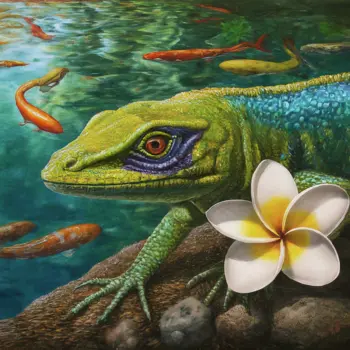
- Moʻo (Guardian Lizard Spirits): These powerful shapeshifters can manifest as standard lizards, giant eels, or terrifying aquatic dragons. Acting as the sentinels of freshwater springs, ancient fishponds, and deep ocean currents, Moʻo hold dominion over the islands’ precious water supplies. Traditional protocol dictates that travelers show deep reverence when passing fresh water sources to avoid invoking the wrath of a guardian Moʻo.
- Menehune (The Master Builders): Standing only two to three feet tall, these elusive, dwarf-like people are credited in legend with constructing massive stone temples (heiau), complex agricultural terraces, and fishponds across the islands overnight. According to lore, they worked exclusively under the cover of darkness and vanished before the first light of dawn, symbolizing the mysterious engineering feats of ancient Hawaiian civilization.
The Spectral Realm: Akua and Huakaʻi Pō
- Akua (Spirits and Ancestors): A blanket term for spiritual entities, akua range from benevolent ancestral protectors to mischievous or malevolent tricksters.
- Huakaʻi Pō (The Night Marchers): Perhaps the most chilling paranormal phenomenon in Hawaii, the Night Marchers are the ghosts of ancient warriors bound to eternal patrol. Witnesses report hearing the ominous beating of shark-skin drums, heavy chanting, and the flickering light of spectral torches moving in single file through the dense tropical foliage. Local tradition dictates that stepping into their path or failing to show proper respect invites severe misfortune or death, leading many residents to strictly heed warnings to stay indoors when the night chants begin.
Chronology: From Ancient Oral Traditions to Modern Encounters
To understand the trajectory of Hawaiian mythology is to trace the history of the islands themselves—from pre-contact Polynesian voyaging to Western contact, suppression, and modern cultural renaissance.

- Pre-Contact Era (Circa 400 AD – 1778): Polynesian voyagers arrive in the Hawaiian Islands, bringing with them an oral tradition rich in genealogy, navigational history, and cosmological tales. Mythology serves as the foundational legal, ecological, and spiritual system (kapu system) governing resource management, social hierarchy, and human interaction with the environment.
- The 19th Century (Post-Contact and Suppression): Following the arrival of Captain James Cook in 1778 and the subsequent arrival of Christian missionaries in 1820, the traditional kapu system is officially overthrown (1819). While public practice of indigenous religion is suppressed, oral histories are preserved by Hawaiian scholars who begin transcribing chants and legends into written form, ensuring the survival of figures like Pele and Maui for future generations.
- The Hawaiian Renaissance (1970s – Present): A massive cultural revival sweeps the islands, sparking renewed pride in the Hawaiian language (ʻŌlelo Hawaiʻi), traditional navigation, hula, and ancestral mythology. Cultural practitioners re-establish sacred sites, and oral histories are integrated into modern educational curricula.
- The 21st Century (Digital Folklore and Paranormal Tourism): Mythology enters the digital age via internet archives, cultural documentaries, and paranormal reality television. Sightings of Pele, encounters with the Night Marchers, and strange occurrences around sacred archaeological sites continue to be reported, cementing Hawaii’s reputation as a globally unique nexus of natural beauty and unexplained phenomena.
Supporting Data: Cultural Impact and Tourism Metrics
The intersection of Hawaiian mythology, environmental conservation, and tourism generates significant economic and cultural data across the archipelago:
- Cultural Heritage Tourism: According to the Hawaiʻi Tourism Authority (HTA), millions of travelers visit the islands annually, with an increasing percentage engaging in cultural education tours that highlight ancient heiau, agricultural fishponds, and moʻolelo (storytelling).
- Volcano National Park Visits: Hawaiʻi Volcanoes National Park on the Big Island routinely draws over 1.5 million visitors annually. Many arrive not only to witness active geological wonders at Kīlauea but also to experience the spiritual weight of Pele’s domain. National Park Service rangers frequently field letters and returned lava rocks from tourists who experienced inexplicable bad luck ("Pele’s Curse") and mailed stolen volcanic stones back to the park out of remorse.
- Preservation Efforts: More than 100 ancient fishponds and dozens of major heiau complexes are actively managed, restored, or studied by state agencies, native Hawaiian organizations, and academic institutions, ensuring that the physical legacy of the Menehune and early builders remains intact for scientific and spiritual analysis.
Official Responses and Perspectives
The coexistence of modern scientific inquiry and ancient spiritual belief systems in Hawaii requires a delicate balance between public safety, historical preservation, and indigenous rights.
National Park Service and State Authorities
Park rangers and emergency services in Hawaii frequently address situations where folklore intersects with modern tourism. When Kīlauea erupts, officials issue standard geological safety warnings regarding sulfur dioxide gas and unstable terrain, but they also remain sensitive to cultural protocols. Hawaiian cultural practitioners are routinely consulted during volcanic activity to perform traditional chants (oli) and offerings (hōkupu) to Pele, acknowledging the deep spiritual significance of the event for Native Hawaiians.
Furthermore, state officials actively discourage the removal of natural elements—such as sand, coral, and lava rocks—not only to preserve the delicate ecosystem but also out of respect for the spiritual boundaries set by traditional beliefs regarding guardians like the Moʻo and Pele.

Cultural Practitioners and Historians
Native Hawaiian elders (kūpuna) and cultural educators emphasize that these myths are historical archives disguised as stories.
"Our legends are maps of our environment," explains a cultural practitioner based in Hilo. "When we talk about the Moʻo guarding the freshwater spring, we are teaching our children not to pollute the water. When we talk about the discipline of the Night Marchers, we are teaching respect for our ancestors and the night. These stories kept our island ecosystem alive and balanced for a thousand years."
Implications: Preserving the Sacred in a Modernizing World
As the Hawaiian Islands face contemporary challenges—ranging from over-tourism and commercial development to the existential threat of climate change—the lessons embedded within Hawaiian mythology carry profound modern implications.
- Environmental Stewardship: The personification of natural elements (volcanoes as Pele, water sources as Moʻo) fosters a deep-seated ecological ethic. In an era of global environmental crisis, the indigenous Hawaiian worldview offers a sustainable model for treating the earth as a living relative rather than a resource to be exploited.
- Cultural Sovereignty and Respect: The commercialization of Hawaiian folklore by mainland media and ghost-hunting television shows occasionally risks reducing sacred ancestral beliefs to cheap entertainment. Cultural advocates continuously push for respectful representation, ensuring that visitors understand the difference between sensationalized ghost stories and the deeply sacred akua and Huakaʻi Pō of Hawaiian cosmology.
- The Unseen Allure: Ultimately, the paranormal landscape of Hawaii adds an intangible dimension to the island experience. Whether one approaches the tales of the Menehune, Maui, and Pele through the lens of strict skepticism or profound spiritual belief, the presence of these ancient narratives ensures that Hawaii remains one of the most culturally enchanting places on Earth.
As the sun sets over the Pacific, casting long shadows across volcanic craters and ancient stone temples, the whispered warnings of the elders remain timeless: Keep your eyes open, listen closely to the wind in the plumeria trees, and always show respect to the unseen forces that share the land.