





Introduction: The Phantom of the British Countryside
Few modern British legends evoke the same blend of rural dread, cryptozoological fascination, and persistent mystery as the Beast of Exmoor. Spanning the rugged, windswept terrain of Somerset and Devon in southwest England, this elusive apex predator has haunted the local imagination for over half a century. Described by terrified witnesses as a massive, panther-like feline capable of astonishing leaps and devastating livestock slaughters, the Beast occupies a strange middle ground between folklore and reality.
While skepticism remains high among zoologists and government officials, the sheer volume of anecdotal evidence, coupled with unexplained livestock mutilations and intermittent footprints found in the mud, keeps the legend alive. To understand the Beast of Exmoor is to examine the intersection of modern wildlife ecology, rural folklore, and the human compulsion to find the extraordinary hiding just beyond the treeline.
Main Facts: Anatomy of a Cryptid
The Beast of Exmoor is not a monolithic figure in cryptozoology; rather, it is defined by a consistent set of characteristics reported by diverse witnesses across decades.
Physical Description
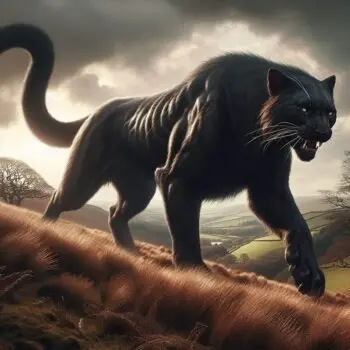
According to those who claim to have locked eyes with the creature, the Beast is an imposing specimen. Witnesses frequently describe it as:
- Size and Build: A massive feline roughly resembling a cross between a panther and a puma. It is reported to measure anywhere from five to over seven feet in length from nose to tail tip.
- Coat: Predominantly jet-black, though some witnesses have reported dark brown or tawny shades depending on the lighting conditions. Its coat is described as sleek and short.
- Behavior: When hunting or moving across the open moorland, the creature is noted for keeping remarkably low to the ground, utilizing heather and gorse for cover before executing explosive bounds.
Geographical Range
The epicenter of the sightings is the Exmoor National Park, a region characterized by expansive open moorlands, deep wooded river valleys, and dramatic coastal cliffs. However, sightings have radiated outward into surrounding farming communities in both Somerset and Devon, most notably around the market town of South Molton.
The Prey
Unlike purely mythical creatures that exist only to frighten children, the Beast of Exmoor has a documented economic and physical impact. The creature is frequently blamed for the violent deaths of sheep, lambs, and occasionally larger farm animals. Unlike attacks by foxes or domestic dogs—which tend to leave ragged wounds and scattered remains—witnesses and farmers have often reported livestock killed with precision bites to the throat or neck, bearing the unmistakable signature of a large, specialized feline predator.
Chronology: A History of Encounters
The timeline of the Beast of Exmoor is marked by decades of sporadic panic, intensive media coverage, and fleeting moments of apparent validation.
The 1970s: The First Whispers
While rural communities have always whispered of strange beasts in the dark, the modern era of the Beast of Exmoor began in the 1970s. As rural populations shifted and outdoor recreation increased, hikers and farmers began reporting brief, startling glimpses of a large black cat darting across country lanes or vanishing into the dense fog of the moors. At the time, these reports were largely dismissed as misidentified domestic cats, dogs, or optical illusions caused by the shifting moorland mists.
1983: The South Molton Massacre
The legend transformed from a local curiosity into a national media sensation in 1983. A farmer in South Molton, Devonshire, suffered a catastrophic loss: over 100 sheep died under mysterious circumstances over the course of just two and a half months. The carcasses displayed wounds inconsistent with typical predator attacks.
The ensuing panic was swift. The British media descended upon Exmoor, dubbing the phantom animal "The Beast of Exmoor." Public pressure mounted to such a degree that the British government authorized the deployment of the Royal Marines to track and neutralize the creature. Armed with thermal imaging and standard-issue weaponry, the elite soldiers scoured the rugged terrain. Ultimately, the Marines found no definitive trace of the beast, but the military intervention cemented the creature’s status in British cultural history.
The 1990s and 2000s: Renewed Sightings and Media Fascination
Throughout the 1990s, sightings continued in waves. In 1995, a farmer reported seeing a creature he positively identified as a leopard stalk across a field, leading to another flurry of police investigations and media stakeouts.
As television documentary teams turned their lenses toward cryptozoology in the 2000s, the Beast of Exmoor enjoyed international attention. Programs such as MonsterQuest traveled to Somerset and Devon to interview witnesses, analyze plaster casts of footprints, and evaluate the plausibility of a surviving population of non-native big cats roaming the British Isles.
Supporting Data and Evidence
Skeptics often demand hard physical proof, and in the case of the Beast of Exmoor, tangible evidence has always been notoriously difficult to secure. However, several pieces of data and forensic clues continue to fuel the debate.
Livestock Mortality Patterns
Agricultural data from the region reveals a consistent baseline of unexplained livestock losses. While foxes and feral dogs account for the vast majority of sheep deaths, local vets and agricultural inspectors have occasionally documented wounds that defy standard categorization—specifically, crushed windpipes and clean puncture wounds spaced too far apart for any native British canine or mustelid.
Non-Standard Footprints
Over the years, farmers and hikers have discovered large, pad-marked tracks in soft mud and snow across Exmoor. Casts taken of these prints often measure between four and five inches in width—significantly larger than any domestic dog or native wild animal, closely matching the paw morphology of a large felid, such as a puma or leopard.
The Exotic Pet Trade Context
To understand the scientific plausibility of the Beast of Exmoor, one must look at the legal and historical context of exotic animal ownership in the United Kingdom. Prior to the passage of the Dangerous Wild Animals Act of 1976, British citizens could legally purchase and keep exotic pets—including pumas, leopards, and lynxes—with relative ease.
When the 1976 legislation went into effect, imposing strict licensing fees, enclosures, and safety regulations, many owners were faced with a difficult choice: surrender their expensive, dangerous pets to zoos that were often reluctant to take them, or quietly release them into the wild. Cryptozoologists argue that numerous big cats were freed into the wild across the UK, specifically in remote areas like Exmoor, where an abundance of sheep provided an easy food source.
Official Responses and Scientific Analysis
The official stance of government bodies, wildlife authorities, and mainstream zoologists remains grounded in biological possibility rather than cryptozoological myth.
The Ministry of Defence and Police Response
The 1983 deployment of the Royal Marines remains one of the most unusual official responses to a wildlife mystery in modern British history. While the Ministry of Defence participated in the operation as an exercise in tracking and reconnaissance at the request of local authorities, the official conclusion was inconclusive. Local police forces have similarly responded to dozens of sightings over the decades, often treating them as genuine public safety concerns in the moment, but ultimately closing files due to a lack of physical specimens.
The Zoological Perspective
Mainstream biologists and zoologists take a nuanced view of the Beast of Exmoor phenomenon. Most experts agree on two key points:
- The Escapees are Real: It is entirely historically plausible that exotic cats were released into the British countryside following the 1976 legislation.
- Long-Term Survival is Unlikely: While individual big cats could theoretically survive for several years in the wild by preying on abundant sheep populations, population biologists argue that a sustained, breeding population of large felines on Exmoor is statistically improbable. Without a viable breeding pool, any released animals would have died off decades ago due to old age, disease, or harsh winters.
Despite this, anomalous individual sightings continue to occur long past the natural lifespan of a cat released in the 1970s, keeping the mystery alive and prompting alternative theories—ranging from escaped hybrids to persistent urban legends.
Implications: Folklore, Tourism, and Rural Identity
The enduring presence of the Beast of Exmoor carries significant cultural, economic, and psychological implications for the communities of Somerset and Devon.
Tourism and Local Economy
Rather than driving visitors away, the legend of the Beast has become a valuable economic asset for the region. Exmoor National Park embraces its mysterious reputation. Local pubs, bed-and-breakfasts, and gift shops frequently feature the silhouette of a black panther in their branding. Cryptozoology enthusiasts, paranormal investigators, and curious tourists visit the moors every year hoping to catch a glimpse of the shadow cat, injecting vital revenue into rural communities.
The Psychological Landscape of the Moor
The legend also speaks to humanity’s deep-seated relationship with the wild. In a heavily industrialized and densely populated island nation like the United Kingdom, true wilderness is rare. The Exmoor moors, with their vast open skies, sudden fog banks, and desolate valleys, offer a rare space where the imagination can roam free. The Beast serves as a physical manifestation of nature’s untamable power—a reminder that despite centuries of human civilization, agriculture, and enclosure, there are still dark corners of the landscape where humanity is not entirely in control.
Conclusion
Whether the Beast of Exmoor is a surviving exotic cat, a succession of feral felines, a misidentified domestic animal, or purely a modern myth born of rural isolation and media sensationalism, its cultural footprint is undeniable. For over fifty years, it has captured the public imagination, bridging the gap between scientific inquiry and ancient folklore. As long as the mist rolls across the heather-clad hills of Somerset and Devon, people will look out across the dark landscape and wonder what is watching them from the shadows.