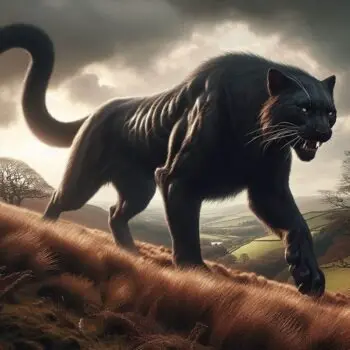
EXMOOR, England — Across the windswept expanse of the West Country, where the rugged moorlands of Devon and Somerset blur into an undulating sea of heather and gorse, a phantom has haunted the rural imagination for half a century. To local farmers, it is a costly and terrifying nuisance; to cryptozoologists, it is the quintessential modern British mystery; and to folklorists, it is a living ghost born from the marriage of isolation and the human desire for the extraordinary.
Known simply as the Beast of Exmoor, this elusive predator has occupied a peculiar space in British culture since the 1970s. Described variously as a panther, a puma, or a monstrous hybrid of both, the creature is said to stalk the foggy valleys and desolate ridges, leaving a trail of terrified livestock, shattered fences, and unanswered questions in its wake.
Despite decades of government inquiries, eyewitness accounts, military sweeps, and media frenzies, the true nature of the Beast of Exmoor remains as obscured by mist as the valleys it allegedly calls home.
Main Facts: Anatomy of a Phantom
To understand the enduring fascination with the Beast of Exmoor, one must examine the consistent profile constructed by those who claim to have crossed its path. Unlike the Loch Ness Monster, whose aquatic habitat shields it from direct confrontation, the Beast of Exmoor operates in a landscape shared intimately by humans, livestock, and domestic pets.
According to decades of accumulated witness testimony, the creature possesses a striking and uniform physical description:
- Size and Build: Eyewitnesses frequently report a massive feline measuring between five and eight feet in length from nose to tail tip. It is often described as remarkably muscular, standing low to the ground when stalking, yet capable of remarkable bursts of speed and vertical leaps.
- Coloration and Coat: The creature is almost universally described as having a sleek, jet-black or dark grey coat, though rare accounts mention tawny or brownish hues reminiscent of a mountain lion.
- Behavior: Observers note its preternatural stealth and agility. Unlike domestic dogs or foxes, the Beast is said to move with the fluid, calculated grace of an apex predator.
The primary evidence linking this phantom cat to the physical world has always been its purported diet. The Exmoor region is predominantly agricultural, dotted with sheep farms and cattle ranches. Since the height of the panic in the 1980s, farmers have reported gruesome and highly unusual livestock deaths. Unlike kills made by foxes or domestic dogs—which tend to be messy and indiscriminate—the Beast is frequently blamed for precision kills: clean throat punctures, precise feeding patterns on the hindquarters, and, most disturbingly, instances where sheep were found cleanly killed with no apparent consumption, suggesting the behavior of a young or exploratory predator practicing its hunting techniques.
Chronology: A Timeline of Terror and Sightings
The legend of the Beast of Exmoor did not materialize overnight; it evolved through a distinct historical timeline marked by periods of intense panic, investigative lulls, and sudden resurgences.
The Pre-1970s Whispers
While mass panic did not set in until the late 20th century, scattered local legends of large cats roaming the British countryside date back centuries. However, modern sightings in the Exmoor region began to trickle in during the late 1960s and early 1970s, coinciding with a wave of exotic pet ownership in the United Kingdom and the passage of the Dangerous Wild Animals Act of 1976, which many believe prompted illegal releases of captive big cats.
The 1983 South Molton Massacre
The defining moment of the Exmoor mythos occurred between April and June 1983, centered around the rural town of South Molton in Devon. In the span of just two and a half months, a local farmer suffered the catastrophic loss of over 100 sheep. The carcasses displayed injuries unlike anything local veterinarians had encountered. The scale and brutality of the losses galvanized the local community and attracted nationwide media attention, cementing the "Beast of Exmoor" in the national lexicon.
The 1990s Resurgence and Military Involvement
As sightings continued through the late 1980s and 1990s, public pressure mounted for an official response. The situation reached a boiling point in 1995 when a farmer near North Molton reported the slaughter of nearly 35 sheep in a single week. The cluster of attacks prompted unprecedented action, leading to official reconnaissance efforts involving the Royal Marines and local marksmen dispatched to comb the moors. Though no animal was captured or shot, the deployment added an air of official gravity to what many had previously dismissed as rural folklore.
The 21st-Century Persistence
Entering the 2000s and beyond, the frequency of dramatic livestock slaughters declined, yet sporadic eyewitness accounts persisted. Hikers, motorists, and landowners continued to report fleeting glimpses of a large black cat crossing rural roads or vanishing into the mist-shrouded combes of Devon and Somerset. The advent of digital media and trail cameras in the 21st century has brought a new wave of blurry photographs and speculative video footage, keeping the legend alive for a new generation.
Supporting Data: Scientific Realities vs. Folklore
When investigating a cryptid like the Beast of Exmoor, researchers must balance human testimony against hard ecological and biological data. The scientific community has long grappled with the question: Could a population of big cats survive undetected in the British countryside?
The Ecological Perspective
Zoologists and wildlife biologists generally view permanent populations of large, non-native felines in Britain as highly improbable. To maintain a viable breeding population, an animal species requires a sufficient gene pool, an adequate and steady food supply, and protection from human encroachment. While Exmoor offers vast tracts of uninhabited moorland and an abundance of deer and livestock, the region is also crisscrossed by roads, farms, and tourist trails.
Furthermore, big cats such as pumas (Puma concolor) or leopards (Panthera pardus) have finite lifespans—typically 10 to 15 years in the wild. For sightings to continue reliably over a span of 50 years, the original escapees or released pets would have had to successfully breed over multiple generations, turning a handful of isolated incidents into a localized invasive species. To date, no definitive scat, hair sample, DNA evidence, roadkill carcass, or skeletal remains of a non-native big cat have ever been officially recovered from Exmoor.
The Domestic and Feral Cat Phenomenon
A more grounded explanation favored by skeptics and wildlife experts is the phenomenon of misidentification. Britain is home to a robust population of large feral domestic cats, some of which can grow to impressive sizes when granted access to abundant rural food sources. When viewed from a distance, in poor lighting, or across a misty moor, an oversized domestic tabby or a feral farm cat can easily be exaggerated by the human mind into a panther-sized predator—a psychological process known as paramnesia or size distortion fueled by cultural expectation.
The Exotic Pet Trade Hypothesis
Conversely, cryptozoologists and independent researchers point to the historical reality of the British exotic pet trade prior to the 1976 legislation. Before strict licensing was introduced, it was surprisingly easy for wealthy individuals to purchase panther, puma, or lynx cubs. When these animals grew too large, dangerous, or expensive to maintain, it is widely theorized that owners quietly released them into remote areas like Exmoor or Dartmoor rather than surrendering them to authorities where they might face euthanasia or expose illegal ownership. While some of these animals likely succumbed to the British winter, starvation, or vehicular collisions shortly after release, enthusiasts argue that a hardened few could have adapted, living out solitary, long lives as rogue apex predators.
Official Responses: Government Action and Public Inquiry
The government response to the Beast of Exmoor has historically oscillated between cautious investigation and polite skepticism, reflecting the difficulty of allocating public resources to what is largely perceived as a folkloric phenomenon.
During the height of the 1983 panic, local agricultural ministries and police forces investigated the sheep deaths. While veterinarians confirmed that the wounds were inflicted by a canine or feline predator rather than disease or environmental hazards, officials stopped short of officially confirming the presence of an exotic big cat.
The most significant official intervention occurred in 1995, when the Ministry of Agriculture, Fisheries and Food (MAFF)—responding to intense political lobbying from local Members of Parliament and distressed farmers—authorized a formal investigation. Royal Marines stationed nearby were deployed to sweep the terrain using thermal imaging and night-vision equipment. Despite combing the rugged hills and valleys, the military operation yielded no physical trace of the creature.
Official statements from agencies like Natural England and local police forces generally maintain a pragmatic stance: while authorities acknowledge that the public may occasionally spot escaped exotic pets or large feral animals, there is no credible, verifiable evidence of a breeding population of wild panthers or pumas roaming the British Isles. Officials routinely advise farmers to secure their livestock against standard predators and encourage anyone who sights an unusual animal to report it immediately, though such calls rarely result in physical confirmation.
Implications: Cultural Legacy and Modern Myth-Making
The enduring endurance of the Beast of Exmoor transcends mere zoological curiosity; it touches upon profound aspects of modern psychology, rural sociology, and cultural anthropology.
The Psychology of the Unknown
In an increasingly interconnected, mapped, and digitized world where satellite imagery can pinpoint almost any square foot of the globe, human beings retain a psychological hunger for mystery. The moors of Exmoor—with their brooding topography, prehistoric barrows, and unpredictable weather—serve as a natural canvas for the uncanny. The Beast represents the untamable wilderness pushing back against the encroaching boundaries of civilization. It is a reminder that despite human dominion over nature, dark, hidden things still lurk just beyond the perimeter fence.
Economic and Cultural Impact on the Region
Locally, the Beast of Exmoor has transformed from a genuine agricultural threat into a unique cultural asset. While farmers in the 1980s suffered devastating financial losses, contemporary Exmoor has embraced its mysterious reputation. Pubs, bed-and-breakfasts, and local tour operators frequently reference the Beast in marketing materials, drawing tourists, paranormal enthusiasts, and cryptozoology buffs eager to explore the atmospheric landscapes where the phantom cat was supposedly sighted.
Media explorations—ranging from television documentaries like MonsterQuest to countless podcasts, books, and digital deep-dives—ensure that the legend remains vibrant. Every generation reinterprets the story through the lens of contemporary media, transitioning from newspaper clippings in the 1980s to viral internet forums, AI-generated artistic renderings, and high-definition trail camera debates today.
Conclusion: A Mystery That Refuses to Fade
Whether the Beast of Exmoor is a literal panther surviving against all ecological odds, a series of exaggerated encounters with oversized feral cats, or a collective psychological projection born of mist and folklore, its place in British history is secure. It bridges the gap between the ancient mythology of dragons and phantom hounds and the modern reality of ecological anxiety and the exotic pet trade.
As long as the mist rolls in over the valleys of Somerset and Devon, and as long as farmers tend their flocks against the gathering dusk, the shadow of the Beast of Exmoor will continue to loom large—a testament to humanity’s enduring fascination with the things that go bump in the night.