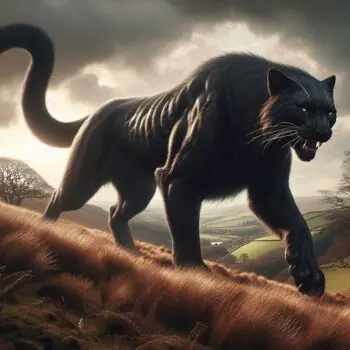
EXMOOR, England — For more than half a century, the rugged, windswept expanse of the West Country has played host to a phantom. Stretching across the borderlands of Somerset and Devon, the heather-clad hills and deep coombes of Exmoor are traditionally celebrated for their wild ponies, serene landscapes, and rich literary heritage. Yet, beneath the picturesque surface lies a persistent and unsettling legend—one that has haunted local farmers, terrified holidaymakers, and confounded zoologists since the 1970s.
Known simply as the Beast of Exmoor, this elusive predator is said to prowl the mist-shrouded moors under the cover of darkness. Described by eyewitnesses as a massive, panther-like creature capable of astonishing athleticism, the beast occupies a liminal space between folklore and reality. While skeptics dismiss it as a combination of misidentified domestic animals, escaped exotic pets, and rural hysteria, the sheer volume of detailed testimonies—coupled with unexplained livestock mutilations—keeps the legend vibrantly, hauntingly alive.
Main Facts: Anatomy of a Phantom
To understand the enduring grip of the Beast of Exmoor on the public consciousness, one must examine the consistent profile constructed by those who claim to have crossed its path. Unlike fleeting glimpses of mythological creatures, the descriptions of the Exmoor big cat share striking anatomical and behavioral similarities across decades of reporting.
Physical Characteristics
Eyewitness accounts typically characterize the beast as a feline hybrid bearing the physical traits of both a panther and a puma. Observers frequently note the following features:
- Size and Scale: The creature is consistently described as alarmingly large, often reported to measure upwards of seven feet from the tip of its nose to the base of its tail.
- Coat and Build: It is typically described as sleek, muscular, and jet-black, though some witnesses have reported dark brown or tawny variations. When hunting or moving through open terrain, it is noted for hugging the ground with a low, predatory slink.
- Agility and Strength: Witnesses emphasize its extraordinary leaping ability, with reports of the creature clearing high dry-stone walls and barbed-wire fences with effortless grace.
The Epicenter of the Legend
The primary theater of operations for the beast spans the vast, sparsely populated uplands of Exmoor National Park, spilling into surrounding agricultural communities. Areas such as South Molton in Devonshire have long served as the focal point for the most dramatic and economically devastating encounters. Here, the boundary between manicured farmland and untamed wilderness blurs, creating an ideal hunting ground for an apex predator operating outside the bounds of known local wildlife.
Chronology of Terror: A Timeline of Sightings and Incidents
The history of the Beast of Exmoor is marked by waves of heightened panic, punctuated by quiet periods where the creature seemingly vanishes into the mist before striking again.
The 1970s: The Genesis of a Legend
While sporadic reports of large, unidentified cats in the British countryside date back to the early 20th century, the specific legend of the Beast of Exmoor crystallized in the late 1970s. As rural populations shifted and local newspapers began aggregating odd animal sightings, farmers in Somerset began reporting strange, unidentifiable losses among their flocks. These early accounts were largely dismissed as the work of stray dogs or urban legends, but the atmosphere changed dramatically as the decade turned.
1983: The South Molton Massacre
The defining moment of the Beast of Exmoor phenomenon occurred between late 1982 and early 1983. In the farming community of South Molton, Devonshire, a local farmer suffered an unprecedented and catastrophic loss: more than 100 sheep were found dead over a span of just two and a half months.
The nature of the kills horrified agricultural workers. Unlike the chaotic carnage typically left by packs of feral dogs, which often maim multiple animals without killing them efficiently, these sheep bore the distinct hallmarks of a large, solitary ambush predator. Many carcasses exhibited clean, crushing bites to the neck or throat, and several animals appeared to have been dragged significant distances or hoisted over stone walls. The scale and precision of the slaughter galvanized local media and brought the "Beast of Exmoor" into the national spotlight.
The 1990s to Present: Continued Encounters and Evolving Lore
As the decades progressed, sightings did not abate. Throughout the 1990s and 2000s, ramblers, motorists, and landowners reported brief, heart-stopping encounters with a large black cat darting across rural roads or standing sentinel on distant ridges.
Crucially, the timeline of these sightings presents a profound biological conundrum. If the original beast was an exotic pet released or escaped following the passage of the Dangerous Wild Animals Act 1976, standard feline lifespans dictate that the original animal would have perished decades ago. Consequently, cryptozoologists and enthusiasts argue that if the sightings are genuine, a breeding population of large, stealthy felines must be successfully surviving and reproducing undetected in the British countryside.
Supporting Data and Evidence: Clues in the Mist
For decades, investigators—ranging from amateur cryptozoologists to mainstream journalists—have sought tangible proof to validate the eyewitness claims. While a definitive "smoking gun" or a captured specimen has never been produced, a body of circumstantial and physical evidence continues to fuel the debate.
Livestock Autopsies and Predation Patterns
Veterinary and agricultural inspections of livestock carcasses recovered from suspected beast attack sites have frequently yielded puzzling conclusions. While some losses are easily attributed to foxes, badgers, or domestic dogs, a subset of cases consistently baffles local veterinarians. The precision of the puncture wounds—matching the inter-canine distance of a large panther or leopard—has been documented in several high-profile investigations, leaving authorities unable to fully rule out large felid predation.
Tracks, Casts, and Fur Samples
Over the years, search parties have recovered large, unidentifiable paw prints pressed into the muddy banks of Exmoor streams and peat bogs. Plaster casts of these tracks reveal pads significantly wider and longer than those of any domestic dog or native British mammal. Similarly, occasional tufts of coarse, dark hair snagged on barbed wire fences have been collected and subjected to informal analysis, though official laboratory testing has frequently proved inconclusive or heavily contested.
Media Documentation and Investigation
The enduring fascination with the creature has attracted international attention, drawing documentary crews and paranormal investigators to the region. Notably, programs such as MonsterQuest have dedicated episodes to investigating the phenomenon, deploying thermal-imaging cameras, motion-activated trail traps, and expert trackers to comb the remote valleys of Exmoor in search of the elusive predator. While these modern expeditions have captured plenty of native wildlife on film, the phantom big cat has consistently managed to elude high-tech detection.
Official Responses: Skepticism, Policy, and Public Safety
The official stance of government bodies, law enforcement agencies, and scientific institutions regarding the Beast of Exmoor has remained largely consistent: a mixture of cautious skepticism, ecological rationalization, and administrative pragmatism.
The Ministry of Agriculture and the Military
During the height of the panic in the 1980s, the situation in South Molton became so politically and economically charged that official intervention was requested. The Ministry of Agriculture, Fisheries and Food (MAFF) deployed personnel, and in a striking escalation, even authorized Royal Marines stationed nearby to conduct patrols and attempt to track or neutralize the creature.
Despite intensive sweeps of the rugged terrain, the military operation yielded no physical trace of the beast. Officials ultimately concluded that while livestock had undeniably been killed, the culprit was more likely a combination of feral dogs and isolated, opportunistic predators rather than a sustained menace from an exotic big cat.
The Scientific and Zoological Consensus
Mainstream zoologists and British wildlife authorities maintain that the permanent establishment of a breeding population of large cats in the UK is highly improbable. British ecosystems, they argue, lack the uninterrupted wilderness corridors and dense, continuous prey bases required to support large apex predators without frequent, undeniable detection.
Instead, experts suggest that many reported sightings are psychological projections—instances where witnesses misidentify standard fauna, such as oversized domestic cats, large foxes, or bounding hares, through the lens of local folklore and atmospheric mist. Furthermore, the passage of the Dangerous Wild Animals Act in 1976 certainly prompted some illegal owners to release exotic pets into the wild, but wildlife biologists contend that most of these animals would have succumbed to harsh British winters or starvation within a short timeframe.
Implications: Folklore, Tourism, and the British Countryside
Regardless of whether the Beast of Exmoor is a flesh-and-blood panther, a genetic anomaly, or a modern myth, its cultural and economic footprint on the West Country is profound and permanent.
The Economics of Mystery
In an era where rural economies continually seek innovative ways to sustain themselves, the Beast of Exmoor has inadvertently become a unique tourism asset. Pubs, inns, and local guides frequently embrace the legend, offering "beast trails," themed ales, and storytelling evenings that draw curious travelers to the region. For visitors looking to add a frisson of danger to a peaceful hiking holiday, the possibility—however remote—that a panther might be watching from the treeline adds an undeniable thrill to the landscape.
The Psychology of the Unknown
Beyond commerce, the enduring tale of the Beast of Exmoor speaks to a deeper human desire for mystery in an increasingly mapped and cataloged world. In the 21st century, satellite imagery covers every square inch of the globe, and digital tracking has demystified much of the natural world. Yet, the rugged moors of Somerset and Devon retain a stubborn pocket of the unknown.
The beast represents a collective yearning for wildness—a reminder that despite our fences, roads, and regulations, untamed nature still exists on the periphery, lurking just beyond the edge of the headlights and whispering through the ancient heather. As long as the mist rolls over Exmoor, the shadow of the beast will continue to prowl the margins of human imagination.