YALVAÇ, TÜRKİYE — More than a century after its initial discovery, a modest stone temple nestled in the rugged mountains of southwestern Türkiye has finally yielded its ancient secret. Archaeologists announced that a structure long misattributed to the Greek agricultural goddess Demeter is, in fact, one of the rarest finds in classical archaeology: a dedicated sanctuary of Hecate, the primordial goddess of the moon, crossroads, and the liminal spaces between life and death.
The breakthrough resolves a 113-year-old archaeological mystery that began when the building was first excavated between 1912 and 1913. Located within the sprawling Sanctuary of Men Askaenos near modern Yalvaç in the Isparta Province, the structure had baffled generations of researchers. Lacking inscriptions or definitive artifacts during those early twentieth-century digs, scholars relied on safe assumptions, dubbing it the "Small Temple" or tentatively assigning it to Demeter.
Today, following nearly two decades of meticulous, renewed excavations and material analysis led by Professor Mehmet Özhanlı of Süleyman Demirel University, that century-old placeholder has been discarded. Armed with newly recovered figurines, architectural context, and religious topography, Özhanlı’s team has definitively rewritten the site’s history.
The discovery marks only the second archaeologically confirmed temple dedicated to Hecate in all of Türkiye, standing alongside the legendary sanctuary at Lagina in ancient Caria. For classical historians, ancient art specialists, and contemporary Pagan communities alike, the revelation provides an unprecedented window into the inland worship of a deity who has fascinated humanity for millennia.
Main Facts: A Paradigm Shift in Pisidian Archaeology
The newly reidentified temple sits high in the Pisidian landscape, positioned strategically within the Sanctuary of Men Askaenos. Dedicated to Men, an ancient Anatolian lunar god, the sanctuary itself is recognized as one of the best-preserved cult centers of its kind.
However, the presence of Demeter—a deity inextricably linked to grain, earth, and the Mediterranean seasonal cycle—had always troubled strict architectural and theological logic. Demeter bore no mythological or functional relationship to Men, the lunar deity who ruled the night sky.
Hecate, conversely, fits the landscape of the sanctuary with seamless precision.
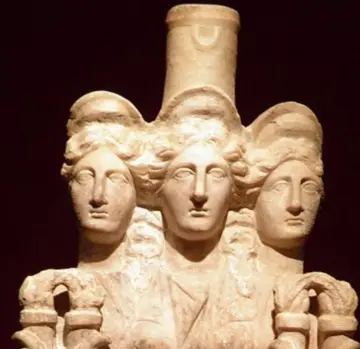
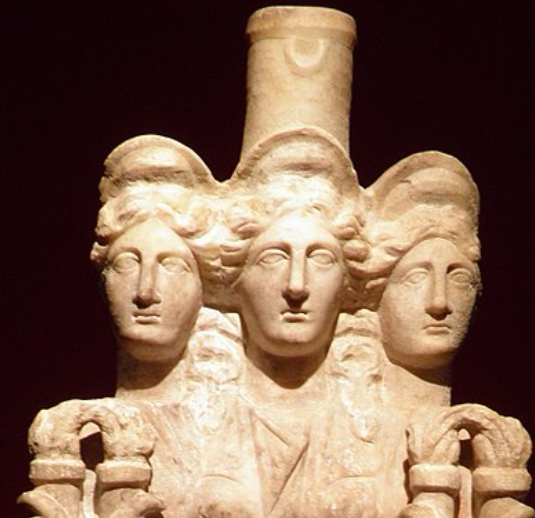
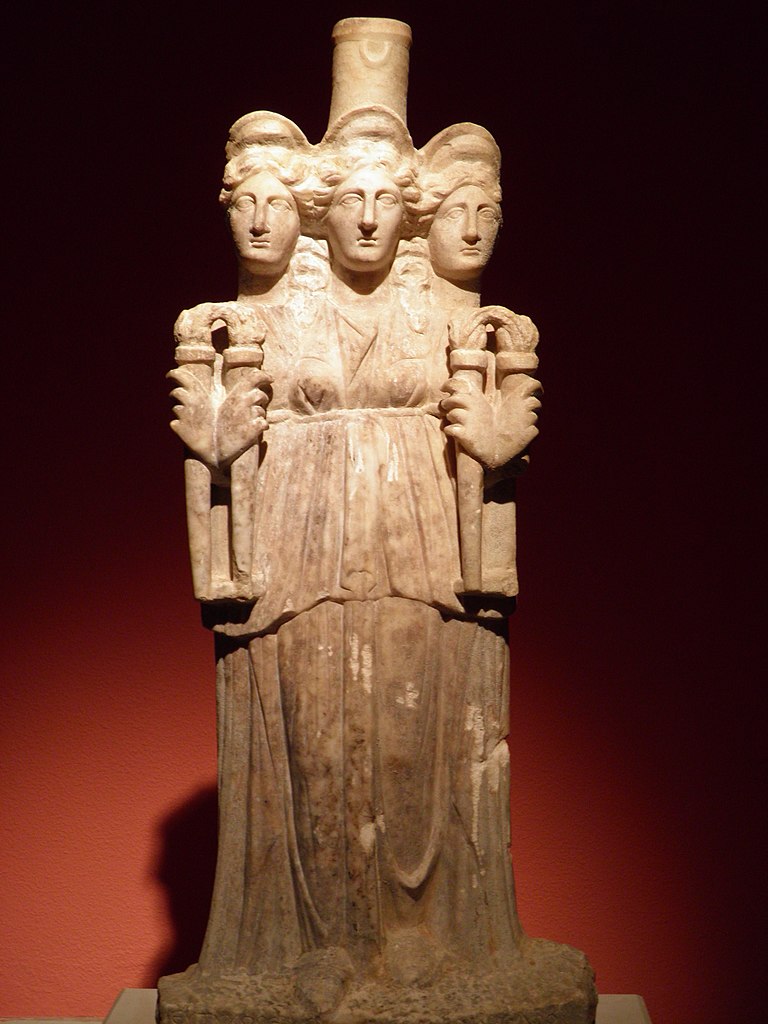
The Deity: Hecate is widely known in classical mythology as a triformis (three-bodied and three-headed) goddess whose dominion spans earth, sea, and sky. In her earliest Anatolian manifestations, she was deeply intertwined with lunar symbolism, guarding thresholds, gateways, and the mysteries of the dark moon.
The Physical Evidence: Excavations at the site have consistently unearthered terracotta figurines, votive offerings, and reliefs depicting Hecate. Crucially, iconography discovered at the site shows the goddess wearing a high polo (a cylindrical crown) adorned with a crescent moon—an unmistakable visual link to the lunar themes of the surrounding sanctuary.
The Architectural Layout: Surviving primarily at the foundation level, the temple preserves the classic tripartite layout of classical architecture. It features a pronaos (entrance porch), a central naos (main chamber for the cult statue), and an opisthodomos (rear treasury/room). At the heart of the naos, an octagonal stone pedestal still marks the exact spot where the cult statue of Hecate once stood to receive the silent prayers of ancient supplicants.
Chronology of Discovery: From 1912 to the Present
The journey toward unmasking the "Small Temple" spans over a century of fluctuating archaeological fortunes, academic debate, and modern technological persistence.
1912–1913: The Initial Excavations
During the twilight of the Ottoman Empire, European and local archaeologists first mapped and excavated sections of the Sanctuary of Men Askaenos. Among the various structures brought to light was a small, unassuming foundation complex built directly against a natural rock face. Because systematic typology of minor Anatolian cults was still in its infancy, and no smoking-gun inscriptions were immediately found, the excavators filed the building away under a provisional heading: the Temple of Demeter.
The Intervening Decades
For decades, the attribution went largely unquestioned in textbooks, even as the broader Sanctuary of Men yielded rich insights into Hellenistic and Roman religious syncretism in Pisidia. The site remained quiet, weathered by the Anatolian elements, its true identity obscured by the lack of definitive epigraphic evidence.
The Modern Campaign (Mid-2000s–Present)
Under the direction of Professor Mehmet Özhanlı, a renewed, long-term excavation campaign was launched across the region, encompassing both Pisidian Antioch and the Sanctuary of Men. Utilizing modern stratigraphic analysis, artifact-clustering techniques, and rigorous spatial mapping, Özhanlı’s team began to re-examine legacy assumptions about the site’s minor structures.
August 2026: The Official Announcement
Following comprehensive cataloging of votive deposits, relief fragments, and comparative studies with coastal Anatolian sanctuaries like Lagina, the research team formally announced that the "Small Temple" was, without a doubt, a sanctuary of Hecate. The announcement immediately captured international attention, reframing the religious geography of inland Pisidia.
Supporting Data and Archaeological Corroboration
The identification of the temple does not rely on architectural layout alone; it is heavily bolstered by surrounding archaeological data uncovered across Özhanlı’s broader excavations in the region—most notably at nearby Pisidian Antioch.
During excavations at Pisidian Antioch, archaeologists uncovered two distinct sacrificial dog burials. In classical antiquity, particularly within the cultic sphere of Hecate, dogs held profound chthonic significance. As the guardian of crossroads and the mistress of the underworld who walked alongside spirits and hounds, Hecate was frequently honored with canine sacrifices. In mythology, she was intimately tied to Cerberus, the multi-headed hound guarding the gates of Hades.
"In many myths, Hekate is a goddess who rules over ‘Kerberos,’ which we call the ‘Hell dog’ of Hades, the underworld," Özhanlı explained during a press briefing. "The most sacred animal is the dog, and we found two sacrificed dog graves during the Antiocheia excavations. These two sacrificed dog graves also archaeologically document that there was a Hekate cult in Antiocheia. Now we are standing in front of the temple."
Furthermore, the physical material of the temple itself offers a path forward for public heritage. Because much of the structure was dismantled during the aggressive Christianization of the Roman Empire—when pagan shrines were systematically leveled or repurposed—the temple now survives primarily at its foundation level. However, the original architectural blocks have not vanished; they lie scattered immediately adjacent to the footprint.
The excavation team has announced ambitious plans to use these surviving ancient stones to Anastylosis-style reconstruction, raising portions of the walls to restore the building’s original visual presence on the landscape.
Official Responses and Scholarly Perspectives
The academic community has warmly received the reattribution, viewing it as a major correction that sheds light on how minor deities operated within major regional sanctuaries.
Scholars emphasize that while coastal sites like Lagina (located in ancient Caria) have long dominated the study of Hecate’s organized priesthood and monumental architecture, inland evidence has historically been sparse, fragmentary, and heavily reliant on portable amulets or household curses (defixiones). Finding a dedicated, formal temple structure deep in the mountainous interior of Pisidia proves that Hecate’s organized, state-supported or community-supported cult reached far beyond the Aegean coastline.
Professor Özhanlı has also noted the cultural resonance of the discovery. Hecate remains a prominent figure in the religious imagination of the modern world, serving as a focal deity for various contemporary Pagan and esoteric traditions. While media reports originating in local Turkish press occasionally leaned into colloquial or generalized descriptions of modern esoteric groups (such as Wicca), academic summaries have kept the focus squarely on the historical, theological, and architectural gravity of the find.
By bridging the gap between classical archaeology and modern cultural interest, the site is expected to draw a new wave of cultural tourists, elevating Yalvaç beyond its traditional archaeological footprint and positioning it alongside Türkiye’s premier classical destinations.
Broader Implications for the Study of Ancient Religion
The reidentification of the Yalvaç temple carries profound implications for our understanding of ancient Anatolian syncretism and religious life during the Hellenistic and Roman imperial periods.
Mapping Inland Cults: For decades, a false dichotomy existed in classical studies, which often assumed that major chthonic and lunar goddesses like Hecate were primarily coastal phenomena, heavily concentrated in regions like Caria or Ionian Greece. This discovery forces a geographical re-evaluation, proving that inland populations actively maintained formal institutional spaces for chthonic deities whose domains crossed the boundaries of life, death, and the unseen world.
The Theology of Liminality: The physical proximity of Hecate’s temple to the Sanctuary of Men Askaenos suggests a sophisticated theological dialogue between the lunar god of the sky and the dark-moon guardian of the crossroads. In the religious mindset of ancient Pisidia, the heavens and the underworld were not disconnected spheres; rather, they formed a continuous cosmological wheel over which divine powers presided in tandem.
The Material History of Christianization: The fate of the Hecate temple—pulled down to its foundations during late antiquity—provides a clear, localized case study of the friction that accompanied the Christianization of the Roman Empire. The systematic dismantling of the sanctuary, paired with the preservation of its scattered stones in the immediate vicinity, offers archaeologists a pristine dataset for studying the transition of sacred landscapes from pagan polytheism to Christian dominance.
As Professor Özhanlı and his team prepare for the next phases of excavation and the prospective physical reconstruction of the temple walls, the "Small Temple" of Yalvaç is shedding its century-old anonymity. No longer an administrative footnote or a mislabeled placeholder for Demeter, the sanctuary stands once more as a testament to the enduring presence of Hecate—the three-formed queen of earth, sea, and sky—restored at last to the ancient mountains of Anatolia.