GLOBAL MARITIME ARCHIVE — For millennia, the open ocean has represented the final frontier of human exploration—a vast, sapphire expanse hiding unfathomable depths and unseen dangers. Long before modern sonar and satellite imagery mapped the ocean floor, ancient mariners relied on oral traditions, superstitions, and sheer terror to make sense of the perils lurking beneath the waves. Among the panoply of sea monsters, leviathans, and phantom ships, one behemoth reigns supreme in the collective maritime psyche: the Kraken.
Hailing from the freezing, unpredictable waters of Scandinavian mythology—specifically the rich folklore of Norway and Iceland—the Kraken emerged as the ultimate personification of the ocean’s wrath. It was not merely a predatory beast, but a force of nature capable of swallowing entire crews, shattering oak-hulled ships, and reshaping the very geography of the sea.
Main Facts: Anatomy of a Legend
At its core, the Kraken is a mythical cephalopod of impossible proportions. Rooted in the Old Norse language—where the word krakar refers to an unhealthy animal or something twisted—the creature evolved over centuries into a staple of European nautical lore.
Unlike conventional predators, the Kraken’s legendary M.O. combined brute force with deceptive cunning. Historical accounts attribute several catastrophic behaviors to the beast:
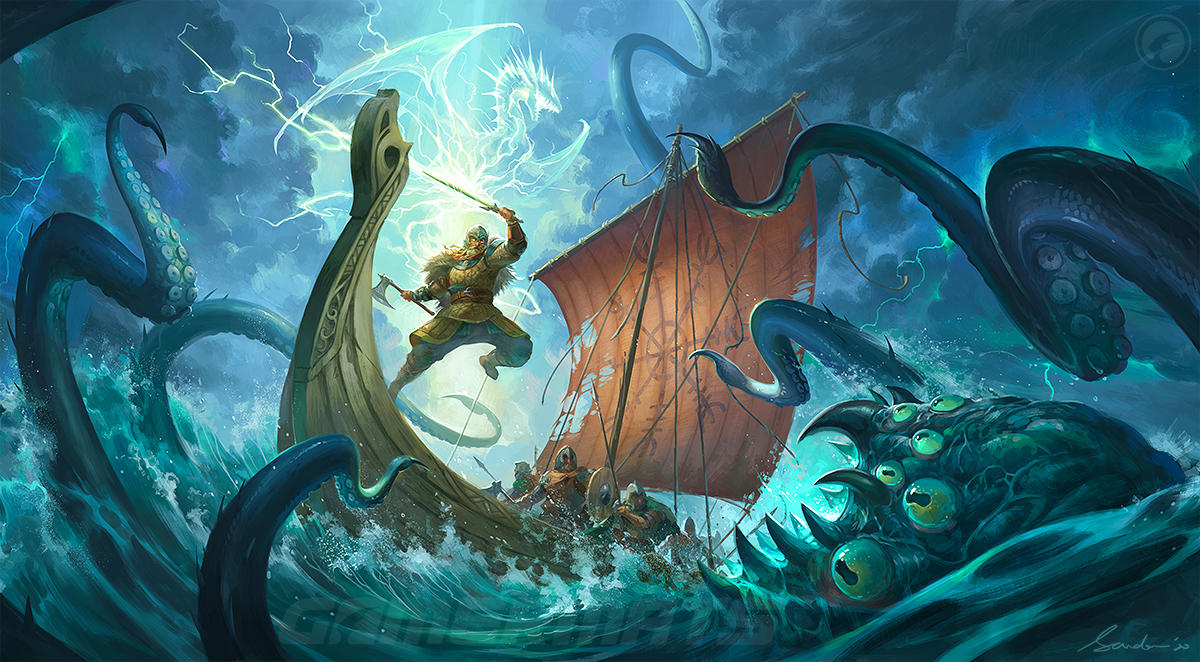
- The Maëlstrom Generation: Legends claim that when the Kraken submerges, it creates a massive vortex or whirlpool powerful enough to drag nearby vessels down into the abyssal deep.
- The Island Deception: Due to its immense surface area, sailors frequently mistook the resting back of a Kraken for a small, uncharted island. Unsuspecting crews would anchor, disembark, and even light campfires on the creature’s hide, only for the "island" to suddenly sink beneath them, boiling the surrounding water.
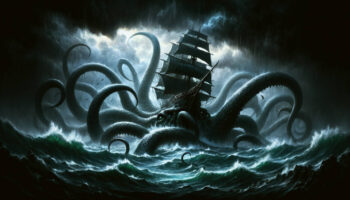
- Vessel Demolition: Using its colossal, barbed tentacles, the beast was said to wrap around the masts of a warship or merchant vessel, dragging the craft vertically into the dark ocean or splitting it clean in half.
Physically, traditional descriptions paint a picture of a super-sized squid or octopus on a cosmic scale. While early 18th-century writers debated whether it possessed the hard shell of a crab or the soft, undulating mantle of a cephalopod, consensus eventually settled on a towering silhouette dominated by dense, muscular tentacles, powerful beaks, and glowing eyes capable of piercing the pitch-black gloom of the deep ocean.
Chronology of Terror: The Evolution of the Myth
To understand how the Kraken cemented its place in history, one must trace its appearances across centuries of literature, ecclesiastical records, and natural history texts.
The Early Norse Sagas (13th Century)
While oral traditions date back even further, the earliest written references to Kraken-like beasts appear in Old Norse literature. The Örvar-Odds saga, an Icelandic tale from the late 13th century, describes two colossal sea monsters—the Hafstramb (Sea-Stump) and the Lyngbakr (Heather-Back)—that haunted the Greenland Sea. The Lyngbakr, in particular, matches the description of the island-sized monster that later morphed into the definitive Kraken legend.
The Bishop’s Account (1752)
The most influential formal documentation of the Kraken came from Erik Pontoppidan, the Bishop of Bergen and a fellow of the Royal Academy of Sciences in Copenhagen. In his seminal work, The Natural History of Norway (1752), Pontoppidan provided a comprehensive, albeit credulous, scientific overview of the beast.
Pontoppidan described the Kraken as "the largest monster in creation," noting that its back was roughly a mile and a half in circumference. He detailed how Norwegian fishermen would willingly brave dangerous waters above known Kraken habitats because the creature’s presence invariably signaled an abundance of fish feeding in its wake. However, he also warned of the fatal perils of lingering too long once the creature began to stir.
The Scientific Skepticism (19th Century)
As the Enlightenment gave way to the Age of Steam and rigorous marine biology, naturalists began aggressively separating fact from fiction. By the mid-19th century, mainstream science dismissed the Kraken as a sailor’s superstition born of optical illusions, floating masses of seaweed, and exaggerated accounts of standard marine life.
Supporting Data: When Myth Meets Reality
While the island-swallowing leviathan of Norse lore remains strictly in the realm of fantasy, modern marine science has revealed that the Kraken was not entirely a product of overactive imaginations.
The Real-Life Kraken: Architeuthis dux
In 1857, Danish naturalist Japetus Steenstrup formally identified the Giant Squid (Architeuthis dux) after examining a massive beak washed ashore on the coast of Denmark. This discovery provided concrete physical evidence that colossal cephalopods truly do inhabit the twilight zones of the ocean.

| Feature | Mythological Kraken | Giant Squid (Architeuthis) | Colossal Squid (Mesonychoteuthis hamiltoni) |
|---|---|---|---|
| Estimated Length | 1 mile (island-sized) | Up to 43 feet (13 meters) | Up to 46 feet (14 meters) |
| Weight | Tens of thousands of tons | Up to 600 kg (1,300 lbs) | Up to 500 kg (1,100 lbs) |
| Primary Habitat | Surface waters & shipping lanes | Bathypelagic zone (2,000–3,300 ft deep) | Antarctic and Southern Oceans |
| Behavior | Actively hunts ships and crews | Ambush predator hunting deep-sea fish and other squid | Solitary deep-sea dweller, preyed upon by sperm whales |
Furthermore, the discovery of the Colossal Squid (Mesonychoteuthis hamiltoni) in the 20th century proved that nature is capable of producing even heavier, more aggressive cephalopods equipped with rotating hooks on their tentacles—weapons far more terrifying than anything imagined by early Scandinavian fishermen.
Sperm Whale Encounters
Marine biologists studying sperm whales have frequently documented intense, life-or-death battles between the massive marine mammals and giant squids in the deep ocean. Deep scars found on the skin of sperm whales—perfectly circular suction-cup marks sometimes measuring several inches across—serve as permanent testimony to the titanic struggles occurring miles beneath the surface, far away from human eyes.
Official Responses and Cultural Resonance
Governments, maritime agencies, and scientific institutions no longer issue warnings about the Kraken, but the beast’s cultural imprint remains heavier than ever.
Modern Maritime and Naval Lore
Navies past and present have playfully embraced the iconography of the Kraken. During World War II, various submarine units and naval squadrons adopted the giant squid or Kraken as an emblem of stealth, hidden power, and psychological warfare. In modern pop culture, the Kraken has transitioned from a source of genuine dread to an enduring cinematic and literary icon, featuring prominently in franchises like Pirates of the Caribbean, Clash of the Titans, and various fantasy role-playing games.
Furthermore, professional sports teams—such as the Seattle Kraken of the National Hockey League—have embraced the name to symbolize regional maritime heritage, raw power, and an untamed competitive spirit.
Implications: Why the Kraken Endures
The enduring fascination with the Kraken highlights a fundamental truth about human nature: our paradoxical relationship with the unknown.
Even in the 21st century, humanity has explored less than five percent of the Earth’s oceans. We possess better maps of the surface of Mars and the Moon than we do of the abyssal plains and deep-sea trenches of our own planet. As long as the deep ocean remains a realm of mystery, extreme pressure, and perpetual darkness, monsters like the Kraken will continue to capture our imaginations.
The Kraken is more than a relic of Scandinavian folklore; it is a timeless reminder of human vulnerability in the face of nature’s raw majesty, proving that the deepest waters of the earth will always be home to wonders—and terrors—beyond our full comprehension.