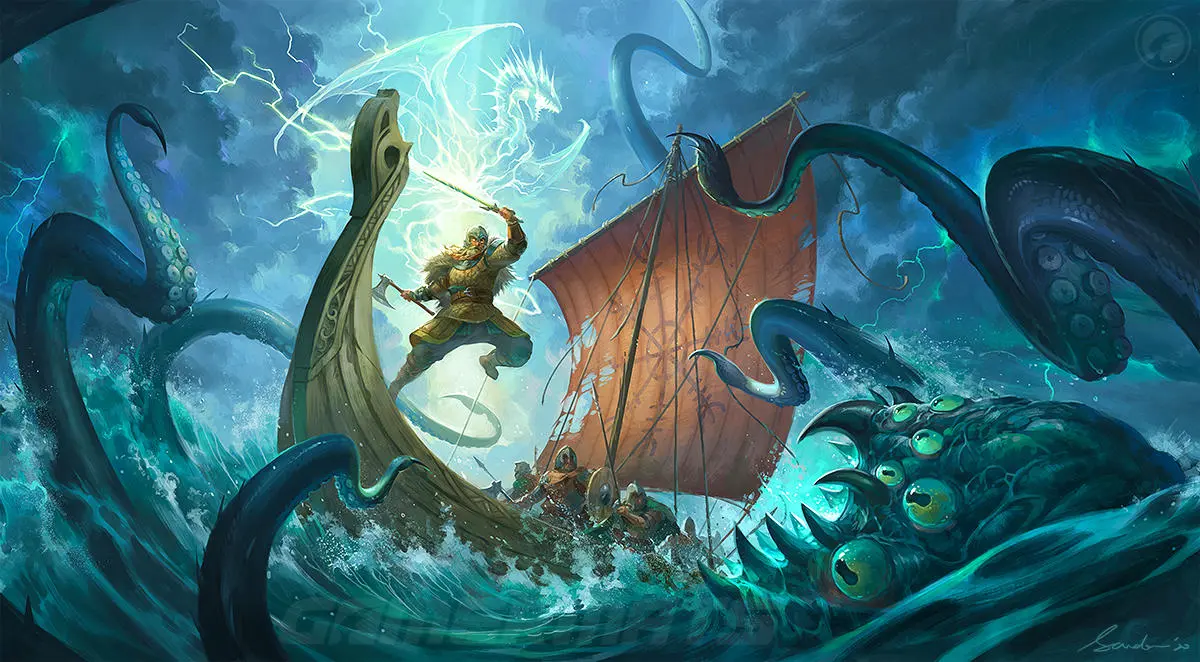
OSLO, NORWAY — For centuries, the deep ocean has served as humanity’s ultimate frontier—a realm of profound darkness, crushing pressure, and unfathomable depths. Long before modern sonar and deep-submergence vehicles mapped the ocean floor, mariners contended with the unknown through mythology. Among the most enduring and terrifying titans of maritime folklore is the Kraken. Hailing from the cold, turbulent waters of Scandinavian mythology, particularly the rich oral and written traditions of Norway and Iceland, the Kraken stands as the ultimate embodiment of oceanic peril.
More than just a monster of the deep, the Kraken represents a cultural coping mechanism for early seafaring societies, a biological bridge to real-world cephalopods like the colossal squid, and a persistent fixture in modern pop culture. This comprehensive retrospective examines the origins, lore, biological parallels, and enduring cultural impact of history’s most formidable mythical beast.
Main Facts: Anatomy, Behavior, and the Legend of the Deep
In its traditional mythological context, the Kraken is not merely a large animal; it is a force of geological and meteorological disruption. Norse and Icelandic mariners did not view the open ocean as a highway to be easily conquered, but rather as an unpredictable domain controlled by leviathans.
What Does a Kraken Do?
According to historical accounts and folklore compiled over the centuries, the Kraken’s behavior was defined by catastrophic destruction:
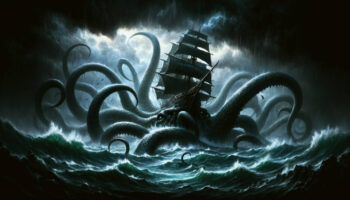
- Generating Lethal Whirlpools: When the Kraken submerged or moved rapidly through the water, it was said to displace such massive volumes of water that it created colossal whirlpools or maelstroms capable of dragging entire fleets of ships down into the abyss.
- Vessel Demolition: The beast possessed the strength to wrap its immense tentacles around the hulls of multi-masted sailing ships, crushing them like timber and dragging crews to their watery graves.
- The "Floating Island" Deception: Historical chronicles note that the Kraken would sometimes surface and remain motionless, its broad, barnacle-covered back resembling a small island or series of islets. Unwary sailors would mistake the beast for land, drop anchor, and sometimes even disembark, only to realize their fatal mistake when the island began to sink back into the freezing sea.
- Feeding Strategies: Legend holds that the Kraken was so gargantuan that it could not survive on ordinary fish alone. Instead, it relied on consuming schools of fish that gathered around it, or whole ships and their unfortunate crews. To attract prey, the creature was occasionally described as emitting a thick, nutrient-rich fluid that smelled intoxicating to fish, darkening the surrounding waters.
What Does a Kraken Look Like?
Because the Kraken belongs to the realm of myth, its precise appearance varied depending on the teller, but several core anatomical features remained consistent across Scandinavian folklore:
- Cephalopod Characteristics: It was universally envisioned as a cephalopod-like entity—a monstrous cross between a gigantic octopus and a super-sized squid, equipped with powerful, flexible tentacles lined with sharp suckers or hooks.
- Colossal Proportions: While a modern giant squid might reach lengths of 40 feet, the legendary Kraken was imagined on a continental scale. Some historical texts describe it as being a mile and a half wide, with arms long enough to encircle the largest warship ever built.
- Terrifying Visage: Tales frequently highlighted the creature’s immense, unblinking eyes—often described as glowing red or deep amber—that peered through the briny gloom just before an attack. Its skin was mottled, slimy, and covered in deep-sea barnacles, parasitic growths, and patches of bioluminescent algae.
Chronology: The Evolution of the Kraken in History and Literature
While the terrifying reputation of sea monsters dates back to antiquity, the specific moniker "Kraken" and its formalized characteristics evolved gradually through Scandinavian history.
- 12th to 13th Century (Norse Sagas): Early precursors to the Kraken appear in Old Norse literature. Texts such as the Konungs skuggsjá (King’s Mirror), written around 1250 AD, describe monstrous sea creatures native to the northern seas, including the hafgufa (sea-mist) and lyngbakr (heather-back). These creatures matched the description of the Kraken, particularly in their habit of masquerading as islands.
- 1752 (Pontoppidan’s Masterwork): The definitive codification of the Kraken occurred in the 18th century. Bishop Erik Pontoppidan of Bergen, Norway, published his seminal work, Det første Forsøg paa Norges naturlige Historie (The First Attempt at the Natural History of Norway). Pontoppidan provided the most detailed and widely cited account of the Kraken, treating it with scientific earnestness and compiling eyewitness reports from Norwegian fishermen and sea captains.
- 1755 (Linnaeus’s Taxonomy): Recognizing the cultural weight of the creature, the famous Swedish botanist and zoologist Carl Linnaeus included the Kraken in the first edition of his landmark Systema Naturae (1735/1755) under the scientific name Microcosmus marinus. Though later editions removed the classification as scientific rigor advanced, its inclusion by the father of modern taxonomy highlights how blurred the line between fact and folklore was in the 18th century.
- 1802 (Denys de Montfort’s Cephalopods): French malacologist Pierre Denys de Montfort fueled European fascination with giant sea monsters by proposing the existence of two types of giant octopuses: the "kraken octopus" (inspired by Scandinavian lore) and the colossal "colossal octopus" said to attack ships off the coast of Angola. While his later claims became increasingly exaggerated and discredited, his work cemented the squid/octopus identity of the Kraken in the public consciousness.
- 1870 (Literary Immortality): French author Jules Verne forever etched the Kraken into modern adventure fiction with his classic novel Twenty Thousand Leagues Under the Sea. Verne’s depiction of a battle between the Nautilus and a pack of giant squids drew heavily on Kraken mythology, thrilling generations of readers.
- 20th and 21st Centuries (Cinematic and Pop Culture Era): The Kraken transitioned seamlessly from literature to Hollywood. From the stop-motion animation masterpiece Clash of the Titans (1981) and its 2010 remake to video games, board games, and modern fantasy franchises, the Kraken has become the ultimate cinematic shorthand for aquatic terror.
Supporting Data: Mythology Meets Marine Biology
How did centuries of seasoned sailors and respected scholars become convinced that a mile-wide, ship-crushing beast lurked in the North Atlantic? Modern marine biology and oceanography offer fascinating insights into the natural phenomena that inspired the legend.
1. Giant and Colossal Squids (Architeuthis dux and Mesonychoteuthis hamiltoni)
For generations, science dismissed giant squids as sailors’ fairy tales. However, strandings of giant squids on Scandinavian shores and encounters in the deep ocean proved that real-life leviathans do exist.
- Size Comparisons: While a giant squid cannot sink a battleship, an animal stretching up to 43 feet in length with dinner-plate-sized eyes and barbed tentacles is more than formidable enough to terrify an 18th-century merchant crew.
- The Deep-Sea Factor: Because giant squids inhabit the bathypelagic zone (between 3,300 and 13,000 feet below the surface), they rarely appear alive at the surface. When a sick, dying, or disoriented giant squid did surface—often flailing wildly or attacked by sperm whales—it would have presented a terrifying, alien spectacle to medieval sailors.
2. Underwater Volcanic Activity and Maelstroms
The Norwegian coast is famous for its extreme tidal currents, most notably the Moskenstraumen (the famous Maelstrom described by Edgar Allan Poe).
- Geological Disruption: Submarine volcanic eruptions, seismic shifts, and sudden underwater landslides off the coast of Norway and Iceland can displace enormous amounts of water instantly.
- The Illusion of the Monster: These geological events create sudden, violent whirlpools and bubbling, boiling surface water caused by escaping volcanic gases. To superstitious mariners, water boiling up from the depths and dragging ships downward was naturally attributed to a living subterranean beast exhaling or thrashing beneath the waves.
3. Optical Illusions and Fata Morgana
The freezing waters of the Arctic and North Atlantic frequently produce complex atmospheric optical phenomena known as Fata Morgana. These superior mirages bend light rays through layers of varying air temperatures, making distant icebergs, islands, or even ships appear magnified, distorted, floating in the air, or mutating into strange shapes. A distant rock formation or whale pod distorted by a Fata Morgana could easily give the impression of a colossal, shifting sea monster.
Official Responses and Historical Inquiry
While modern governments and scientific institutions do not deploy navies to hunt the Kraken, historical figures took the beast remarkably seriously. The inquiries of the 18th and 19th centuries provide a window into how early science attempted to reconcile folklore with empirical observation.
In his 1752 treatise, Bishop Pontoppidan recorded testimonies from sea captains who claimed their sounding lines—often several hundred fathoms long—struck solid obstructions in deep water where charts indicated thousands of feet of clearance. Pontoppidan interpreted this as the dome-like back of the Kraken rising toward the sun to warm itself.

Furthermore, maritime insurance underwriters and admiralties in Copenhagen and London occasionally received formal loss reports in the 17th and 18th centuries attributing the mysterious disappearance of vessels not to storms or piracy, but to sudden, catastrophic strikes by "sea-serpents" or "krakens." While these claims were viewed with increasing skepticism as the Age of Enlightenment progressed, they illustrate that the fear of the Kraken was codified into the administrative and economic realities of early modern shipping.
In contemporary times, marine biologists from institutions such as the Smithsonian National Museum of Natural History and Norway’s Institute of Marine Research view the Kraken as a vital cultural touchstone. It represents humanity’s earliest attempts to conceptualize the biodiversity of the deep sea—a legacy that inspired the scientific search for actual deep-sea giants.
Implications: The Enduring Legacy of the Abyss
The myth of the Kraken carries profound implications for how humanity interacts with the natural world, particularly regarding our relationship with the oceans.
1. The Psychology of the Unknown
The Kraken is a monument to human fear of the unstructured and unexplored. Psychologically, monsters like the Kraken serve as placeholders for our ignorance. As humanity mapped the coastlines, the Kraken retreated from the North Sea into the uncharted trenches of the Pacific and Atlantic. Today, even as deep-sea exploration reveals hydrothermal vents, bizarre fish species, and vast abyssal plains, the ocean remains 80% unexplored, ensuring that the psychological archetype of the Kraken retains its visceral power.
2. Conservation and Ecological Awareness
Ironically, the monster that once terrified mariners has become an ambassador for ocean conservation. Modern public fascination with giant squids, octopuses, and deep-sea ecosystems has transformed public perception from fear to awe. Documentaries capturing giant squids in their natural habitat generate millions of views, fostering a desire to protect fragile marine environments from overfishing, deep-sea mining, and plastic pollution.
3. Pop Culture and Mythmaking
In the 21st century, the Kraken has transcended its Scandinavian roots to become a global icon. From professional sports teams (such as the Seattle Kraken of the National Hockey League) to blockbuster movie franchises and video games, the name commands immediate recognition. It proves that ancient myths do not simply die when science explains them; instead, they evolve, embedding themselves into the modern cultural fabric as symbols of unstoppable power, mystery, and untamed natural majesty.
As long as the oceans retain their dark, unmapped depths, the ghost of the Kraken will continue to haunt our collective imagination—a timeless reminder of the awe and terror inspired by the vast, mysterious deep.