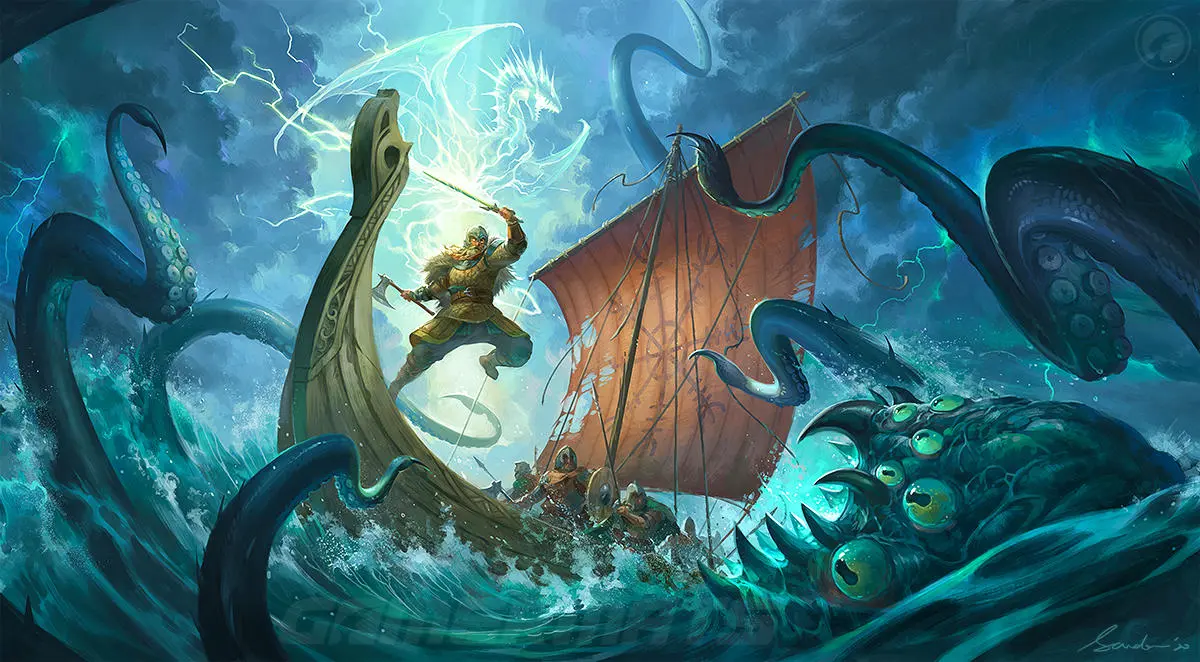
OSLO, NORWAY — For centuries, the deep ocean has inspired both awe and terror among those who dare to cross its uncharted expanses. Long before modern sonar and deep-sea submersibles mapped the ocean trenches, ancient mariners relied on folklore to make sense of the unfathomable dangers lurking beneath the waves. Among the most fearsome of these maritime legends is the Kraken—a colossal cephalopod-like behemoth said to stalk the frigid waters of the North Atlantic, dragging entire ships and their crews down to a watery grave.
Hailing deep from the rich oral traditions of Scandinavian mythology, particularly the coastal cultures of Norway and Iceland, the Kraken remains the ultimate embodiment of oceanic dread. While dismissed today as a mythical monster, the creature’s enduring legacy bridges the gap between ancient sailor superstitions and the modern scientific discovery of real-world deep-sea giants.
Main Facts: Anatomy and Behavior of a Mythological Terror
In Scandinavian folklore, the Kraken is not merely a large animal; it is a force of catastrophic nature. Historical accounts describe a creature of truly staggering proportions—so massive that its anatomy blurs the line between living organism and geological landmass.
What Does a Kraken Do?
According to historical legends, the Kraken’s primary occupation is inducing terror on the high seas. Its documented (albeit folkloric) actions include:
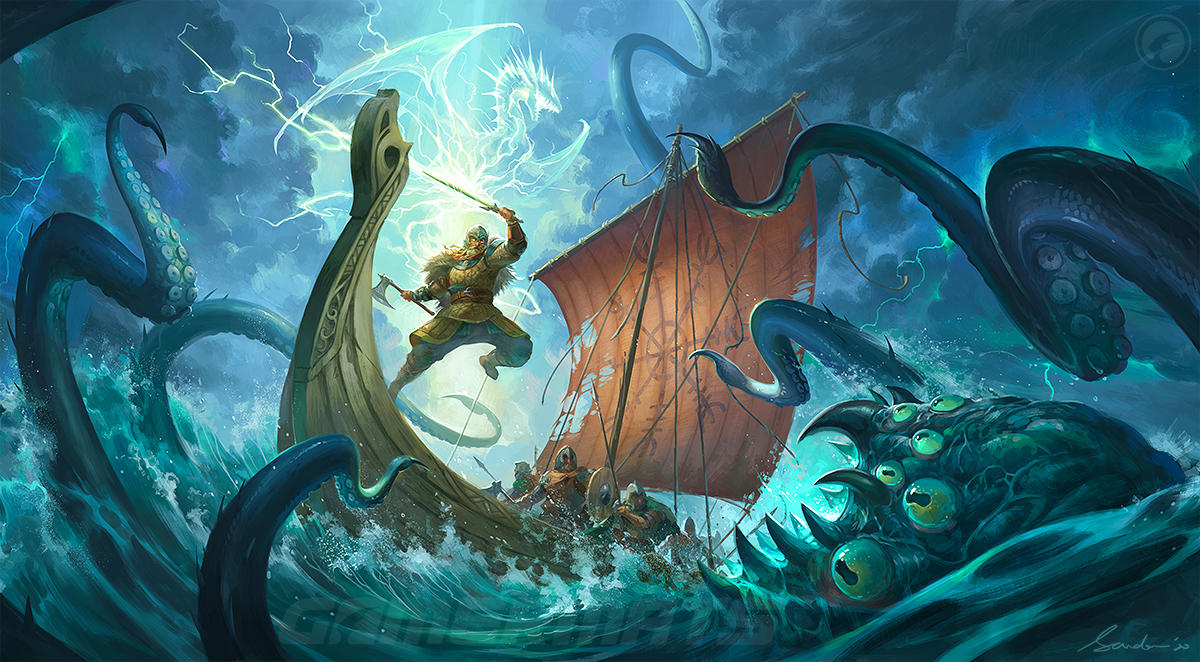
- Generating Lethal Whirlpools: When the Kraken submerges or descends rapidly back into the abyss, it displaces vast amounts of water, creating violent maelstroms capable of pulling passing vessels down into the depths.
- Vessel Demolition: Using its immensely powerful, tree-trunk-thick tentacles, the beast is said to wrap around the hulls of tall ships, snapping masts, splintering timber, and dragging crews to their doom.
- Submarine Ambush: Sailors of antiquity believed the creature would lurk in the darkest ocean trenches, waiting for unsuspecting merchant fleets before striking from beneath.
Physical Appearance and Scale
While classic depictions vary depending on the century and the region, the Kraken is most commonly visualized as an ultra-sized, hyper-aggressive squid or octopus.
- Colossal Proportions: The creature is consistently described as being larger than the largest man-made ships of its era.
- The "Floating Island" Phenomenon: Perhaps the most famous aspect of Kraken lore is its deceptive camouflage. In 18th-century accounts, unsuspecting sailors would mistake the creature’s broad, flat back for an uncharted island or reef. Crews would anchor their ships, step onto the "land," and begin cooking a meal—only for the island to heave, sink, and reveal a living nightmare with massive, glowing eyes and thrashing tentacles.
- Armament: Tales highlight its forest of massive tentacles, capable of reaching the highest crows’ nests, and an armored, beak-like mouth capable of crushing iron-reinforced hulls.
Chronology: The Evolution of the Kraken in History and Literature
The legend of the Kraken did not appear overnight; it evolved over centuries as a blend of genuine encounters with rare marine life, poetic exaggeration, and maritime folklore.
The Viking Age and Early Sagas (13th Century)
The earliest written references to Kraken-like beasts appear in Old Norse literature. One of the oldest is Örvar-Oddr, an Icelandic saga from the 13th century, which mentions two colossal sea monsters: the hafgufa (sea mist) and the lyngbakr (heather-back). These creatures shared the defining trait of the Kraken: growing so massive that they resembled islands.
Bishop Erik Pontoppidan’s Natural History (1752)
The definitive codification of the Kraken occurred during the Enlightenment, courtesy of Erik Pontoppidan, the Bishop of Bergen and a member of the Royal Academy of Sciences in Copenhagen. In his seminal work, The Natural History of Norway (1752), Pontoppidan provided the most detailed and influential description of the beast.
Pontoppidan described the Kraken as a creature "round which is a circle or augmentation of a mile and a half breadth," noting that its back resembled floating islands. He detailed how fishermen would deliberately seek out waters frequented by the Kraken, knowing that vast schools of fish gathered above it—though doing so was a calculated gamble with death.
The 19th Century: Transition from Folklore to Science
As scientific inquiry accelerated in the 1800s, naturalists began to parse through sailors’ tales to find kernels of truth. Pierre Denys de Montfort, a French malacologist, studied accounts of giant sea monsters in the early 19th century and proposed the existence of two types of "kraken octopus"—the colossal octopus and the giant squid (Architeuthis).
While Montfort’s later career suffered a blow due to overly sensationalized claims (such as a Kraken dragging a British warship down), his intuition proved remarkably prescient. In 1857, Danish naturalist Japetus Steenstrup officially described the giant squid Architeuthis dux based on a massive beak washed ashore in Denmark, giving biological credibility to the ancient myths.
Supporting Data: Mythology Meets Marine Biology
How did an ancient myth about island-sized beasts become a cornerstone of modern marine biology? The answer lies in the deep, dark layers of the ocean—the pelagic and benthic zones—where humanity’s understanding of biology reaches its limits.

- The Reality of Cephalopods: The modern giant squid (Architeuthis dux) can grow up to 43 feet (13 meters) in length, while the colossal squid (Mesonychoteuthis hamiltoni) may reach weights of over 1,000 pounds (495 kg) and features razor-sharp rotating hooks on its tentacles.
- Deep-Sea Sightings: For centuries, live giant squids were never seen by scientists in their natural habitat. They were only known through decaying carcasses washing up on beaches, which often looked mangled, otherworldly, and terrifying—ideal fuel for sailor superstitions. It wasn’t until 2004 that Japanese researchers captured the first images of a live giant squid in the deep ocean, followed by video footage in 2012.
- The Giant Pacific Octopus (Enteroctopus dofleini): Native to the temperate coastal waters of the North Pacific, these creatures are known to reach weights of over 150 pounds and arm spans exceeding 20 feet. While they do not sink ships, their intelligence, camouflage abilities, and impressive size heavily influenced Pacific Northwest and Scandinavian folklore.
Official Responses and Maritime Authorities
While marine biologists do not believe in the literal, island-sized Kraken of Norse sagas, maritime safety organizations and oceanographic institutions acknowledge that the deep ocean still holds secrets capable of overwhelming human vessels.
The Stance of the National Oceanic and Atmospheric Administration (NOAA)
NOAA maintains that while mythical beasts like the Kraken do not exist, the ocean remains 80% unexplored and unmapped. According to NOAA marine scientists, the discovery of new deep-sea species—including gigantism in deep-sea organisms (abyssal gigantism)—proves that the ocean can produce lifeforms far more unusual and massive than previously imagined.
Modern Maritime Operations
Commercial shipping lines and naval authorities treat deep-sea hazards through the lens of severe weather, rogue waves, and mechanical failure rather than sea monsters. However, the United States Navy and international maritime agencies continue to fund deep-sea exploration programs (such as the Ocean Exploration Trust) precisely to understand the ecological and physical dynamics of the deep pelagic zones where giant cephalopods reside.
Implications: The Psychological and Cultural Impact of the Kraken
The legacy of the Kraken extends far beyond historical archives and marine biology textbooks; it occupies a permanent, influential space in global pop culture, psychological archetypes, and environmental philosophy.
In Popular Culture
The Kraken has transcended its Scandinavian origins to become a global pop culture icon. From Jules Verne’s classic 1870 novel Twenty Thousand Leagues Under the Sea (which features a battle with a giant squid) to blockbuster film franchises like Pirates of the Caribbean: Dead Man’s Chest and Clash of the Titans, the monster serves as the ultimate cinematic shorthand for untamed natural fury. In recent years, the name has even been adopted by professional sports teams, most notably the Seattle Kraken of the National Hockey League (NHL).
Psychological Significance
To early human civilizations, the Kraken represented the terrifying unknown. It served as a psychological coping mechanism for the very real dangers of seafaring—sudden storms, treacherous currents, uncharted reefs, and unexplained disappearances. By personifying these dangers into a tangible (albeit monstrous) entity, sailors could conceptualize and respect the immense power of the natural world.
Environmental Awareness and Conservation
Today, the Kraken serves as a potent symbol of ocean conservation. As human activity—ranging from deep-sea mining to plastic pollution and overfishing—threatens the fragile ecosystems of the deep ocean, monsters of the deep remind humanity of the profound mystery and vulnerability of our planet’s last true frontier. The mythical Kraken, once feared as a destroyer of ships, now stands as a reminder of the magnificent, awe-inspiring life that dwells just beneath the surface of the blue.