









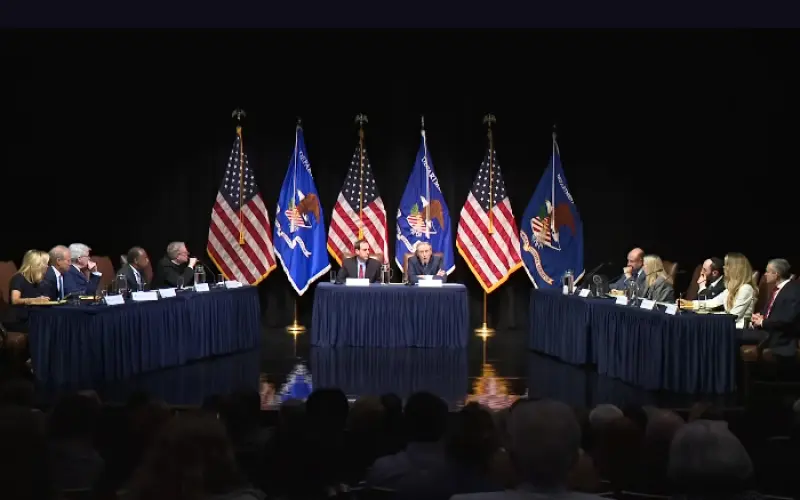
WASHINGTON — As the federal Religious Liberty Commission moves into its final review phase, a quiet yet significant battle over the parameters of American pluralism has brought minority and non-traditional faiths into sharp focus. Established by executive order under President Donald Trump and housed within the Department of Justice (DOJ), the Commission was tasked with examining the status of religious freedom across government, education, healthcare, workplaces, and the military.
Since its inception in 2025, the Commission has drawn intense scrutiny from civil rights organizations, interfaith coalitions, and legal scholars over whether its foundational framework prioritizes a "Judeo-Christian" paradigm to the exclusion of America’s broader religious tapestry. Amid this ongoing national debate, the Pagan Solidarity Alliance (PSA)—representing modern Pagans, Wiccans, Druids, Heathens, and polytheists—has injected a crucial institutional perspective into the official federal record.
Through a detailed policy brief submitted during the summer public-comment period, the PSA is urging lawmakers and federal administrators to recognize that true religious liberty must account for administrative visibility, institutional infrastructure, and the realities of minority faiths that routinely fall outside the cultural mainstream.
Main Facts: The Commission, the Controversy, and the Pagan Intervention
The Religious Liberty Commission’s journey has been marked by ideological friction. Following its inaugural meeting at the Museum of the Bible in Washington, D.C., on June 16, 2025, the body launched a series of hearings that culminated in its final scheduled public session on April 13, 2026. Shortly thereafter, the Commission published a 12-point draft recommendation touching on hot-button cultural and institutional matters, prompting the DOJ to open a public-comment period that flooded federal databases with thousands of pages of submissions.
The core facts surrounding this administrative cycle highlight several critical tensions:
- The Multifaith Backlash: A broad coalition of Muslim, Hindu, and Sikh organizations previously filed a federal lawsuit alleging that the Commission’s hearings and framing disproportionately elevated Judeo-Christian perspectives while marginalizing non-traditional faiths.
- The PSA Policy Brief: Submitted as Policy Brief No. 2026-01, titled "Administrative Principles Supporting the Practical Implementation of Religious Liberty," the PSA’s submission successfully entered the federal record under DOJ tracking designation DOJ-RLC Comment-009205.
- The Administrative Blind Spot: While many public comments acknowledged the rights of Muslims, Sikhs, Hindus, Buddhists, Jews, and Indigenous spiritual traditions, modern Pagan and polytheist communities were frequently omitted entirely from discussions of religious pluralism.
- The Military Conundrum: The Commission’s review coincides with the Department of Defense’s (DoD) 2026 restructuring of its Faith and Belief Codes, which compressed more than 200 religious identity categories down to 31, eliminating numerous minority-faith and non-religious markers.
According to Rev. Dr. Davron Michaels, Paramount Priest of New Aeon Church International and member of the PSA Spiral Council, the intervention was designed not to seek special privileges for Pagans, but to address the mechanics of governance. "Religious liberty is often tested not when government serves the religious majority, but when it encounters communities that are unfamiliar, numerically small, or imperfectly understood," Michaels noted.
Chronology of Events: From Inception to the Final Review
To understand how modern Paganism entered the federal religious liberty dialogue, it is necessary to trace the timeline of the Commission’s operations and the parallel administrative shifts that provoked the PSA’s response:
- June 16, 2025: The Religious Liberty Commission holds its inaugural meeting at the Museum of the Bible in Washington, D.C., setting off a wave of public concern among civil liberties groups and religious minorities regarding its institutional scope and ideological alignment.
- April 13, 2026: The Commission convenes its final scheduled public hearing, concluding months of testimony from legal scholars, faith leaders, and advocates.
- Spring 2026: The Department of Defense implements a major restructuring of its religious-affiliation codes, cutting the number of recognized faith categories from over 200 to 31. This administrative shift strips away specific identifiers for various minority and non-religious service members.
- June 2026: The Commission releases its draft report featuring twelve broad recommendations concerning healthcare, education, the military, and church-state relations. The DOJ opens an extended public-comment window.
- Summer 2026: Civil rights groups, faith-based alliances, and the Pagan Solidarity Alliance review the draft and submit formal policy comments. The PSA files its administrative brief, securing its place in the permanent federal docket.
- August 17, 2026: The Commission schedules a virtual public meeting to review public submissions, evaluate the draft recommendations, and prepare its final report to the administration.
Supporting Data: Administrative Mechanics and the Crisis of Visibility
The debate over the Commission’s findings is not merely philosophical; it is intensely bureaucratic. Government-administered religious liberty relies on classification systems, chaplaincy allocations, demographic tracking, and compliance procedures. When those systems fail to capture a population, the practical exercise of freedom breaks down.
The Problem of the DoD Faith Codes
The intersection of federal policy and minority faith visibility is starkly illustrated by the military’s recordkeeping practices. When the DoD expanded its Faith and Belief Codes in 2017, the explicit justification was that granular data collection was necessary to improve demographic reporting, plan for adequate religious support, and accurately assess chaplaincy capabilities.
When the DoD reversed course in 2026 by slashing the recognized categories to 31, independent watchdogs immediately recognized the operational fallout. In its public comment, the Interfaith Alliance echoed concerns similar to those raised by the PSA, noting that the removal of specific traditions—such as Humanism, Unitarian Universalism, and various minority faiths—creates an administrative barrier for service members seeking accommodation.

For the PSA, the question remains operational: If specificity was deemed necessary for military planning and support in 2017, how can those exact same administrative functions be maintained under a drastically impoverished classification scheme? To answer this, the PSA has initiated a series of Freedom of Information Act (FOIA) requests aimed at uncovering the internal administrative record behind the DoD code restructuring.
Mapping the Public Record
An analysis of the DOJ public-comment docket reveals a distinct stratification among submissions:
- The Majority-Focused Bloc: Submissions that view religious liberty primarily through the lens of traditional institutional churches, often advocating for broad exemptions in healthcare, education, and public funding based on traditional conscience protections.
- The Pluralistic Coalition: Submissions from organizations such as the Sikh American Legal Defense and Education Fund (SALDEF), the Interfaith Alliance, and Americans United for Separation of Church and State, which argue that religious freedom is hollow if it does not protect minority traditions from systemic erasure.
- The Unintentional Exclusion: Submissions from well-meaning advocates of religious pluralism who routinely list Muslims, Sikhs, Hindus, Buddhists, Jews, Baha’is, Indigenous groups, and Humanists, yet omit Pagans, Wiccans, Druids, and Heathens entirely from their rosters of overlooked American faiths.
Official Responses and Coalition Perspectives
The divergence in how religious liberty is conceptualized has created strange political alignments, moving the primary ideological fault line away from a simple "Christian versus non-Christian" binary toward a deeper philosophical divide: preferential religious liberty versus pluralistic religious liberty.
The Pluralistic Defense of Neutrality
Numerous submissions in the federal record—including those authored by progressive Christian groups—argued strongly for strict government neutrality and the preservation of church-state separation. Their core contention is that when the state favors particular religious frameworks, it ultimately corrupts both the integrity of religion and the neutrality of government.
The Minority-Faith Critique
SALDEF’s formal comments emphasized that the Commission’s reliance on "Judeo-Christian" terminology alienated non-traditional communities. Without explicit, structural engagement with traditions outside the cultural mainstream, federal policy risks constructing a tiered system of rights where well-established institutions enjoy robust protections while minority communities must fight for ad-hoc accommodations.

The Pagan Institutional Perspective
The PSA’s brief deliberately bypassed theological appeals in favor of public administration arguments. By framing religious classification systems as administrative tools rather than arbiters of theological legitimacy, the PSA argued for systemic transparency.
"Government discrimination does not always arrive as someone declaring that Wicca is not a religion or that Druids have no constitutional rights. Sometimes it is quieter," the PSA noted in its retrospective analysis. "A classification disappears. A form contains no appropriate choice. An advisory board is assembled without noticing that entire families of religions are absent."
Implications: What This Means for the Future of American Pluralism
As the Religious Liberty Commission finalizes its deliberations and prepares to submit its definitive report, the long-term implications for American religious minorities are profound.
- The Necessity of Institutional Advocacy: The inclusion of DOJ-RLC Comment-009205 marks a watershed moment for modern Paganism. It proves that institutional engagement—filing formal policy briefs, navigating federal comment periods, and treating administrative bodies as legitimate arenas for advocacy—can bridge the gap between cultural obscurity and federal recognition.
- The Danger of Bureaucratic Erasure: Even in eras where religious freedom is championed at the highest levels of government, administrative streamlining poses a hidden threat to pluralism. When federal agencies reduce complex demographic realities into broad strokes, minority faiths are rendered invisible on paper, directly impacting resource allocation, chaplaincy access, and equal protection under the law.
- A Blueprint for Future Engagement: The PSA’s proactive stance serves as a strategic roadmap for other non-traditional and emergent religious groups. As the definition of American public life continues to shift, the burden increasingly falls on minority communities to ensure that when the state asks what freedom should mean, their voices are part of the permanent record.
For decades, the modern Pagan movement has fought for legitimacy through high-profile legal battles, military chaplaincy fights, and community outreach. The work before the Religious Liberty Commission demonstrates that the struggle for religious liberty is just as frequently won—or lost—in the quiet filing cabinets of federal agencies, administrative rulemakings, and policy dockets that few will ever read, but which shape the reality of American freedom for all.