










Introduction: The Terror of the North Atlantic
For centuries, the unfathomable depths of the world’s oceans have captured the human imagination, serving as both a boundless frontier and a source of profound dread. Among the pantheon of maritime monsters born from this psychological abyss, few command the sheer terror and awe of the Kraken. Hailing from the rugged maritime traditions of Scandinavian folklore—particularly the rich oral and written histories of Norway and Iceland—the Kraken emerged as the ultimate personification of the ocean’s unpredictable, violent, and unfathomable perils.
To seafaring communities whose survival depended on navigating treacherous northern waters, the ocean was not merely a body of water, but a living, hostile entity. The Kraken served as an explanatory myth for the sudden disappearance of vessels, unexplained maritime hazards, and the terrifying reality of deep-sea isolation. Today, while science has mapped much of the globe, the legend of the Kraken endures, straddling the line between ancient mythology and the genuine biological wonders of the deep sea, such as the elusive giant squid (Architeuthis dux).
Main Facts: Anatomy of a Legend
The Kraken is most famously understood as a colossal cephalopod-like creature that wreaked havoc on the high seas. While the creature is entirely mythical in its most exaggerated forms, its folkloric footprint is well-documented in historical texts.
What Does a Kraken Do?
In Scandinavian mythology, the Kraken is synonymous with catastrophic destruction. Its legendary actions include:
- Creating Deadly Whirlpools: When submerging back into the dark depths, the Kraken was said to displace such massive volumes of water that it created powerful vortexes. These whirlpools could easily pull nearby ships down into the crushing pressure of the deep ocean.
- Targeting Vessels: Tales often describe the beast actively wrapping its colossal appendages around wooden galleons, splintering their hulls, and dragging entire crews to a watery grave.
- Unsettling Encounters: Fishermen frequently reported finding themselves in unusually shallow waters—only to realize moments later that what they assumed was a safe sandbar or uncharted island was actually the shell or back of the resting leviathan.
Physical Characteristics
Unlike modern cinematic interpretations that rely on standardized CGI, historical descriptions of the Kraken varied, though certain terrifying motifs remained consistent:
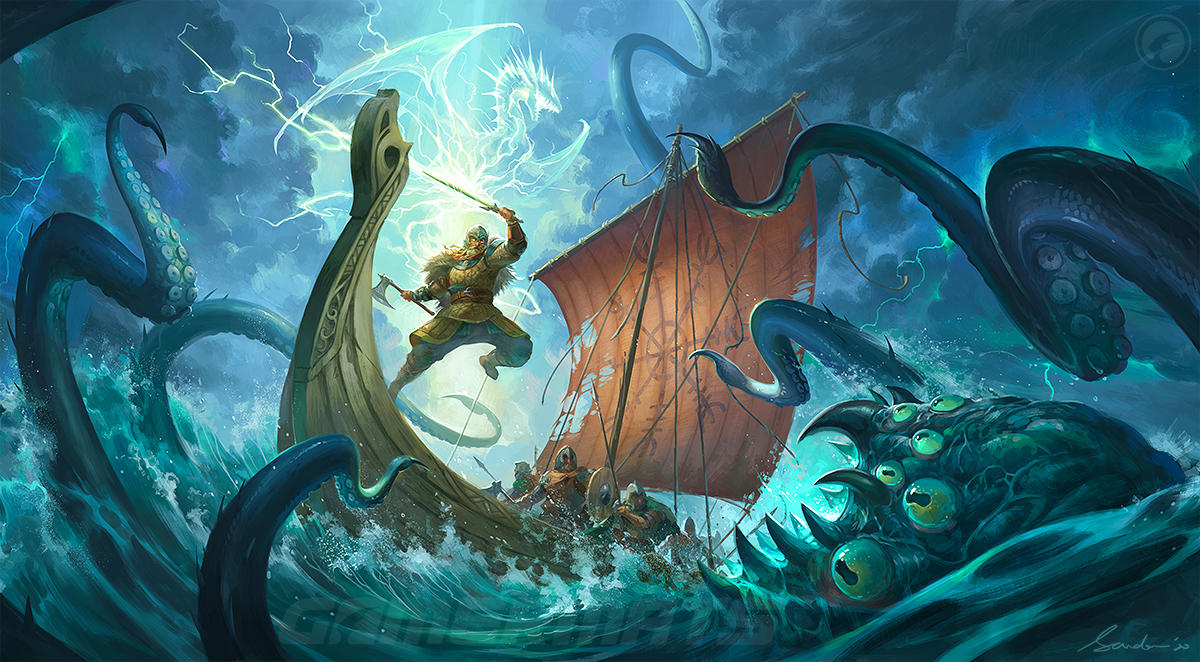
- Colossal Proportions: The creature was routinely described as being larger than the largest man-made ships of the era.
- Formidable Appendages: It possessed an array of thick, muscular tentacles capable of ensnaring entire vessels.
- The Island Illusion: The most infamous trait attributed to the Kraken was its deceptive camouflage. Its broad, dark back would breach the surface, covered in seaweed and barnacles, tricking weary sailors into anchoring upon it. Once the creature felt the disturbance of a fire or a dropped anchor, it would submerge, plunging the crew into disaster.
- Overwhelming Presence: Accounts frequently emphasized the beast’s dark, fathomless eyes and the overpowering, foul-smelling slime it purportedly left behind on the water’s surface.
Chronology: The Evolution of the Kraken in History
The legend of the Kraken did not appear overnight; rather, it evolved through centuries of mariner tales, scholarly texts, and changing cultural perceptions of the ocean.
1. Ancient Roots and Early Norse Sagas (Pre-13th Century)
Long before it was formally named "the Kraken," early Norse literature and Viking-era oral traditions frequently referenced giant sea monsters. Texts such as the Örvar-Odds saga speak of terrifying sea beasts like the Hafgufa (sea-mist) and the Lyngbakr (heather-back), creatures of colossal size that possessed habits mirroring those later attributed to the Kraken.
2. The First Written Accounts (18th Century)
The first formal, detailed descriptions of the Kraken in print emerged from Scandinavian natural historians and ecclesiastical figures who attempted to catalog the wonders and terrors of the North.
- Erik Pontoppidan (1752): The Bishop of Bergen, Erik Pontoppidan, provided the most influential and comprehensive description of the Kraken in his seminal work, The Natural History of Norway. Pontoppidan described the creature not merely as a fairy tale, but as a living entity of "the largest sea-monster in the world." He documented accounts from Norwegian fishermen who claimed that the Kraken was roughly a mile and a half in circumference, acting almost like a floating island before diving and creating dangerous swells.
3. Scientific Skepticism and Reclassification (19th Century)
As the Age of Sail gave way to the Age of Steam and rigorous scientific inquiry, naturalists began to strip away the supernatural hyperbole surrounding the Kraken.
- The Discovery of the Giant Squid (1857): Danish naturalist Japetus Steenstrup formally described the giant squid (Architeuthis dux) after studying large beak fragments washed ashore. This monumental discovery provided a tangible biological anchor for the centuries-old myths. Sailors’ exaggerated tales of island-sized beasts with sprawling tentacles were suddenly re-evaluated as distorted encounters with real, albeit rarely seen, deep-sea cephalopods.
- Herman Melville and Literary Immortality (1851): Just prior to formal scientific classification, the Kraken-adjacent imagery permeated classic literature. In Moby-Dick, Melville references the "Great Heidelburgh Tun" and monolithic sea-terrors, cementing the archetype in global literature.
4. Modern Pop Culture and Cryptozoology (20th–21st Century)
In the modern era, the Kraken has transcended its Scandinavian origins to become a global pop-culture fixture. It appears regularly in blockbuster cinema (such as Pirates of the Caribbean and Clash of the Titans), high-fantasy literature, video games, and professional sports (most notably the Seattle Kraken NHL franchise). Simultaneously, cryptozoologists and marine biologists continue to study giant and colossal squids, proving that the ocean still holds secrets capable of inspiring genuine awe.
Supporting Data: Dimensions, Biology, and Real-World Counterparts
While a creature the size of an island is physically impossible under the laws of biology and physics, the natural world provides staggering precedents that explain how the Kraken myth was born.
The Limits of Biological Size
Fictional descriptions often portray the Kraken as unbound by real-world constraints. In reality, large marine animals face severe physiological hurdles:
- Oxygen and Metabolism: Maintaining a body the size of a warship would require an impossible caloric intake and an extraordinarily complex respiratory system, especially in the oxygen-poor depths of the deep sea.
- Square-Cube Law: As an animal increases in size, its volume grows much faster than its surface area and muscle strength, limiting how massive a soft-bodied creature can become before it collapses under its own weight out of water.
Real-World Equivalents: Architeuthis dux and Mesonychoteuthis hamiltoni
Science has revealed two primary living inspirations behind the Kraken myth:
| Species | Estimated Maximum Length | Weight | Primary Habitat |
|---|---|---|---|
| Giant Squid (Architeuthis dux) | Up to 13 meters (43 feet) | Up to 275 kg (600 lbs) | Deep ocean worldwide, frequently North Atlantic |
| Colossal Squid (Mesonychoteuthis hamiltoni) | Up to 14 meters (46 feet) | Up to 500 kg (1,100 lbs) | Southern Ocean, Antarctic depths |
These creatures possess formidable anatomical features that align with Kraken lore:
- The Beak: A giant squid possesses a razor-sharp, chitinous beak capable of snapping bone and tearing flesh.
- Tentacles with Suction Cups and Hooks: Equipped with powerful suckers and, in the case of the colossal squid, rotating hooks, their tentacles are designed to capture and hold struggling prey in pitch-black water.
- Bioluminescence: Many deep-sea cephalopods possess light-producing organs, adding an eerie, supernatural element to any rare encounter near the surface.
Official Responses and Maritime Perspectives
Historically, maritime authorities, navy officers, and commercial captains took the threat of deep-sea monsters seriously, viewing them as genuine navigational hazards alongside rogue waves, storms, and uncharted reefs.

Historical Authority and Testimony
In his 18th-century writings, Bishop Pontoppidan emphasized that his accounts of the Kraken were gathered from credible, seasoned Norwegian fishermen and sea captains who swore to the veracity of their observations under oath. For these mariners, acknowledging the presence of the beast was a matter of survival and situational awareness.
Modern Marine Science and Conservation Stance
Today, marine biologists and institutions—such as the National Oceanic and Atmospheric Administration (NOAA) and various international oceanographic research bodies—approach the Kraken through the lens of history, education, and marine conservation.
- Debunking the Supernatural: Modern science firmly separates the mythical elements (island-sized bodies, world-ending whirlpools) from biological reality.
- Protecting the Deep Sea: Ironically, while ancient sailors feared what lay beneath the waves, modern scientists advocate for the protection of these deep-sea habitats. The giant and colossal squids remain poorly understood precisely because they inhabit the extreme depths (the bathypelagic zone) of the ocean—regions largely undisturbed by human activity until recently.
- The Unknown Frontier: Oceanographers frequently remind the public that we know more about the surface of the Moon than we do about Earth’s deep ocean trenches. In this sense, the spirit of the Kraken persists as a reminder of how much of our own planet remains unexplored and mysterious.
Implications: Why the Kraken Endures
The persistence of the Kraken legend across centuries reveals profound truths about human psychology and our relationship with the natural world.
1. The Psychology of the Unknown
Throughout history, humans have relied on mythology to rationalize what science could not yet explain. The vast, pitch-black expanse of the North Atlantic was a terrifying theater where imagination filled the gaps left by empirical knowledge. The Kraken transformed a generalized, abstract fear of drowning into a tangible, formidable antagonist.
2. Shifts in Environmental Awareness
As society transitioned from viewing the ocean as a hostile monster to be conquered, to an fragile ecosystem requiring protection, the cultural role of the Kraken shifted as well. Once a symbol of nature’s wrath directed at human travelers, the giant squid and its mythological ancestor now serve as ambassadors for the majesty and mystery of the deep sea.
3. Cultural Resilience and Storytelling
Ultimately, the Kraken stands as a testament to the power of folklore. Even in an era dominated by satellite imaging, deep-sea submersibles, and rigorous scientific taxonomy, humanity retains a deep-seated appetite for the wondrous and the terrifying. Whether through blockbuster films, video games, or historical retrospectives, the Kraken continues to reign supreme as the undisputed monarch of the maritime mythos—reminding us that beneath the calm surface of the sea, the world is far stranger, wilder, and more wondrous than we can possibly imagine.