









JERUSALEM — Archaeological discoveries often validate ancient texts, bridge cultural divides, or shed light on lost civilizations. Occasionally, however, an artifact emerges from the dust that feels uncannily familiar—resembling something straight out of modern fantasy fiction or classical mythology.
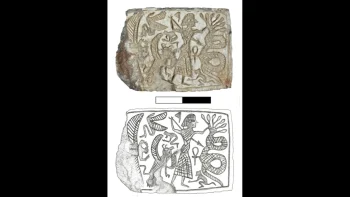
Such is the case with a remarkable 2,800-year-old stamp seal recently analyzed by researchers in the Levant. Measuring barely larger than a modern postage stamp, this tiny stone artifact depicts a timeless and universal narrative: a valiant hero locked in mortal combat with a terrifying, multi-headed serpent.
Far more than a simple piece of ancient artistry, this artifact has sent ripples through the academic community. Historians, biblical scholars, and mythologists view the seal as a missing physical link connecting diverse ancient traditions, shedding new light on how epic motifs of monster-slaying traversed the ancient Near East, ultimately embedding themselves in Hebrew scripture and Greco-Roman mythology.
Main Facts: The Discovery and Its Iconography
The artifact in question is a conical stamp seal dating back to the Iron Age II period, approximately 8th century BCE. Unearthed in the historical regions of the southern Levant, the stone object features an intricately carved intaglio design intended to leave a raised impression when pressed into wet clay or wax.
The primary scene captured on the seal’s face is dynamic and violent:
- The Hero: A human figure, depicted with the distinct stylistic markers of Iron Age Levant iconography, stands in an aggressive, offensive posture.
- The Beast: Looming before the hero is a monstrous serpentine entity adorned not with one head, but with seven distinct, writhing serpents.
- The Symbolism: The composition portrays the classic trope of cosmic order versus primordial chaos. The hero represents civilization, divine order, and light, while the seven-headed beast symbolizes the untamed, destructive forces of the abyss.
Archaeologists and epigraphers emphasize that the execution of the carving points to a high level of craftsmanship. This was not a child’s toy or a rudimentary amulet; it was likely owned by a high-ranking official, a merchant of considerable means, or a local administrator who utilized the seal to authenticate documents and secure property. The choice of a seven-headed serpent motif highlights the cultural significance of the imagery to its owner and contemporaries.
Chronology: Tracing the Seven-Headed Serpent Through Time
To understand the profound weight of this 2,800-year-old seal, one must trace the genealogy of the multi-headed serpent motif across the ancient world. The trope of the aquatic, multi-headed dragon or serpent is remarkably persistent, evolving across centuries and migrating between civilizations through trade, conquest, and shared cultural exchange.
1. The Bronze Age Roots: Mesopotamian and Ugaritic Precedents
Long before the Iron Age seal was carved, the archetype of the multi-headed monster was already well-established in Near Eastern mythos. In ancient Mesopotamian and Canaanite literature, chaos monsters were standard personifications of the primordial sea.
At the coastal Syrian site of Ugarit, texts dating back to the Late Bronze Age (circa 1400–1200 BCE) speak of Lotan (or Lôtān), a twisting, fugitive serpent with seven heads. In the Baal Cycle, the storm god Baal battles Lotan to establish cosmic order. This Ugaritic imagery bears a striking linguistic and thematic resemblance to the biblical Leviathan.
2. The Iron Age Seal (8th Century BCE)
Fast forward to the era of the newly discovered seal. During the 8th century BCE, the Levant was a geopolitical melting pot. The Neo-Assyrian Empire was expanding its shadow over the region, while local kingdoms—Israel, Judah, Phoenicia, and the Philistine city-states—interacted, traded, and exchanged religious and cultural ideas.
It is within this volatile crucible of empires that the seal was crafted. It serves as physical evidence that the literary motifs found in epic poetry were actively visualized and carried by everyday people in the form of personal signets.
3. Biblical Literature and Hebrew Tradition
The cultural memory of the seven-headed serpent naturally bled into Hebrew scripture. In the Hebrew Bible, the creature known as Leviathan appears multiple times as a symbol of cosmic chaos and divine conquest.
While the Pentateuch and historical books reference Leviathan as a formidable sea creature, later prophetic literature evokes the imagery more explicitly. A notable parallel is found in Psalm 74:14, which recalls God breaking the heads of Leviathan in the waters. Centuries later, this ancient Near Eastern motif reaches its apocalyptic zenith in the New Testament Book of Revelation, where a great red dragon with "seven heads and ten horns" wages war in heaven.
4. Classical Antiquity: The Hellenic Hydra
As maritime trade and Mediterranean cultural exchange intensified, Near Eastern motifs migrated westward into the Hellenic world. Greek mythology adopted the concept of the multi-headed water serpent in the form of the Lernaean Hydra, battled by the legendary hero Hercules as the second of his Twelve Labors.
While Greek artists eventually standardized the Hydra as a swamp-dwelling serpent with anywhere from five to dozens of heads, the foundational concept—a multi-headed chthonic beast that regenerates or poses an insurmountable multi-pronged threat—shares a deep genetic ancestry with the Canaanite Lotan and the imagery preserved on the 8th-century BCE seal.
Supporting Data: Archaeological and Comparative Analysis
The validation of such an artifact requires rigorous comparative analysis by numismatists, iconographers, and historians. Researchers have cataloged thousands of seals from the ancient Levant, Mesopotamia, and Persia, allowing them to contextualize this specific find.
- Material and Typology: The seal is fashioned from a durable semi-precious stone common to the region during the Iron Age II. Its conical shape is characteristic of neo-Assyrian and local Levantine glyptic art from the 9th to 7th centuries BCE.
- Stylistic Parallels: Similar iconography has occasionally surfaced on cylinder seals from Mesopotamia, but finding a stamp seal of local Levantine manufacture depicting a distinct seven-headed variant is exceedingly rare. Most Iron Age stamp seals feature single-headed serpents, scorpions, or stylized palm trees.
- Epigraphic Context: While the seal lacks a full inscription, the artistic style of the human figure—particularly the rendering of the tunic, hair, and posture—aligns precisely with contemporaneous artifacts recovered from secure archaeological strata in Samaria, Jerusalem, and Megiddo.
This convergence of material culture, artistic style, and mythological tradition provides scholars with a robust dataset, confirming that the artifact is an authentic product of the Iron Age Levant rather than a modern forgery or an anomaly.
Official Responses and Academic Perspectives
The unveiling of the seal has sparked enthusiastic commentary from leading archaeologists and ancient historians specializing in the Levant and Near Eastern mythology.
Dr. Alon Cohen, a prominent Near Eastern archaeologist involved in the artifact’s broader comparative study, noted the unique nature of the find during a recent symposium:
"We often study ancient myth through texts—damaged clay tablets, faded papyri, and centuries-old parchment manuscripts. What makes this seal so profoundly exciting is that it brings the myth down to earth. It shows us that ordinary people, or at least elite administrators of the 8th century BCE, carried this cosmic battle in their pockets. They used it to sign documents, effectively stamping their daily business with the ultimate victory of order over chaos."
Meanwhile, biblical scholar Dr. Rachel Sterling emphasized the intertextual value of the discovery:
"For generations, scholars have debated the directional flow of mythological motifs. Did the Greeks influence the Near East, or did the Levant absorb traditions from Mesopotamia and Canaan? This seal acts as a physical anchor in the 8th century BCE, right in the heart of the Levant, demonstrating that the conceptual framework of the multi-headed chaos monster was vibrant, active, and shared long before the Hellenistic period."
Museum curators and cultural preservationists have also praised the discovery, noting that it reinforces the importance of meticulous artifact recovery and provenance tracking in a region rich with overlapping histories.
Implications: Rewriting the Narrative of Cultural Transmission
The implications of this 2,800-year-old seal extend far beyond a single neat archaeological anecdote. They force a re-evaluation of how cultural ideas spread and persisted across the ancient Mediterranean and Near Eastern worlds.
1. Visualizing the Invisible
Ancient peoples did not separate their religious, mythological, and daily lives into neat compartments. By placing a cosmic battle against a seven-headed monster on an administrative stamp seal, the owner was invoking powerful protective and authoritative magic. Every time the seal was pressed into clay, the owner symbolically reenacted the defeat of chaos, projecting strength, stability, and divine favor.
2. Bridging the Gap Between East and West
The artifact provides tangible support for diffusionist and contact theories in ancient history. It proves that the literary tropes found in Ugaritic poetry and later adapted into biblical and Greek literature were part of a shared visual and cultural vocabulary. The monster with many heads was a universally understood symbol of existential dread that required a heroic champion to conquer.
3. A Precursor to Modern Fantasy
On a cultural level, the seal serves as a fascinating historical mirror to modern storytelling. Humanity’s enduring obsession with heroic archetypes—warriors facing impossible odds, multi-headed dragons guarding forbidden realms, and the eternal struggle between light and darkness—is proven to be at least 2,800 years old in this specific artistic medium, and arguably much older in oral tradition.
Conclusion
As researchers continue to clean, scan, and analyze the seal, it stands as a testament to the depth of human imagination and the continuity of storytelling. The next time modern audiences marvel at legendary heroes battling multi-headed hydras in cinema, literature, or gaming, they can look back to a tiny stone carved in the Levant 2,800 years ago.
The hero on the seal may be faceless to modern eyes, and the beast he fights may be frozen in stone, but their epic struggle echoes across the millennia—a reminder that the stories we tell today are direct descendants of the myths that shaped the ancient world.