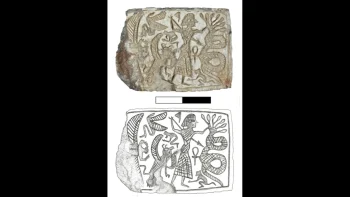
JERUSALEM — In the realm of archaeology, discoveries are rarely confined to the physical objects pulled from the earth; more often, they are keys that unlock the deep, interconnected architecture of human thought. Such is the case with a remarkable 2,800-year-old artifact recently brought to the forefront of academic discussion in Israel. Measuring mere centimeters across, this ancient stamp seal bears an intricate engraving depicting an epic struggle: a valiant hero locked in mortal combat with a terrifying, seven-headed serpent.
Far from a simple piece of primitive artistry, researchers and Near Eastern scholars suggest this small relic represents a monumental missing puzzle piece. It bridges a vast historical and cultural chasm, tying together the ancient mythologies of the Levant, Mesopotamia, the Hebrew Bible, and classical Greece. From the legendary Labors of Hercules to the apocalyptic imagery of biblical texts, the trope of the multi-headed chaos monster has haunted the human imagination for millennia. Now, experts believe this tiny seal may capture one of the pivotal evolutionary steps of that enduring narrative.
Main Facts: The Relic, the Imagery, and the Discovery
The artifact in question is an iron-age stamp seal, an administrative and ritual object common in the ancient Levant during the Neo-Assyrian period, roughly spanning the 8th century BCE. Crafted from stone, the seal was designed to be pressed into wet clay to authenticate documents, goods, or property—yet the miniature canvas carved into its face tells a story of cosmic proportions.
The iconography is striking and immediately recognizable to students of mythology. It depicts a dominant human figure—interpreted as a divine warrior or hero—engaged in a fierce confrontation with a monstrous serpentine entity featuring not one, but seven distinct heads.
Key elements of the find include:
- The Date: Archaeological context places the seal firmly in the 8th century BCE (approximately 2,800 years ago), a time of intense geopolitical upheaval, cultural exchange, and religious syncretism in the southern Levant.
- The Motif: The seven-headed serpent is a rare, highly specific motif in ancient Near Eastern art. While serpents and dragons are common symbols of chaos, the specific enumeration of seven heads directly mirrors descriptions found in later religious and mythological texts across the Mediterranean and Near East.
- The Medium: As a stamp seal, the object was meant to be carried, traded, and utilized daily, suggesting that the mythological motif it bore held profound, active cultural significance for the people who used it.
According to epigraphers and art historians studying the piece, the engraving is not merely decorative. It serves as a visual encapsulation of the Chaoskampf—the primordial battle between an order-bringing deity or hero and a chaotic sea monster, a foundational trope in ancient cosmologies.
Chronology: The Evolution of the Seven-Headed Serpent
To understand the weight of this 2,800-year-old seal, one must trace the chronological footprint of the multi-headed serpent across the ancient world. The motif did not emerge in a vacuum; rather, it evolved through centuries of oral tradition, religious transformation, and cross-cultural trade.
1. The Bronze Age Roots (Third to Second Millennium BCE)
Long before the creation of the Israeli seal, the foundational blueprints for the chaos serpent were being forged in Mesopotamia and the Levant. In ancient Sumerian and Akkadian mythologies, deities like Ninurta and Marduk battled monstrous serpentine entities such as Tiamat and Bashmu. While Tiamat is often envisioned generally as a primordial dragon of the deep, contemporary Ugaritic texts from ancient Canaan (modern-day Syria) explicitly mention multi-headed foes. The Baal Cycle, discovered in the ruins of Ugarit and dating back to the 14th century BCE, explicitly describes the storm god Baal defeating Lotan (the linguistic and thematic precursor to the biblical Leviathan), characterized as a "fleeing serpent" and a "wriggling serpent, the tyrant with seven heads."
2. The Iron Age Pivot (Eighth Century BCE)
The newly highlighted Israeli seal fits squarely into this chronological window. During the 8th century BCE, the Neo-Assyrian Empire exerted massive political and cultural dominance over the Levant. This era saw an intense blending of Mesopotamian, Canaanite, and local Israelite iconographies. The seal acts as a physical snapshot of this period, demonstrating how the motif of the seven-headed beast was actively circulating, being reinterpreted, and utilized in daily administrative and protective magic across the region.
3. The Classical and Biblical Era (First Millennium BCE to First Millennium CE)
As centuries progressed, the imagery of the multi-headed serpent trickled into classical Greek mythology and Judeo-Christian literature.
- In Greek tradition, the Lernaean Hydra—slain by Hercules as the second of his Twelve Labors—possessed multiple heads (often depicted as nine, but historically fluid in early depictions) and regenerated new ones when severed, symbolizing unending chaos.
- In the Hebrew Bible, references to Leviathan retain the echoes of the Ugaritic chaos dragon. While the Old Testament generally tames Leviathan into one of God’s magnificent sea creatures, later apocalyptic literature—most notably the Book of Revelation in the New Testament—revives the primordial imagery in full force, describing a "great red dragon with seven heads and ten horns" that wages war in heaven.
Supporting Data: Comparative Mythology and Archaeological Context
The significance of the seal is amplified when examined alongside archaeological data from contemporary excavations throughout the southern Levant and Mesopotamia.
Iconographic Parallels
Archaeologists have long cataloged cylinder and stamp seals from the Neo-Assyrian and Neo-Babylonian periods featuring divine combat. However, instances featuring specifically seven heads are exceedingly rare.
- A comparable representation can be found on ancient Mesopotamian boundary stones (kudurrus), where serpentine symbols frequently appear alongside divine emblems to ward off oath-breakers and thieves.
- In Ugaritic poetry, the numeric descriptor "seven" often denotes totality, completeness, or overwhelming power rather than a strict anatomical count. Therefore, a "seven-headed serpent" was understood by ancient audiences not merely as an unusual animal, but as the ultimate embodiment of cosmic disorder, rebellion against divine rule, and existential threat.
The Geographic Crossroads
The discovery of the artifact within the geographical confines of ancient Israel highlights the porous nature of borders in the ancient world. The southern Levant was a crucible where Egyptian, Mesopotamian, Phoenician, and local traditions collided. The presence of a sophisticated Chaoskampf motif on a portable object indicates that merchants, scribes, and officials across the region shared a common visual and narrative vocabulary, regardless of their specific linguistic or religious affiliations.
Official Responses and Scholarly Perspectives
The academic community has received the insights surrounding the seal with profound enthusiasm, viewing it as a tangible anchor for abstract literary theories.
Dr. Elena Vance, a Near Eastern art historian specializing in Iron Age iconography, notes the exceptional nature of the find:
"When we read ancient texts like the Ugaritic Baal Cycle or biblical passages mentioning multi-headed sea monsters, modern readers often struggle to visualize how ancient people actually conceived of these beasts. This seal provides the missing visual link. It proves that the seven-headed serpent was not merely a poetic metaphor confined to scribal elite circles; it was a deeply ingrained cultural image that resonated in popular iconography."
Meanwhile, biblical archaeologist Thomas R. Sterling emphasizes the cross-cultural transmission of the myth:
"What this artifact demonstrates is the remarkable persistence of a narrative meme across millennia. The battle between the divine hero and the multi-headed dragon of the deep is essentially the same story told in Sumer, Ugarit, Israel, and Greece. The seal shows us the exact historical conduit through which these ideas were being shared, adapted, and preserved during a time of great imperial shifts in the ancient Near East."
Museum curators and conservation specialists handling the artifact have also stressed the importance of non-destructive imaging techniques—such as high-resolution RTI (Reflectance Transformation Imaging)—which have allowed researchers to map the microscopic chisel marks left by the ancient artisan, revealing a surprising level of anatomical detail in the serpent’s writhing coils and individual heads.
Implications: Rewriting the Narrative of Ancient Cultural Diffusion
The implications of this 2,800-year-old relic extend far beyond a single interesting museum piece; they challenge how modern historians understand the spread and persistence of foundational human myths.
1. Re-evaluating Text and Image Relationships
For decades, scholars of religion debated whether ancient iconography influenced sacred texts, or if texts inspired art. This artifact suggests a dynamic, bidirectional feedback loop. The visual motif of the hero battling the seven-headed serpent reinforced oral traditions that would eventually crystallize into the epic literature of the Bible and classical antiquity. It serves as proof that ancient people lived within a deeply visual mythic landscape.
2. The Universality of the Chaos Narrative
Psychologically and culturally, the persistence of the multi-headed serpent speaks to humanity’s enduring fascination with the struggle against overwhelming, chaotic forces. Whether the heads represent the multifaceted problems of nature, political enemies of an empire, or internal spiritual trials, the Chaoskampf remains one of our most potent storytelling templates. The fact that a merchant or bureaucrat 2,800 years ago used a stamp bearing this image to conduct daily business reminds us of how closely tied ancient administrative life was to cosmic, religious worldviews.
Conclusion: A Tiny Relic with a Giant Legacy
As researchers continue to analyze the microscopic details of the seal and cross-reference its design with newly digitized collections of Near Eastern artifacts, it stands as a monument to the power of storytelling. The next time civilization looks back at the legends of Hercules and the Hydra, or reads the soaring, apocalyptic poetry of ancient texts, it must account for this tiny stone seal. Unearthed from the soil of Israel, it whispers across 28 centuries, reminding us that the monsters we fear—and the heroes we cheer for—have been with us since the very dawn of history.