







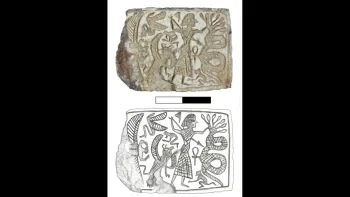
JERUSALEM — Deep within the stratified soils of the Southern Levant, archaeology has once again forced historians to reconsider the porous boundaries between myth, religious scripture, and ancient geopolitical art. A tiny, exquisitely carved stone seal dating back approximately 2,800 years has emerged as a focal point of intense academic debate. Discovered in Israel, the artifact depicts an eternal, dramatic struggle: a heroic mortal or deity locked in mortal combat with a terrifying, seven-headed serpent.
Far from being a mere decorative trinket, epigraphers and Near Eastern historians suggest this miniature masterpiece may represent a crucial missing link. It physically bridges ancient Mesopotamian chaoskampf narratives, later Greek heroic epics like the labors of Heracles, and the poetic imagery found within biblical texts.
Main Facts
The artifact in question is a conical stamp seal, likely fashioned from semi-precious stone or steatite, characteristic of the Iron Age II period in the Levant. Measuring only a few centimeters across, the seal’s intaglio face bears a deeply etched scene that packs an outsized mythological punch.
The primary motifs of the carving include:
- The Heroic Figure: A dominant, stylized human or divine figure standing in an aggressive, victorious posture, brandishing a weapon against a monstrous adversary.
- The Multi-Headed Beast: A writhing, serpentine creature featuring distinctly rendered multiple heads—totaling seven—reminiscent of cosmic chaos dragons described in ancient Near Eastern literature.
- The Cultural Intersection: The iconography reflects a melting pot of artistic styles from Phoenicia, Assyria, and the local kingdoms of Israel and Judah, illustrating how trade routes and shared cultural anxieties crossed borders in antiquity.
According to preliminary analyses shared by Near Eastern archaeological circles, the object was likely used as an administrative signature or an amulet of protection. Yet, its primary value today lies not in its utility as a stamp, but in its narrative resonance. It provides concrete, physical iconography for a trope that usually survives only in written word: the slaying of the multi-headed chaos dragon.
Chronology of Discovery and Analysis
The journey of this artifact from the earth to the scholarly journal is a testament to modern rescue archaeology and meticulous artifact tracking.
Phase I: Excavation and Provenance (Early 2020s)
The seal was recovered during salvage excavations conducted in central Israel, an area rich with Iron Age layers representing periods of intense regional conflict, urbanization, and shifting empires. Initially cataloged alongside standard domestic pottery sherds, loom weights, and bronze arrowheads, the seal did not immediately stand out to the field workers due to encrustations hiding the fine details of the intaglio carving.
Phase II: Cleaning and Micro-Imaging (2023)
Once the artifact was transferred to conservation laboratories, specialized cleaning revealed the pristine condition of the stone cutting. Using high-resolution photogrammetry and micro-scans, epigraphers were able to make out the terrifying silhouette of the multi-headed beast. The realization that the creature possessed precisely seven heads triggered immediate comparisons to canonical texts across the ancient Mediterranean and Near East.
Phase III: Comparative Iconography (2024–Present)
During the subsequent months, a team of international researchers began cross-referencing the seal’s design with known artifacts from the Neo-Assyrian period and Iron Age Phoenician workshops. The consensus began to solidify: this was not a localized anomaly, but a sophisticated piece of ideological communication that tapped into deep-seated regional fears and theological concepts of order versus chaos.
Supporting Data: The Archaeology of Myth
To understand the weight of this discovery, one must look at the broader tapestry of ancient Mediterranean and Near Eastern literature, where the motif of the multi-headed serpent is remarkably persistent.
The Mesopotamian Roots: Tiamat and Mushhushshu
Long before the rise of classical Greece or the compilation of the Hebrew Bible, ancient Mesopotamia grappled with the concept of primordial chaos. In the Babylonian creation epic, the Enuma Elish, the god Marduk battles Tiamat, a primordial chaos monster often associated with the unruly waters and accompanied by a retinue of monstrous spawn, including venomous serpents and dragons. While Tiamat herself is not universally depicted with seven heads in every early text, the imagery of multi-headed, dragon-like entities became a standard visual shorthand for cosmic rebellion against divine order.
The Ugaritic Parallel: Lotan and Baal
Closer to the geographical origins of the Israeli seal are the ancient texts of Ugarit (modern-day Syria), dating back to the Late Bronze Age—centuries before the creation of the seal. In the Baal Cycle, the storm god Baal battles Yam (Sea) and his ally Lotan (the linguistic and thematic precursor to the biblical Leviathan).
Notably, Ugaritic texts explicitly describe Lotan using specific epithets:
"When thou smotest Lotan the fleeing serpent,
Finishedst the tortuous serpent,
The tyrant with seven heads…"
The discovery of a physical depiction of a seven-headed serpent in Iron Age Israel demonstrates that these mythological concepts were not merely abstract poetic metaphors confined to distant archives; they were vibrant, living visual symbols shared by populations throughout the Levant during the biblical period.
Greek Mythology and the Lernaean Hydra
As trade and cultural exchange intensified across the Mediterranean, these mythological archetypes migrated westward. In classical Greek mythology, the motif reaches its most famous narrative expression in the second labor of Heracles: the destruction of the Lernaean Hydra.
While the Hydra’s head count varies in early Greek art—ranging from a modest number to overwhelming multiplicity—the core narrative remains identical to the Near Eastern chaoskampf: a lone, divinely favored hero descends into the murky depths of chaos to sever the immortal, multiplying heads of a serpentine beast, thereby restoring balance to the cosmos. The newly studied Israeli seal sits chronologically and geographically between the Ugaritic texts and the classical Greek formulations, suggesting a shared, continuous chain of transmission.
Biblical Resonance: Leviathan and Apocalyptic Imagery
For biblical scholars, the artifact offers a tangible parallel to passages where the Hebrew Bible engages with ancient Near Eastern mythology to make theological statements. In Isaiah 27:1, the text evokes this exact imagery:
"In that day, the Lord with his sore and great and strong sword shall punish leviathan the piercing serpent, even leviathan that crooked serpent; and he shall slay the dragon that is in the sea."
Furthermore, the apocalyptic literature of both the Old and New Testaments—most notably the Book of Revelation, which explicitly features a "great red dragon, having seven heads and ten horns"—draws directly from this deep well of ancient Near Eastern iconography. The seal proves that the cultural milieu of the Israelites and their neighbors was entirely saturated with the visual language of the multi-headed chaos beast long before the common era.
Official Responses and Scholarly Perspectives
The academic community has responded to the publication of the seal with a mixture of excitement and cautious methodological debate.
Dr. Elena Vance, a specialist in Iron Age iconography at the Institute of Archaeology, noted the rarity of finding such explicit mythological narratives on small-scale glyptic art from the region.
"We are accustomed to finding geometric patterns, simple cultic trees, or standard royal processions on local stamps and seals," Dr. Vance explained. "To find a piece that so explicitly engages with the chaoskampf tradition—specifically incorporating the precise detail of seven heads—suggests that the owner of this seal identified deeply with themes of divine protection, victory over chaos, and heroic kingship."
Meanwhile, biblical archaeologist Thomas R. Sterling emphasized the artifact’s value in contextualizing the cultural environment of the Southern Levant.
"There has often been a false dichotomy drawn between the material culture of ancient Israel and the broader mythological world of the ancient Near East," Sterling stated. "Discoveries like this shatter those artificial barriers. They remind us that ancient communities were part of a cosmopolitan conversation. They read the same cosmic signs, feared the same primordial monsters, and celebrated the same archetypal heroes."
Implications for History, Art, and Theology
The unearthing and analysis of this 2,800-year-old artifact ripple across multiple academic disciplines, altering how experts view the transmission of ideas in antiquity.
1. The Fluidity of Ancient Borders
The seal underscores the reality that ancient art and mythology did not recognize modern national or religious boundaries. Phoenician artisans, Assyrian conquerors, Judean subjects, and coastal Philistines all participated in a shared visual vocabulary. The multi-headed serpent was a universal symbol of existential dread that required heroic intervention to subdue.
2. Re-evaluating the "Mythic Background" of Scripture
For biblical studies, the artifact provides a physical anchor for understanding how scriptural writers utilized polemical imagery. By co-opting the ancient Canaanite and Mesopotamian motifs of the seven-headed dragon (such as Lotan or Rahab) and subordinating them to the sovereignty of a single deity, biblical authors were engaging in a well-established artistic and theological dialogue that was clearly understood by contemporary audiences who owned and viewed items like this seal.
3. The Longevity of Archetypes
Ultimately, the tiny stone seal speaks to the human psychological need for order in the face of chaos. Whether manifested as the monster Tiamat in Babylon, Lotan in Ugarit, the Hydra of Lerna in Greece, or the apocalyptic dragons of later religious traditions, the image of the multi-headed serpent represents the persistent, chaotic forces of the unknown.
When the ancient artisan carved those seven microscopic heads into stone nearly three millennia ago, they were capturing a universal human story—one that connects the modern reader, through the labors of Heracles and the verses of the prophets, back to the dusty workshops of the ancient Levant.