









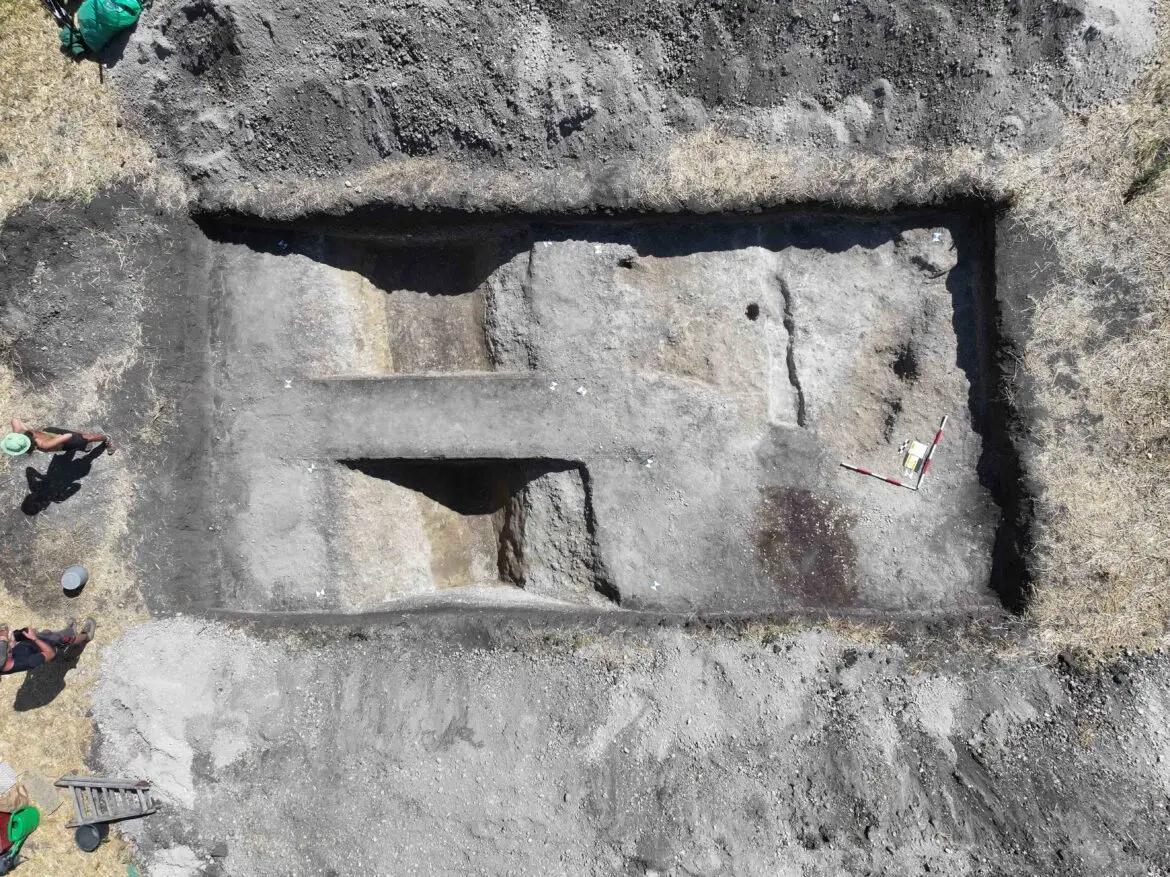
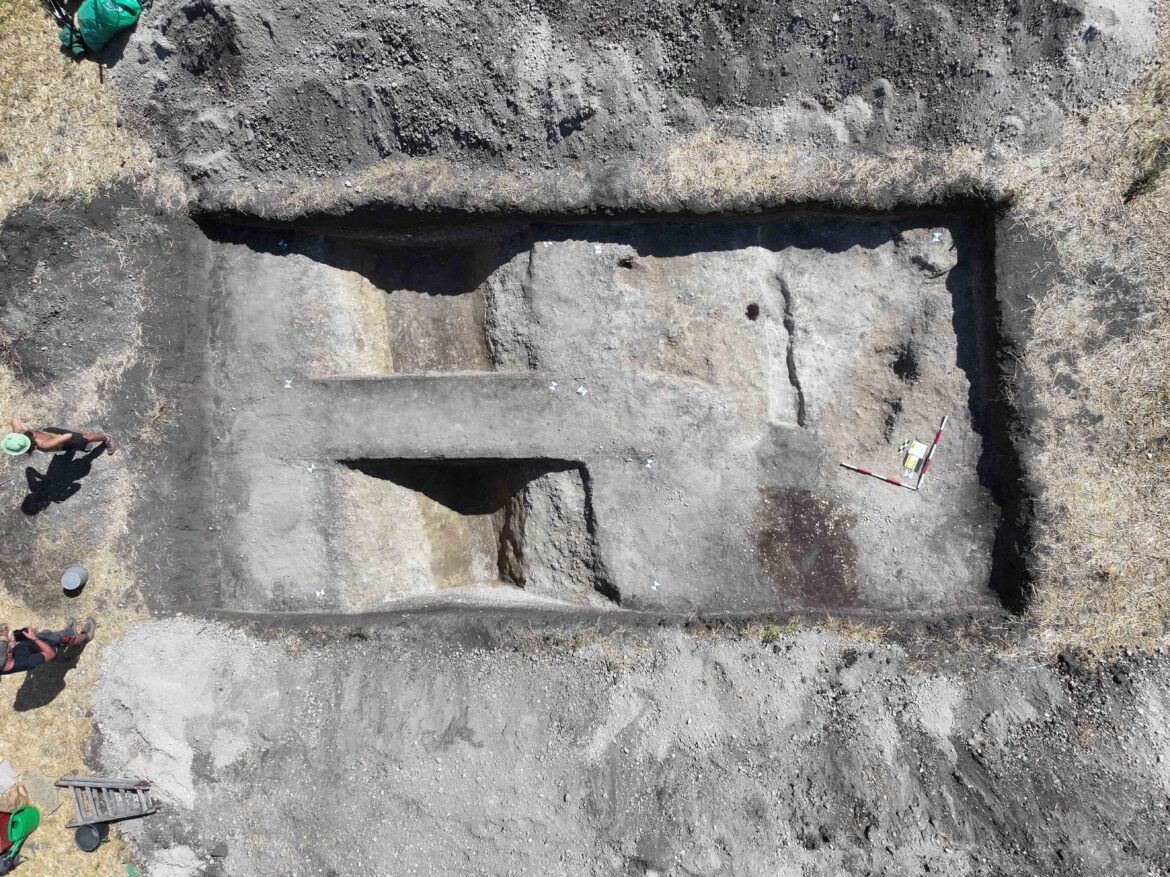
CHLEBY, Czech Republic — Deep in the agricultural flatlands of Central Bohemia, a team of international and local archaeologists is rewriting the early history of European astronomy and ritual architecture. Recent excavations and advanced three-dimensional spatial analysis of a massive prehistoric enclosure near the village of Chleby have revealed a breathtaking discovery: a monumental, 6,500-year-old sanctuary featuring architectural alignments deliberately mapped to the celestial movements of the Sun and the Moon.
The site, measuring a staggering 230 meters (approximately 755 feet) in diameter, not only stands as one of the oldest monumental enclosures ever discovered in Central Europe, but it also predates the principal phases of England’s world-famous Stonehenge by more than a millennium. Far from being a mere primitive defensive ditch or a basic agricultural stockade, the Chleby complex represents an early, sophisticated nexus of sacred geometry, celestial tracking, and profound communal ritual.
Main Facts: The Chleby Enclosure
The monumental earthwork at Chleby is defined by an immense, near-circular perimeter ditch that plunges more than 2.5 meters (8 feet) deep into the native soil. Carved into this massive earth-moving project are 12 distinct, irregularly spaced entrances. Rather than serving simple functional purposes, these gateways are the key to unlocking the site’s astronomical purpose.
Led by Petr Krištuf of the Department of Archaeology at the Faculty of Arts of the University of West Bohemia (UWB), researchers utilized cutting-edge geospatial surveys, remote sensing, and 3D modeling to understand how the monument interacts with the horizon. Their findings indicate that the 12 entrances were meticulously placed to frame specific celestial events.
The structural layout relies on two principal observation axes:
- The Solar Alignment: One axis locks onto the sunrise of the summer solstice and directly mirrors the sunset of the winter solstice. This dual-point alignment establishes a direct conceptual bridge between the genesis of the solar year and its nadir—a motif famously immortalized millennia later at Stonehenge.
- The Lunar Alignment: The second primary perspective coordinates with the extreme stations of the Moon as it rises and sets along the shifting horizon throughout its complex, roughly 18-year cycle.
The presence of a circular enclosure of this magnitude during this specific era is unprecedented in the region, turning decades of archaeological assumptions about early Central European farming societies on their head. These communities were not just surviving day-to-day; they possessed an intricate, long-term conceptual understanding of the cosmos, embedding astronomical literacy directly into their sacred architecture.
Chronology: From Neolithic Sanctuary to Bronze Age Cemetery
To understand the lifecycle of the Chleby monument, researchers have had to piece together thousands of years of human habitation, ritual transformation, and eventual abandonment. Radiocarbon dating of organic material retrieved from the bottom of the foundational ditches anchors the construction firmly in the Neolithic period, more than 6,500 years ago.
Phase I: The Neolithic Ritual Landscape (c. 4500 BCE)
During the early Neolithic, the site functioned as a grand communal gathering place. The monumental scale of the ditch, paired with the solar and lunar orientations of the 12 gateways, suggests that the location served as a regional calendar and sacred theater. Here, early farming populations gathered to mark critical agricultural transitions, celebrate seasonal turning points, and perform spiritual rites linked to the heavens.
Phase II: The Bronze Age Shift (c. 2000–1600 BCE)
As centuries bled into millennia, the primary function of the Chleby enclosure evolved. Earlier archaeological investigations at the site uncovered a significant collective burial linked to the Early Bronze Age Únětice culture. Rather than a sudden mass grave, the remains of approximately 18 individuals were deposited gradually over an extended period. This indicates that long after the original Neolithic calendar lost its active astronomical use, the ancient earthworks still retained a powerful, sacred geography, serving as a repository for honored ancestors.
Phase III: Iron Age Demolition and Settlement (c. 500 BCE – 1st Century CE)
Unlike Stonehenge—which experienced repeated phases of veneration, rebuilding, and persistent cultural memory well into historic periods—Chleby suffered a striking decline. By the Iron Age, the monument had completely shed its sacred mantle.
"By the Iron Age, the monument appears to have definitively lost its original significance," notes Krištuf. "The ditch was gradually filled in, and an ordinary settlement was established on the site of the former sanctuary."
The sacred landscape was leveled, turning a once-grand celestial temple into everyday domestic real estate.
Supporting Data: Animal Sacrifice and Soil Chemistry
Beyond the stark geometry of the ditches and gateways, archaeological digs have uncovered material culture that shines a light on the ritual behaviors enacted within the Chleby ring.
Foremost among these discoveries are the remains of bovine skulls and horns recovered directly from the enclosure’s perimeter ditches, clustered heavily around the monumental gateways. According to Jan Turek, an archaeologist from Charles University, these artifacts point to an ancient ritual economy.

"We assume that they may originally have decorated monumental gateways leading into the enclosure," Turek explains. "The cult of the bull was an important religious symbol among the first farming communities and is known from many parts of prehistoric Europe."
These bovine remains neatly align Chleby with a wider, pan-European Neolithic reverence for cattle, which often symbolized power, fertility, wealth, and the divine. However, the exact theological nuances of these animal offerings remain a subject of ongoing debate.
To uncover what physical artifacts and bones cannot tell them, researchers are currently deploying advanced soil chemistry. Led by Jan Fišer of the University of Hradec Králové, the team is analyzing chemical signatures—such as phosphorus, organic residues, and heavy metal traces—trapped within the ancient earth.
"In addition to artifacts and the remains of the dead, people leave chemical traces in the soil," Fišer notes. "These can help us understand how this exceptional site was used during different periods of prehistory."
The soil analysis is expected to map invisible zones of activity, highlighting precise locations where communal feasting occurred, where food was prepared, where animal sacrifices took place, or where human bodies were temporarily processed before burial.
Official Responses and Expert Perspectives
The academic community has received the Chleby revelations with intense excitement, as the discovery bridges critical gaps in European prehistory.
"Circular enclosures are completely unknown in our region for this period, which already makes the site exceptional," Petr Krištuf emphasized during the initial site briefings. "But when we began to analyze the positioning of the entrances in detail, it became clear that their arrangement was not random. Their geometry creates a system that made it possible to observe the most significant moments of the solar and lunar cycles."

The explicit comparisons to Stonehenge have naturally dominated public and academic discourse, though researchers are quick to note the differences in cultural trajectory. While the British monument evolved through successive architectural iterations of stone and earth over centuries, maintaining a persistent mystical identity, Chleby represents an earlier, perhaps more ephemeral wooden and earthen architecture that faded into the agricultural landscape long before the Iron Age.
Jan Turek underscores the broader anthropological significance: "For prehistoric farming communities, the connection between sunrise and the summer solstice symbolized a beginning, while sunset and the winter solstice represented an ending… We can now see that the sanctuary at Chleby was designed similarly. Still, more than a thousand years earlier."
Implications: Rewriting the History of European Astronomy
The implications of the Chleby excavations stretch far beyond the borders of the Czech Republic. For decades, monumental astronomical architecture—the deliberate alignment of earth, wood, or stone with the movements of celestial bodies—has frequently been associated with later, highly stratified societies such as those responsible for Stonehenge or the passage tombs of Western Europe.
Chleby pushes that timeline back by more than a millennium, proving that early Central European Neolithic farming communities possessed sophisticated, practical astronomical knowledge. These people were not reacting blindly to the changing seasons; they were actively calculating them, formalizing their observations into monumental sacred architecture.
The site demonstrates that the human drive to connect earthly existence with the grand mechanics of the cosmos is vastly older and more widespread than previously understood. As soil chemistry results and ongoing spatial analyses continue to unfold, Chleby stands ready to permanently alter our understanding of how Neolithic humanity gazed at the heavens, measured time, and mapped their place in the universe.