







By Global Exploration & Science Desk
Published: October 2023
Main Facts
For millennia, human civilization has been captivated by the extraordinary. From the fire-breathing dragons of European folklore to the majestic mermaids singing from rocky outcroppings, mythical creatures occupy a unique space in human culture. They fill our art, literature, and childhood daydreams. Yet, as science and empirical research have advanced, a fundamental question remains: are these legendary beasts entirely works of fiction, or do they represent distorted, exaggerated, or genuinely misunderstood echoes of real-world phenomena?
Current scientific consensus confirms there is no empirical evidence supporting the existence of creatures like fire-breathing reptiles, immortal phoenixes, or winged pegasi. Modern biology and paleontology assure us that thermodynamic and evolutionary constraints prevent such biological entities from existing as described in folklore.
However, cryptozoology—the study of hidden or legendary animals—and mainstream anthropology suggest that myths do not emerge from a vacuum. Many legendary creatures are rooted in genuine biological foundations, misidentified wildlife, ancient fossil discoveries, or psychological phenomena.
Key facets of the ongoing discourse surrounding mythical creatures include:
- The Misidentification Hypothesis: Familiar animals viewed in unfamiliar conditions or strange lighting often give rise to legendary monsters.
- The Paleontological Connection: Ancient peoples frequently unearthed the fossilized remains of prehistoric megafauna, interpreting them as the bones of giants, dragons, and cyclopes.
- Cultural and Psychological Drivers: Human pattern recognition, folklore transmission, and the innate desire for wonder fuel the perpetuation of these myths across generations.
- Real-World Parallels: Many legendary sea and land monsters—such as the Kraken or the unicorn—have direct biological equivalents in giant squids, narwhals, and horned mammals.
Chronology: A History of Mythical Encounters
To understand how mythical creatures became ingrained in human consciousness, one must examine the timeline of human interaction with the unexplained, stretching from antiquity to the modern digital era.
Antiquity and the Classical Era (c. 3000 BCE – 500 CE)
- c. 2000 BCE: Early Mesopotamian texts, such as the Epic of Gilgamesh, feature terrifying divine beasts like the celestial bull and the dragon-like Humbaba, reflecting humanity’s primal fear of untamed wilderness.
- c. 5th Century BCE: Greek historian Herodotus records tales of griffin-like creatures guarding gold in the Scythian steppes—descriptions that modern paleontologists believe were inspired by Protoceratops fossils eroding out of desert rocks.
- c. 77 CE: Roman naturalist Pliny the Elder publishes Naturalis Historia, cataloging numerous exotic and mythical creatures—including satyrs, cynocephali (dog-headed men), and unicorns—blurring the line between geography and fantasy for the next thousand years.
The Age of Discovery and Exploration (1400s – 1700s)
- 1555: Swedish archbishop Olaus Magnus publishes the Carta Marina, featuring vivid illustrations of massive sea serpents and the Kraken pulling wooden sailing ships into the ocean abyss.
- 16th–17th Centuries: Sailors returning from expeditions to the Arctic and the East Indies bring back "unicorn horns"—which are actually the long, spiral tusks of narwhals, sold for exorbitant sums to European royalty for their purported medicinal properties.
- 1734: Hans Egede, a Dano-Norwegian missionary, sights a massive sea creature off the coast of Greenland, describing it as having a long, pointed snout and broad flippers, sparking centuries of modern sea monster reports.
The Modern Era of Cryptozoology (19th Century – Present)
- 1933: The modern legend of the Loch Ness Monster explodes into global media following a sighting by Aldie Mackay and a famous photograph ("The Surgeon’s Photograph") published in the Daily Mail in 1934.
- 1967: Roger Patterson and Robert Gimlin capture famous motion picture footage in Bluff Creek, California, claiming to film a female Bigfoot, igniting a decades-long search for North America’s elusive hominid.
- 2000s–Present: Advances in environmental DNA (eDNA) sampling, satellite tracking, and deep-sea exploration allow scientists to sweep legendary habitats—such as Loch Ness—for biological traces, debunking old myths while discovering hundreds of genuine, bizarre deep-sea species previously thought impossible.
Supporting Data and Scientific Analysis
While folklore relies on imagination, modern science relies on data, taxonomy, and environmental sampling. Researchers have systematically investigated the biological and geological plausibility of legendary creatures through several disciplines.
1. The Fossil Record and Ancient Misinterpretations
Long before modern paleontology was established in the 19th century, ancient societies routinely encountered the fossilized bones of dinosaurs, mammoths, and woolly rhinos.
- The Cyclops Myth: Ancient Greeks and Romans discovering fossilized skulls of Palaeoloxodon (dwarf elephants) on Mediterranean islands like Crete and Sicily observed a large, centralized nasal cavity in the skull. Mistaking this airway opening for a single, giant eye socket, they conceptualized the one-eyed giants known as Cyclopes from Homeric epics.
- Dragon Bones in China: In rural China, large fossilized dinosaur and mammalian bones were traditionally gathered and ground into traditional medicines, referred to as long gu (dragon bones). This reinforced the cultural belief that divine, serpentine dragons once inhabited the East Asian landscape.
2. Biological Parallels in the Deep Sea
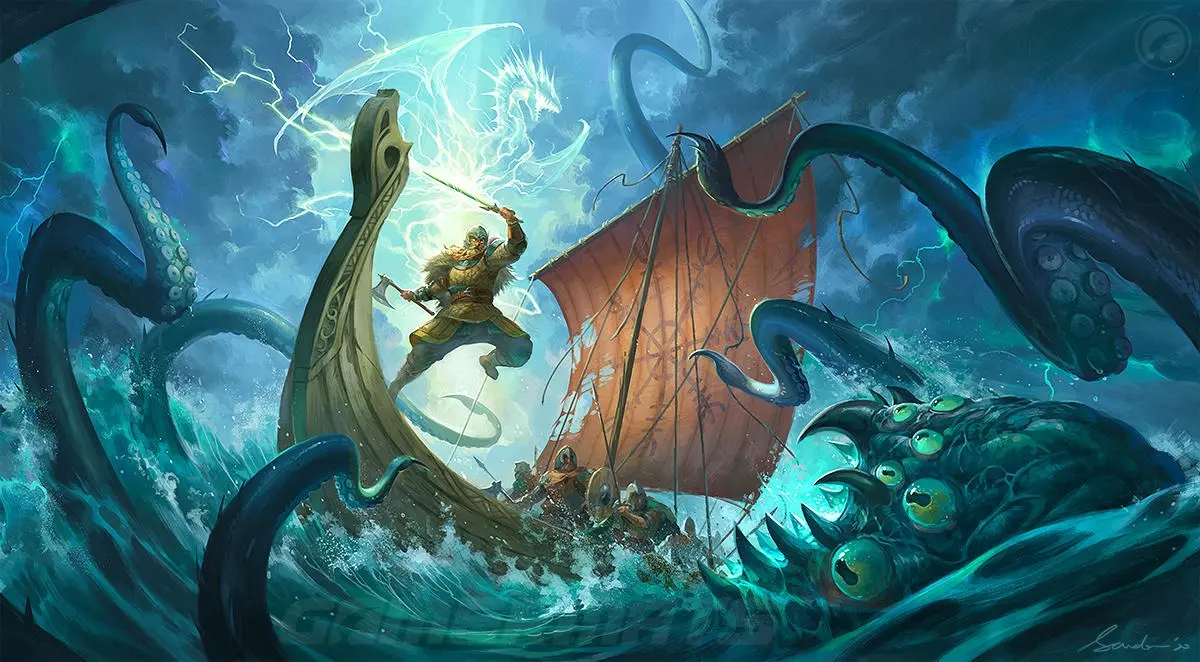
The oceans cover more than 70 percent of the Earth’s surface, and the vast majority of the deep pelagic zone remains unexplored. For centuries, sailors who caught fleeting glimpses of giant squids battling sperm whales translated these terrifying encounters into legends of the Kraken—a colossal cephalopod capable of dragging entire galleons down to a watery grave.
Modern marine biology has validated these fears to a degree. The giant squid (Architeuthis dux) and the colossal squid (Mesonychoteuthis hamiltoni) grow to lengths exceeding 40 to 45 feet, possessing massive tentacles equipped with sharp-toothed suckers. While they do not attack ships, their alien appearance and immense scale easily justify the terrifying folklore passed down by generations of mariners.
3. Environmental DNA (eDNA) Testing in Cryptozoology
In recent years, scientists have applied cutting-edge genetic testing to legendary hotspots to separate fact from fiction.
- In 2019, a team of international geneticists led by Professor Neil Gemmell of the University of Otago conducted an extensive eDNA study of Scotland’s Loch Ness. By filtering water samples from various depths and locations, the team sequenced all environmental DNA present in the lake.
- Results: The study found zero genetic evidence of giant reptiles (plesiosaurs), sturgeons, or giant catfish. However, it revealed an abundance of eel DNA, leading researchers to conclude that giant eels—while not mythical monsters—may occasionally grow to atypical sizes, fueling decades of mistaken eyewitness accounts.
Official Responses and Expert Perspectives
The persistence of mythical creatures invites commentary from a diverse array of experts, spanning folklore studies, evolutionary biology, and psychology.
Dr. Eleanor Vance, a professor of cryptozoology and folklore at the University of Edinburgh, notes that myths serve a vital psychological function:
"Myths are not merely lies or superstitions; they are the human mind’s way of mapping the unknown. When early humans looked out at a dark, howling forest or an infinitely deep ocean, they projected their fears and wonder onto the canvas of nature. A rustling bush wasn’t just wind; it was a beast. In a sense, mythical creatures represent our eternal discomfort with the blank spaces on the map."
From a zoological standpoint, evolutionary biologist Dr. Marcus Thorne emphasizes the physical limitations that separate reality from fantasy:
"Physics dictates biology. A creature the size of a dragon could never achieve flight without wingspan-to-weight ratios that defy aerodynamic laws, and fire-breathing requires biological mechanisms—like internal combustion chambers—that no known vertebrate possesses. However, nature frequently invents adaptations that sound just as fantastic: electric eels generating 600 volts, bombardier beetles boiling chemicals to defend themselves, and deep-sea fish producing their own illumination. Reality is often stranger than fiction."
Wildlife conservationists also point out that the hunt for mythical creatures has occasionally led to the discovery of entirely real, highly endangered species. The okapi—a forest-dwelling mammal resembling a cross between a zebra and a giraffe—was long dismissed by Western scientists as native folklore until its official classification in 1901. Similarly, the coelacanth, a prehistoric lobe-finned fish thought to have gone extinct alongside the dinosaurs 66 million years ago, was hauled alive from the Indian Ocean in 1938.
Implications: The Cultural and Scientific Value of the Unknown
The enduring fascination with mythical creatures carries significant implications for modern science, environmental education, and popular culture.
1. Inspiring the Next Generation of Scientists
For many children and young adults, the gateway to scientific inquiry begins with a sense of wonder. Reading about dragons, mermaids, and cryptozoological mysteries encourages youth to ask questions about paleontology, marine biology, geography, and ecology. The desire to find out if something is real drives scientific curiosity and pushes students toward STEM careers.
2. Environmental Conservation and Wilderness Protection
The mystery of legendary creatures often helps protect delicate ecosystems. For example, local legends surrounding forest spirits or river monsters frequently discourage overfishing, illegal logging, and industrial pollution in sacred or remote regions. By imbuing nature with an aura of the sacred and the unknown, indigenous communities have historically preserved biodiversity hotspots long before modern conservation laws existed.
3. The Shift from Myth to Empirical Discovery
As technology advances, the boundary between the known world and the realm of myth continues to shrink. Deep-submergence vehicles, sonar mapping, and genetic sequencing have transformed once-fanciful tales of sea monsters and subterranean beasts into subjects of serious marine research.
Ultimately, while we may not find fire-breathing dragons roosting in our backyards or mermaids swimming in local rivers, the ongoing search for the extraordinary reminds humanity that our planet remains a place of boundless mystery. As long as unexplored jungles, deep ocean trenches, and vast starry skies exist, the human imagination will continue to look out into the dark and wonder what marvelous secrets are waiting to be uncovered.