By Karl E. H. Seigfried
Published: August 28, 2026
Category: Arts & Culture
What is America, really? Are these United States truly fifty sovereign entities bound by a common civic purpose, striving collectively for the common good? Or are we, increasingly, a fractured mirror reflecting conflicting self-mythologizing—a nation where foundational understandings and historical agreements are continuously revealed as fictions and phantasms?
Every day, civic norms once taken for granted are casually discarded. Laws and regulations are brushed aside like gossamer webs under the whims of the powerful. To confront these fractures, I recently embarked on a late-summer road trip through the physical and historical landscape of the American East. At every stop, I was struck by a jarring dissonance: the collision between manufactured American myths and stubborn historical reality.

Main Facts: The Dissection of National Mythology
My journey took me deep into the heart of America’s founding narratives—from the frozen encampments of Valley Forge to the hallowed halls of Philadelphia and the cinematic shrines of western Pennsylvania. At each location, contemporary political rhetoric clashed violently with archival reality.
In August 2026, Secretary of War Pete Hegseth reiterated the persistent myth of George Washington kneeling in the snow at Valley Forge to pray for divine intervention. Historians note, however, that this tale was concocted by Parson Weems—the same fabulist responsible for the cherry-tree legend. This artistic and political trope serves an obvious purpose: to package America as a nation whose foundational bedrock is fundamentally white, patriarchal, and strictly Christian.
Yet, historical records preserved by the National Park Service tell a starkly different story. The revolutionary army that wintered at Valley Forge in 1777–1778 was remarkably diverse. The camp housed nearly 20,000 soldiers, along with civilian support workers, making it the fourth-largest population center in the colonies. Its ranks included individuals of African, Austrian, Dutch, English, French, German, Irish, Italian, Native American, Polish, Portuguese, Prussian, Scottish, and Swedish descent. Religious affiliations spanned Catholicism, Protestantism, Judaism, and the Religious Society of Friends.

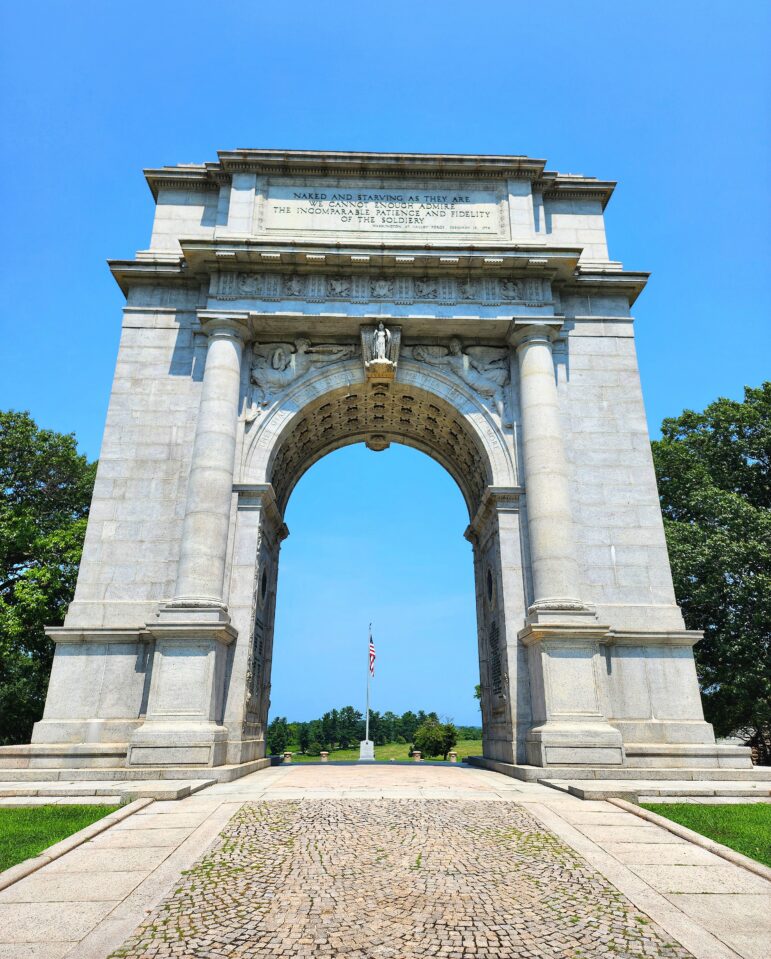
Furthermore, many Founding Fathers, including George Washington, were active Freemasons. They operated under Enlightenment philosophies that viewed the Divine as a "Grand Architect" rather than subscribing to orthodox Christian dogma. The National Memorial Arch at Valley Forge, dedicated in 1917, prominently features pagan deities such as Athena and Nike.
Chronology: From Founding Realities to Modern Erasure
1. Valley Forge and the Blood of the Diverse
During the darkest days of the Revolution, over 700 soldiers at Valley Forge possessed African ancestry, Native American heritage, or both. The disorganized, freezing colonial army was ultimately whipped into professional shape not by a native-born partisan, but by an immigrant: the Prussian Baron Friedrich Wilhelm August Heinrich Ferdinand Freiherr von Steuben. The nation won its independence through the sacrifice of populations that modern political figures actively seek to marginalize.
2. Philadelphia: The Liberty Bell and the Erasure of Slavery
Moving south to Philadelphia, this historical dissonance deepens. Outside the Liberty Bell Center, a welcoming volunteer guide pointed toward the subterranean remains of the President’s House—where George Washington and Vice President John Adams resided before the White House was built, and where Washington’s slaves were housed.

The guide revealed a startling act of modern censorship: the current federal administration forced the National Park Service to purge all mention of slavery from exterior signage and educational materials. In quiet acts of civil disobedience, park guides distributed QR codes linking visitors to the suppressed text. Inside the center, exhibits remind visitors that the Liberty Bell—commissioned in 1752 and immediately cracked—was first dubbed the "Liberty Bell" by 1830s abolitionists who weaponized its inscription against the hypocrisy of a slaveholding republic.
3. Benjamin Franklin’s Ledger: Weighing Legacy
At the Benjamin Franklin Museum, interactive displays force visitors to weigh Franklin’s actions regarding slavery. Despite his late-in-life abolitionist advocacy, Franklin profited for decades from advertisements for slave sales, ran fugitive slave notices, and purchased slaves rather than hiring paid domestic servants. As Thomas Jefferson later noted regarding the deleted anti-slavery clauses of the Declaration of Independence, Northern founders were "considerable carriers of [slaves] to others." Franklin’s late conversion to abolition cannot erase a lifetime of complicity—a lesson equally applicable to modern ideological circles where declarations of reform fail to undo historical harm.
Supporting Data: The Testimony of the Friends and the Public Universal Friend
In stark contrast to the compromised legacy of the Founding Fathers stands the evolution of the Religious Society of Friends (Quakers). Founded by William Penn in 1681, Philadelphia’s Arch Street Meeting House preserves a history of progressive action rooted in spiritual conviction.
While early Quakers owned slaves, the community underwent a profound institutional reckoning. By 1776—the very year of the Declaration of Independence—the Friends officially forbade members from enslaving human beings. By the end of the century, they were leading boycotts of slave-labour goods and operating stations along the Underground Railroad.
The Public Universal Friend
Among the archival treasures at the Arch Street Meeting House is the account of Jemima Wilkinson. Following a bout of typhus in 1776, Wilkinson claimed to have died and been reborn as a genderless prophet known as The Public Universal Friend. Refusing gendered pronouns and donning androgynous clothing, The Friend preached across the northeastern United States, proving that gender non-conformity has deep roots in early American religious history.
Official Responses and Civic Defiance
Throughout my pilgrimage, the most striking figures were not the marble statues, but the living civil servants. National Park Service rangers stationed at historic sites displayed a quiet, resolute fury. Despite directives from the federal administration to sanitize historical narratives, rangers delivered unvarnished truths to visitors, directly challenging sanitized versions of American freedom.
These civil servants embody an ethos akin to Odinnic values: preserving knowledge and speaking truth to power regardless of professional consequence. Their actions stand as a rebuke to political figures who attempt to rewrite history to serve exclusionary nationalist narratives.
Implications: Cinema as American Sagas
To decompress from the heavy burdens of American history, I concluded my journey by visiting sacred sites of a different kind: the cinematic locations of George A. Romero’s horror classics.
At the Monroeville Mall—the setting of 1978’s Dawn of the Dead, currently slated for demolition by corporate acquisition—and the Evans City Cemetery from 1968’s Night of the Living Dead, I felt the uncanny weight of America’s truest modern mythology.
Romero, the son of Spanish and Lithuanian immigrants, used the genre of low-budget horror to dissect the rotting underbelly of American culture: consumerism, racism, militarism, and systemic apathy. If a horror auteur could leverage cheap special effects to critique societal decay, modern citizens possess the capacity to confront the bigotry and democratic erosion occurring in broad daylight.
Between myth and historical truth lies the imperative for action. As the park ranger at Independence Mall asked the circle of wide-eyed children: “And what will you do to further the cause of freedom?” The answer remains ours to write.