OSLO, NORWAY — Long before modern oceanography mapped the abyssal plains of the Atlantic, the terrifying unknown of the deep ocean was given a face, and many churning, tentacled arms. Hailing from the rich seafaring folklore of Scandinavia—particularly the coastal traditions of Norway and Iceland—the Kraken remains one of history’s most enduring mythological entities. Born from an era when sailors looked out at dark, freezing waters and imagined the absolute worst, this colossal cephalopod-like monster served as the ultimate personification of maritime peril.
While pop culture today often reduces the beast to a cinematic action set-piece, historical accounts paint a far more complex picture of a creature intertwined with the daily survival, fears, and observations of early Northern European fishermen and traders.
Main Facts: Anatomy of a Legend
To understand the Kraken is to understand humanity’s primal fear of the deep. In traditional Scandinavian mythology, the Kraken is not merely a large animal; it is a force of geological and meteorological disruption.
What Does the Kraken Do?
Legends attribute several catastrophic phenomena to the sudden appearance of a Kraken:
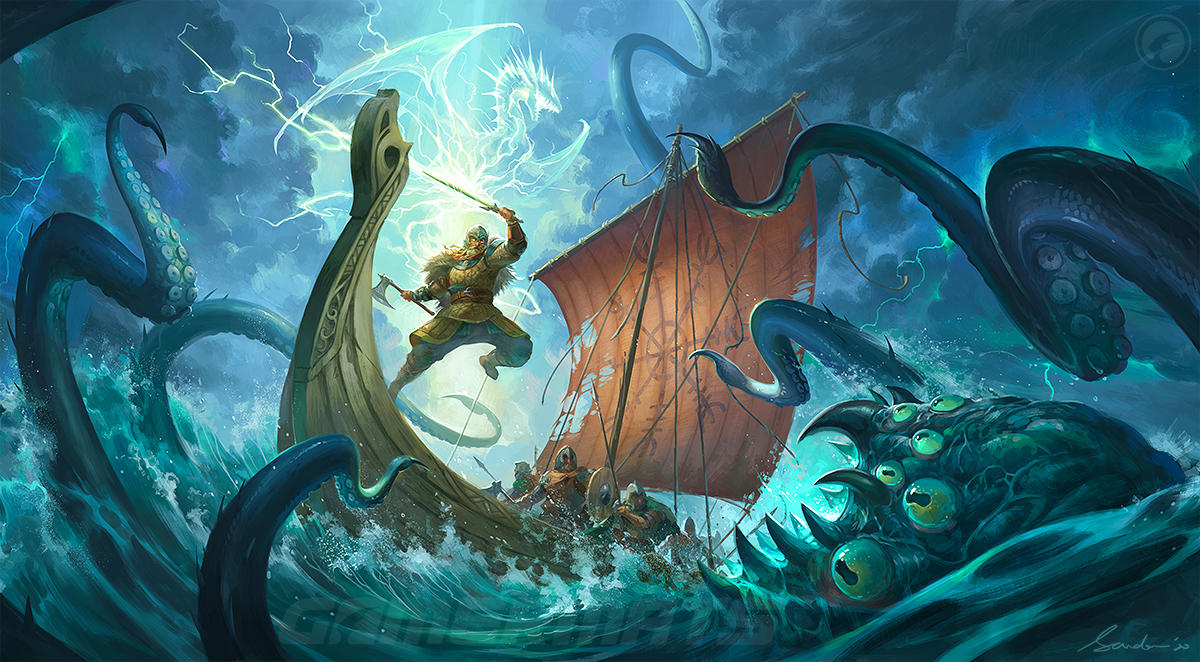
- Whirlpools and Maelstroms: As the beast descends or rises rapidly, it displaces monumental amounts of water, creating deadly vortexes capable of dragging entire galleons down into the abyss.
- Vessel Demolition: Using its massive, barbed tentacles, the creature is said to wrap around the hulls of ships, snapping masts like toothpicks and dragging crews to a watery grave.
- The "Floating Island" Deathtrap: Because of its immense scale, historical texts frequently note instances where sailors mistook the creature’s back for an uncharted island, anchoring their ships to it—only for the "landmass" to suddenly submerge.
- Feeding Maws and Disgorgement: Some accounts claim the beast secretes a rich, alluring scent or excrement that attracts massive schools of fish, drawing unsuspecting fishermen right into the monster’s striking zone.
What Does It Look Like?
Unlike the standardized movie monsters of today, historical descriptions of the Kraken varied wildly depending on the region and century. However, common visual motifs persist:
- Colossal Proportions: Frequently described as resembling an island or a floating continent when resting at the surface.
- Formidable Appendages: Endowed with countless thick, flexible, and powerful tentacles capable of reaching the highest crow’s nests of historical vessels.
- Menacing Features: Possessing wide, luminous, or unblinking eyes that peer out of the dark water, accompanied by a sharp, parrot-like beak capable of rending oak timbers.
Chronology: The Evolution of Kraken Lore
The myth of the Kraken did not appear overnight; it evolved through centuries of oral traditions, ecclesiastical documentation, and early scientific inquiry.
The Viking Age and Medieval Roots (c. 800 – 1300 AD)
While the explicit name "Kraken" (derived from the Norwegian word krake, denoting an unhealthy animal or something twisted) gained traction later, early Norse sagas frequently mention terrifying sea-monsters. Texts such as the Örvar-Odds saga speak of the Hafgufa ("sea mist") and Lyngbakr ("heather-lock"), creatures of monstrous proportions that possessed habits identical to the later-defined Kraken. These early tales served as practical warnings for Viking explorers navigating treacherous fjords and open-ocean routes between Norway, Iceland, and Greenland.
The Renaissance and Bishop Pontoppidan (1752)
The most comprehensive and widely cited historical baseline for the Kraken comes from the pen of Erik Pontoppidan, the Bishop of Bergen and a fellow of the Royal Academy of Sciences in Copenhagen. In his seminal 1752 work, The Natural History of Norway, Pontoppidan dedicated significant space to documenting the creature.
Pontoppidan described the Kraken not as a mindless demon, but as an integral part of the marine ecosystem—albeit a terrifyingly large one. He recorded firsthand accounts from Norwegian fishermen who swore that the creature possessed a circumference of a mile and a half, and that its presence was often marked by vast schools of fish gathering above it to feed on its nutrient-rich droppings.
The Scientific Shift and Demotion (19th Century)
As the Age of Sail gave way to the Age of Steam and rigorous scientific taxonomy, naturalists began separating folklore from zoology. In the early 19th century, French naturalist Pierre Denys de Montfort attempted to classify giant cephalopods, distinguishing between the "Kraken octopus" (which he claimed attacked a British fleet) and the "colossal octopus."
However, much of Montfort’s work was viewed as sensationalist. It wasn’t until the mid-19th century that marine science caught up with the myth: the discovery and scientific description of Architeuthis dux—the Giant Squid—provided physical evidence that inspired centuries of sea stories.
Supporting Data: Fact Meets Fiction in the Abyssal Zone
While a creature the size of an island is physically impossible under the biological constraints of Earth’s gravity and oxygen distribution, the natural world proved that the ocean holds secrets far stranger than fiction suggested.

| Feature | Mythological Kraken | Real-World Giant Squid (Architeuthis dux) | Real-World Colossal Squid (Mesonychoteuthis hamiltoni) |
|---|---|---|---|
| Estimated Length | Up to several miles (island-sized) | Up to 13 meters (43 feet) | Up to 10–14 meters (33–46 feet) |
| Weight | Hundreds of thousands of tons | Up to 275 kg (606 lbs) | Up to 500 kg (1,100 lbs) |
| Primary Habitat | Surface waters, fjords, shipping lanes | Bathypelagic zone (200 to 1,000+ meters deep) | Antarctic deep waters |
| Primary Weaponry | Island-crushing weight, massive tentacles, whirlpools | Long, barbed tentacular clubs, sharp chitinous beak | Swiveling hooks on tentacles, massive beak |
Marine biologists note that historical sightings of the Kraken can easily be explained by rare encounters with living giant or colossal squid, or even distressed baleen whales, basking sharks, and massive jellyfish blooms viewed through the distorting lens of sea fog, panic, and poor lighting.
Official Responses and Cultural Legacy
Today, maritime authorities, cultural institutions, and modern scientists view the Kraken not as a real threat to navigation, but as a triumph of cultural storytelling and a testament to the psychological impact of the unknown ocean.
- The Marine Conservation Perspective: Modern marine biologists frequently use the legacy of the Kraken to drum up public interest in deep-sea exploration. Organizations dedicated to ocean conservation often invoke the imagery of the beast to highlight how little we still know about the twilight and midnight zones of our planet.
- Naval Humor and Traditons: Navies around the world—including the United States Navy and Scandinavian fleets—frequently reference the Kraken in unit mottos, submarine insignias, and morale boosters. Notably, the U.S. Navy’s adoption of "Release the Kraken!" into popular culture transformed the ancient beast into a modern shorthand for unleashing overwhelming force.
- Geological Realities: Norwegian marine agencies point out that actual historical dangers in Nordic waters—such as the Saltstraumen, one of the world’s strongest tidal currents—likely generated the very real whirlpools that early sailors blamed on the awakening of a subterranean monster.
Implications: Why the Kraken Still Captivates Us
The endurance of the Kraken speaks volumes about the human condition. Even in an era of satellite tracking, deep-submersible cameras, and global shipping lanes, the ocean remains the last truly untamed frontier on Earth. Less than five percent of the global ocean floor has been mapped in high resolution, leaving vast, dark spaces where imagination can still take flight.
As long as the deep blue holds mysteries—ranging from undiscovered invertebrate species to hydrothermal vents supporting alien ecosystems—the ghost of the Kraken will linger. It stands as a reminder of a time when the horizon was edge-of-the-world territory, and when every creak of a wooden hull over black water could mean that the masters of the deep were waking up.