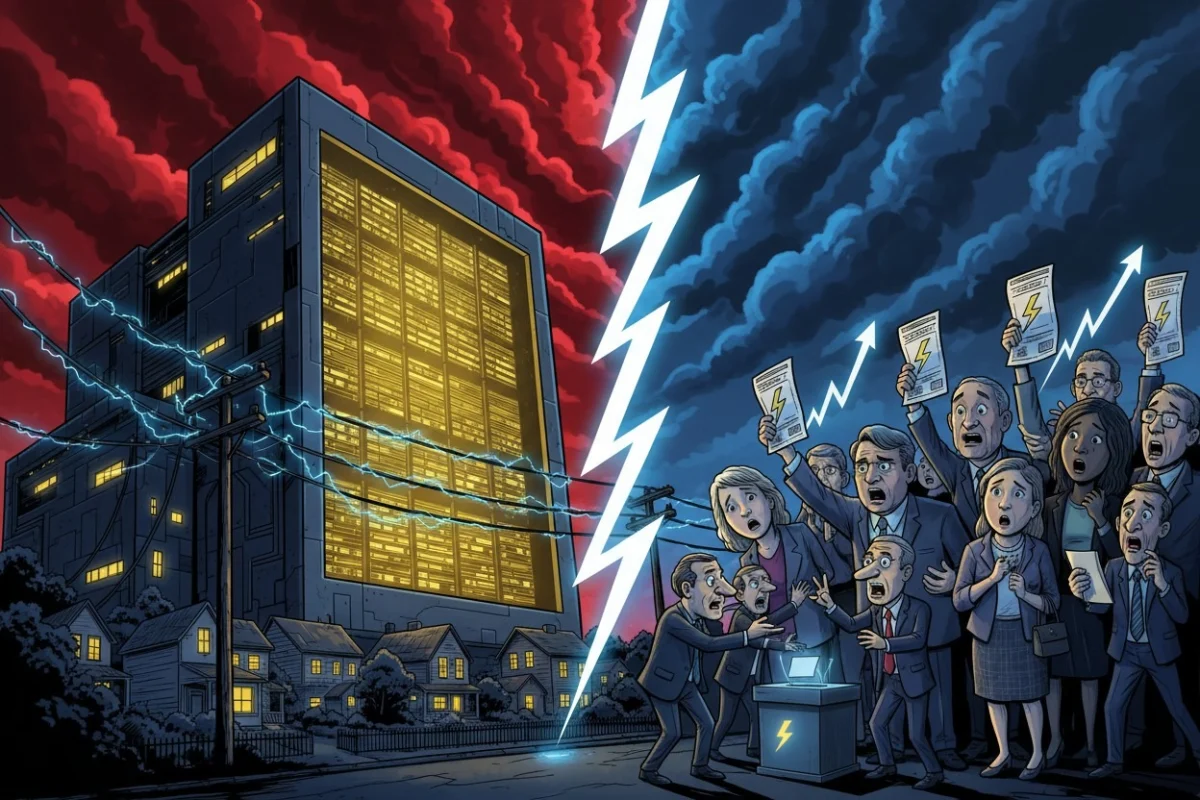
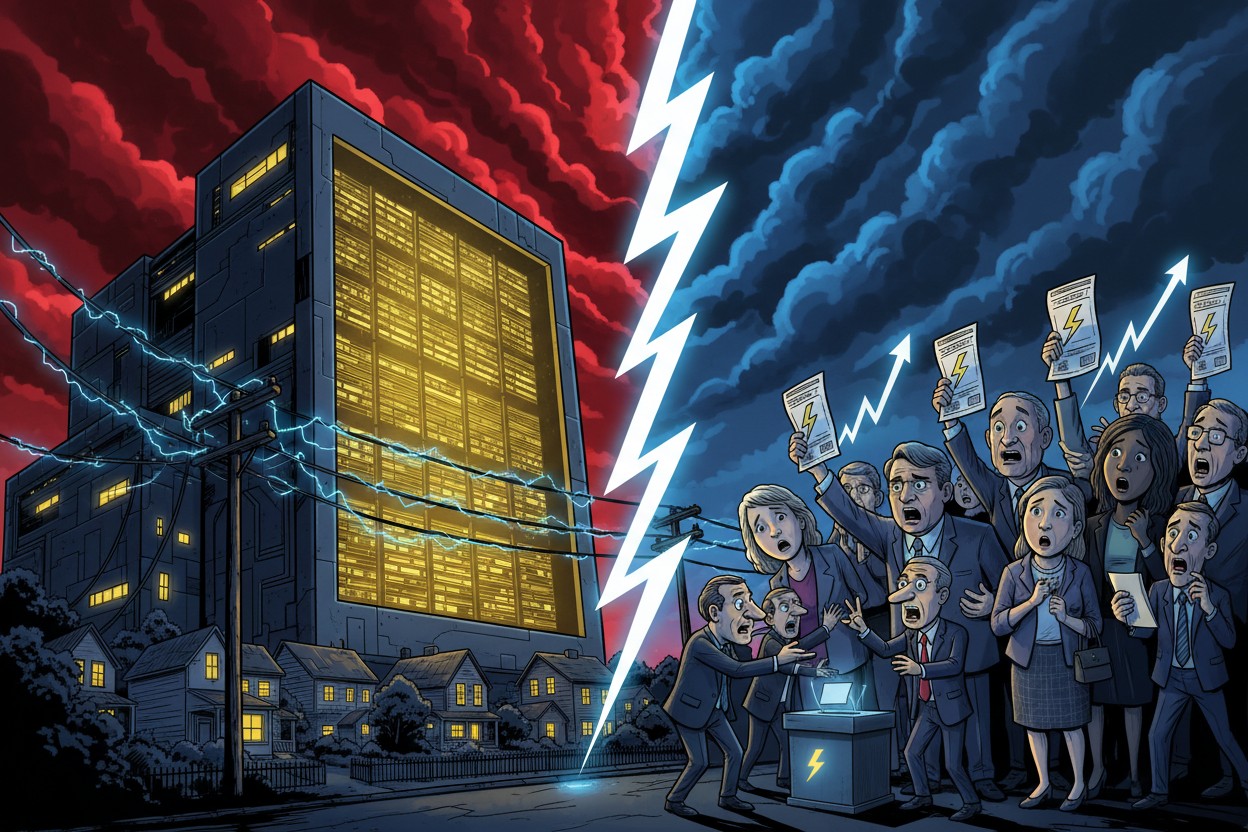
As the nation hurtles toward the final weeks of the midterm election cycle, a high-stakes political vulnerability has emerged for the Republican Party: surging residential electricity bills driven by the explosive proliferation of energy-hungry data centers. With artificial intelligence (AI) and cloud computing expanding at an unprecedented pace, the massive power demands required to fuel these technological hubs have collided directly with the pocketbooks of everyday Americans. The resulting friction has turned what was once a behind-the-scenes utility policy debate into a potent, voter-mobilizing campaign issue that is rattling incumbent lawmakers and scrambling traditional political messaging.
Party strategists and internal memos reveal growing anxiety within GOP ranks. As energy costs climb against the backdrop of an aggressive campaign season, the intersection of tech expansion, grid reliability, and inflation has created a volatile political landscape. With control of Congress hanging in the balance, both parties are grappling with how to address a public increasingly frustrated by the rising cost of keeping the lights on.
Main Facts
The core of the political crisis centers on a fundamental economic squeeze: the rapid construction of data centers—vital for modern artificial intelligence, cloud storage, and digital infrastructure—requires immense amounts of electricity. This massive energy consumption is straining regional power grids, accelerating capacity shortages, and driving up utility bills for residential consumers who find themselves competing with tech giants for power.
At the legislative level, Senate Democrats recently blocked a Republican-sponsored bill introduced by Senator Jon Husted (R-OH). The proposed legislation aimed to establish a federal standard requiring states and select utilities to compel data center operators to absorb the additional costs generated by their outsized energy demands, rather than passing those expenses down to everyday ratepayers.
The failure of the Senate bill has left lawmakers scrambling for legislative remedies as the campaign clock winds down. The data center issue has transcended traditional partisan boundaries, morphing into a localized grievance in competitive congressional and senatorial districts across the country.
While the White House, under President Donald Trump, has championed data centers as vital economic drivers—with Trump telling tech executives that the facilities "are going to be very popular"—that top-down enthusiasm has created a messaging fracture for Republicans on the ground. GOP candidates in tight races are finding themselves forced to distance themselves from unbridled tech expansion or risk alienating voters who are watching their monthly utility statements climb.
Chronology of the Crisis
The collision between massive digital infrastructure growth and consumer electricity costs has evolved rapidly over the past several years, tracing a path from local zoning disputes to a defining national campaign issue.
- April 2020 – April 2025: According to data from the Energy Information Administration (EIA), average residential electricity rates across the United States surged by nearly 13% over this five-year span, driven by aging infrastructure, shifting fuel markets, and early waves of commercial expansion.
- January 2025: President Donald Trump assumes office for his second term, adopting a pro-growth stance that strongly encourages technological innovation, manufacturing, and the unhindered development of AI data centers to maintain American competitiveness.
- Early 2025: Post-inauguration utility data reveals that residential electricity rates have climbed an additional 6% since January, bringing mounting pressure from constituents to the doorsteps of federal lawmakers. The EIA projects a further 6% nationwide rate increase throughout 2026.
- Fall 2026 (Midterm Campaign Home Stretch): The data center debate reaches a boiling point. Senate Democrats block Sen. Jon Husted’s cost-allocation bill, stalling federal legislative relief until after the November elections. Meanwhile, internal party memos—such as a leaked National Republican Senatorial Committee (NRSC) document—flag data centers as a "sleeper issue" threatening vulnerable GOP incumbents. Across key battlegrounds from Ohio to New York, candidates are forced to take hard stances on data center moratoria, tax breaks, and ratepayer protections.
Supporting Data and Economic Realities
The political potency of the data center debate is rooted in hard economic metrics compiled by federal regulators and energy experts. Utility bills have ceased to be a quiet, background household expense and have transformed into a visceral monthly reminder of inflation.
According to the U.S. Energy Information Administration (EIA):
- The Five-Year Climb: Between April 2020 and April 2025, residential electricity rates jumped by nearly 13%.
- The Recent Spike: Following the start of the second Trump administration in January 2025, rates escalated by another 6% in short order.
- Future Projections: The EIA forecasts an additional 6% nationwide increase in residential electricity rates for the full year of 2026.
These rising costs are directly correlated with capacity constraints on the electrical grid. Modern hyperscale data centers—facilities packed with thousands of servers running continuous cooling systems—often consume as much electricity as small cities. In regions experiencing heavy clustering of these facilities, regional transmission organizations have warned of potential reserve margin shortfalls.
When utilities must build new transmission lines, upgrade substations, or bring additional generation capacity online to feed these facilities, the capital expenditures are traditionally folded into the rate base. Without regulatory guardrails—such as the standard proposed in Husted’s stalled Senate bill—residential and small business customers frequently subsidize the infrastructure upgrades necessitated by massive corporate energy users.
Official Responses and Regional Flashpoints
The political fallout from the data center boom is best observed in key electoral battlegrounds where local grievances have merged with federal campaigns.
The Ohio Senate Showdown
In Ohio, the race between Republican incumbent Sen. Jon Husted and former Senator Sherrod Brown (D-OH) has become Ground Zero for the data center debate. Brown has relentlessly targeted Husted over his previous tenure as lieutenant governor, painting him as the architect of state-level tax incentives that lured data centers to Ohio. Brown argues that these corporate giveaways prioritized tech conglomerates at the expense of working families struggling with utility bills.
The issue has sparked alarm within national Republican apparatuses. A leaked National Republican Senatorial Committee memo obtained by NewsNation explicitly warned that data centers have become "the anchor hanging around Husted’s neck," labeling the controversy a dangerous "sleeper issue for the entire election cycle."
Weighing in on the broader political dynamic, GOP analyst Rob Stutzman noted that contemporary voters expect candidates to either actively oppose runaway data center expansion or institute severe regulatory checks, describing it as a political "box that must be checked correctly" to survive competitive elections.
New York’s Toss-Up Battle
The friction is not confined to the Midwest. In a closely watched House race in New York—rated as a pure toss-up by the nonpartisan Cook Political Report—Democratic challenger Cait Conley put Republican Rep. Mike Lawler on the defensive during a News12 debate, pressing him over his stance on a proposed data center moratorium.
Lawler’s campaign manager, Ciro Riccardi, pushed back in a statement to New York Focus, emphasizing a decentralized philosophy: the congressman "believes local residents should decide what gets built in their community" and maintains that municipal governments must take primary responsibility for safeguarding local ratepayers from predatory utility pricing.
Divergent Republican Messaging
The divergence in how Republican officials address the issue highlights the party’s messaging challenge. Rep. Rich McCormick (R-GA), appearing on Newsmax’s "Wake Up America," defended the facilities, arguing that data centers inject vital capital into local economies by funding schools, building roads, and creating high-paying jobs. "If you don’t want a data center, that’s fine, don’t have one," McCormick remarked, leaning into a local-option framework.
However, GOP strategist Amy Koch pointed out the inherent difficulty of reconciling grassroots voter anxiety with the federal administration’s unvarnished enthusiasm. Koch argued that Republicans are desperately trying to forge a nuanced middle ground—acknowledging that data centers are critical for national security and technological dominance while pushing corporations to build responsibly. Yet, she conceded that the White House’s broad, unabashed support "muddles things a little bit," observing that "it’s hard to be nuanced with a president who has no nuance."
Broader Implications
As the nation looks beyond the immediate horizon of the November midterm elections, the clash over data center energy consumption holds profound implications for American infrastructure, economic policy, and political strategy.
- Grid Modernization and Regulatory Reform: Regardless of which party controls Congress after November, the sheer physical limits of the American power grid cannot be ignored. Policymakers on both sides of the aisle will eventually be forced to confront the reality that rapid technological innovation requires massive energy investments. Future legislative sessions will likely revisit cost-allocation standards, compelling tech companies to invest directly in new clean energy generation—such as dedicated nuclear, solar, or geothermal microgrids—rather than drawing exclusively from public utility pools.
- The Evolution of Economic Nationalism: The political tension exposes a deep ideological split within the conservative coalition. On one side sits a pro-business, technocratic impulse that views data centers and AI dominance as essential to winning the geopolitical race against global competitors like China. On the other side sits a populist, consumer-first sentiment focused on the immediate cost of living, inflation, and the protection of working-class households. Reconciling these two forces will be one of the defining challenges for the Republican Party well beyond the current election cycle.
- Local Control vs. Federal Mandates: As municipalities increasingly push back through zoning restrictions, moratoria, and local ordinances, the battle over digital infrastructure is decentralizing. The outcome of these local skirmishes will dictate whether America’s digital future is built through orderly, community-approved expansion or choked by a patchwork of localized resistance and skyrocketing utility bills.
For now, candidates in the final weeks of the midterm campaign must navigate a perilous tightrope: balancing the undeniable economic imperatives of the digital age against the very tangible, very angry voices of voters opening up historically high electricity bills at their kitchen tables.