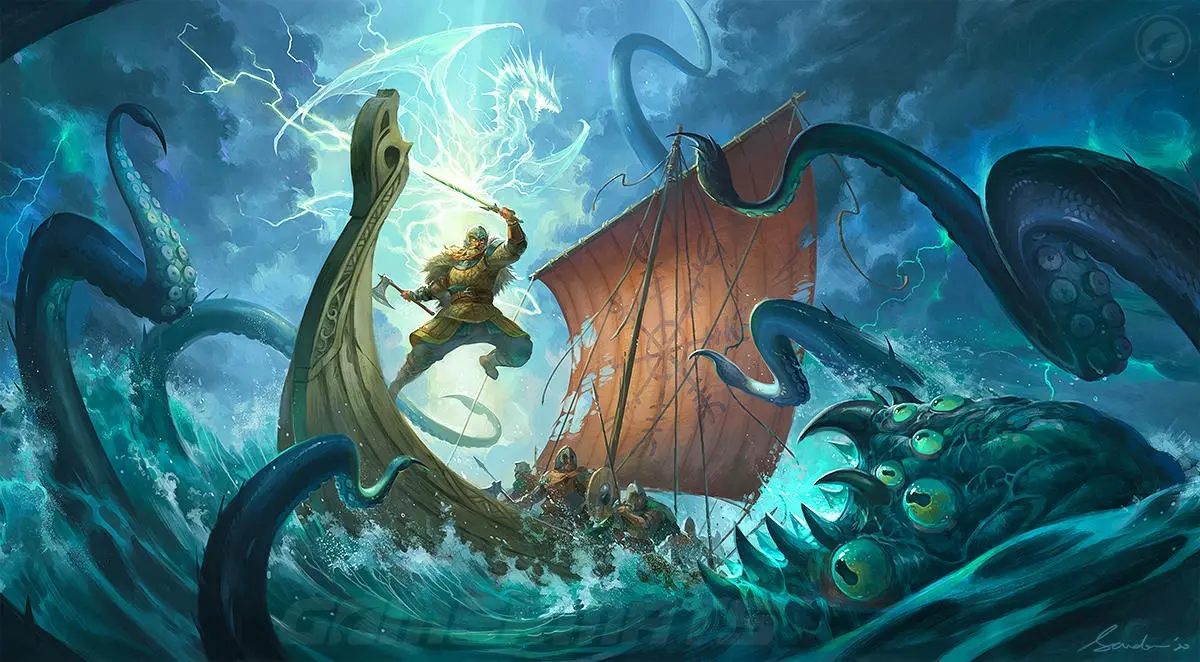
Introduction: The Terror of the North Atlantic
For centuries, the unfathomable depths of the world’s oceans have served as a blank canvas for human imagination, fear, and wonder. Among the pantheon of maritime monsters that have haunted the nightmares of sailors, few command the sheer scale and ferocious reputation of the Kraken. Hailing from the rugged coasts of Scandinavian mythology—particularly the ancient folklore of Norway and Iceland—the Kraken emerged as a terrifying embodiment of the perils associated with the vast, unpredictable, and largely unexplored sea.
Long before modern oceanography mapped the abyssal plains, seafaring cultures developed elaborate myths to rationalize the very real dangers of deep-sea voyages. Sudden storms, treacherous whirlpools, vanishing ships, and unexplainable maritime disasters required a tangible explanation. Enter the Kraken: a colossal cephalopod-like behemoth capable of dragging entire galleons into a watery grave.
This comprehensive investigation explores the origins, historical accounts, physical descriptions, and enduring legacy of one of mythology’s most formidable beasts, examining how a blend of real marine encounters and ancient superstition forged a legend that persists to this day.
Main Facts: Anatomy and Behavior of the Legendary Beast
To understand the enduring fascination with the Kraken, one must examine the core characteristics attributed to the creature across centuries of folklore. While fictional monsters are not bound by the laws of real-world biology, traditional accounts paint a remarkably consistent picture of its behavior and appearance.
What Does a Kraken Do?
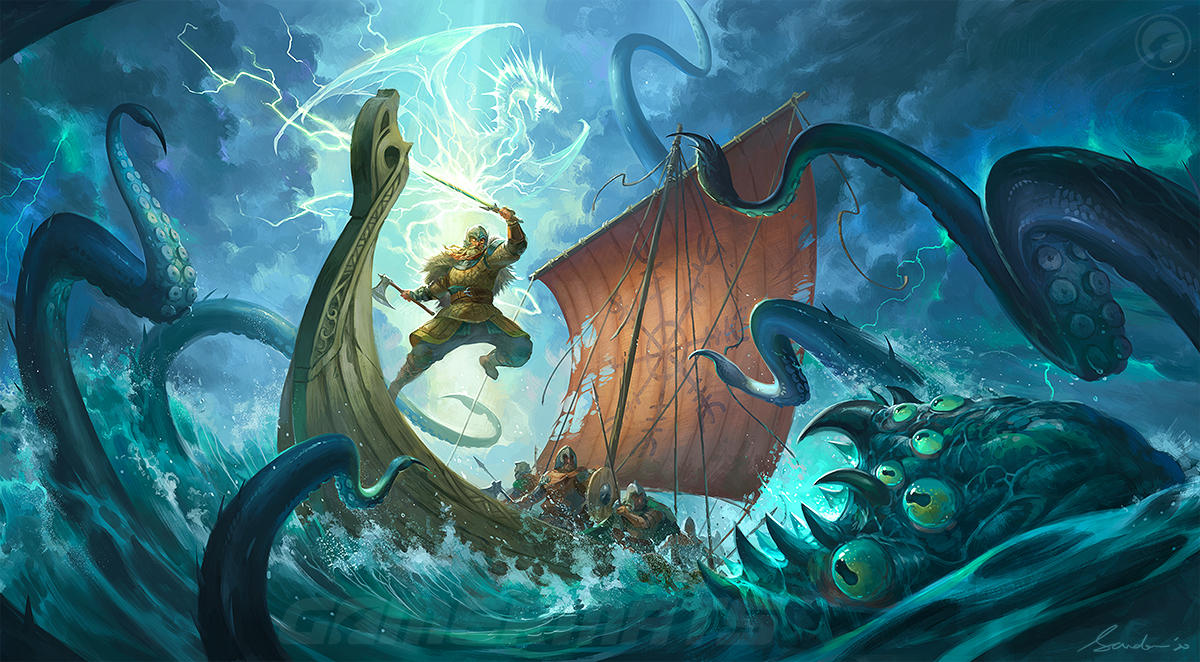
In Scandinavian myth, the Kraken is synonymous with absolute terror on the high seas. Its primary legendary actions include:
- The Creation of Deadly Whirlpools: As the colossal beast submerges or rapidly descends back into the abyssal depths, it is said to displace massive volumes of water, creating powerful maelstroms that can easily swallow nearby vessels.
- Vessel Assault and Capture: Legends recount the Kraken using its immensely powerful, muscular tentacles to wrap around the masts and hulls of large ships, dragging them down into the dark ocean.
- Feeding Habits: According to historical sailors’ accounts, the creature would consume vast schools of fish. However, its immense appetite and sheer size meant that it posed an existential threat to human navigation, accidentally or intentionally destroying anything crossing its path.
Physical Characteristics
When visualizing a Kraken, modern audiences often imagine a super-sized squid or octopus magnified to terrifying proportions. Traditional lore highlights several key features:
- Colossal Proportions: Unlike normal marine life, the Kraken is described as being so gargantuan that its physical form defies standard measurement.
- Impressive Tentacles: Armed with countless suckers and immense muscular strength, its limbs are said to span the length of entire warships.
- Frightening Eyes: Often depicted with glowing or unblinking eyes the size of dinner plates, peering from just beneath the surface before an attack.
Because the Kraken is a creature of legend, there is no single definitive depiction. However, it remains universally recognized as a giant of the deep, defined by its overwhelming scale and formidable appendages.
Chronology: The Historical Evolution of the Kraken Legend
The evolution of the Kraken from oral tradition to written history spans more than a millennium. The timeline below traces the key milestones in the documentation and cultural development of the myth.

- 9th–11th Century (The Viking Age): Norse sailors and explorers encounter the unpredictable and dangerous waters of the North Atlantic. Oral traditions begin to form around sea monsters, laying the groundwork for future folklore.
- 1250 (Early Written Accounts): The Old Norse scientific and historical text Konungs skuggsjá (King’s Mirror) provides one of the earliest written descriptions of a massive sea creature referred to as the hafgufa (sea-mist) or lyngbakr (heather-back), sharing characteristics with the later Kraken.
- 1734 (Egede’s Observation): Norwegian missionary Hans Egede reports sighting a horrifying sea monster off the coast of Greenland, describing it as a creature with long, spiky fins and a head that rose high above the water.
- 1752 (Pontoppidan’s Definitive Account): Bishop Erik Pontoppidan of Bergen publishes The Natural History of Norway, formally compiling folklore surrounding the "Kraken" (derived from the Norwegian word krake, meaning an unhealthy animal or twisted tree). Pontoppidan provides detailed descriptions of its island-like size and the whirlpools it creates.
- 1802 (Scientific Classification): French malacologist Pierre Denys de Montfort attempts to classify sea monsters, recognizing two types of giant octopuses: the "kraken octopus" and the colossal octopus said to attack ships. His work relies heavily on accounts from Norwegian sailors.
- 1861 (The Encounter with the Alecton): The French warship Alecton encounters a giant squid near Tenerife, capturing a portion of its tail. This real-world event bridges the gap between myth and marine biology, providing physical evidence for giant cephalopods.
- Late 19th Century to Present: The discovery of Architeuthis dux (the giant squid) provides a biological reality check, transforming the mythical Kraken from an active terror of the seas into a fascinating subject of cryptozoology, literature, and modern pop culture.
Supporting Data: Just How Big Was the Kraken?
One of the most defining aspects of the Kraken legend is its impossible scale. Because it is a fictional and mythological construct, its size is not limited by real-world biological constraints or the availability of oxygen and food.
Historically, the most common description dictates that the Kraken is so enormous that it far exceeds the dimensions of even the largest wooden sailing vessels of the 17th and 18th centuries.
- The Island Illusion: Some of the most fantastic tales depict the Kraken as so vast that its stationary body could easily be mistaken for an uncharted island. Unsuspecting sailors would occasionally land their ships upon its broad, mossy back (often described as resembling heather or rock), only for the "island" to suddenly submerge as the creature awoke and returned to the depths.
- Tentacles as Archipelagos: In more extreme accounts, the creature’s towering tentacles were said to rise out of the water like groups of smaller islands or towering forest trunks, blocking out the horizon.
- Real-World Counterpart: While a creature large enough to be mistaken for an island is physically impossible under marine biology, the real-world Giant Squid (Architeuthis dux) and Colossal Squid (Mesonychoteuthis hamiltonii) can reach lengths of 43 to 50 feet (13 to 15 meters) or more. While vastly smaller than the mythical Kraken, these deep-sea dwellers undoubtedly inspired the terrifying scale attributed to the legend.
Official Responses and Scientific Perspectives
How did natural philosophers, historians, and modern scientists address claims of a city-sized monster lurking in the ocean?
Historical Perspectives
During the 18th century, prominent figures took the reports of Norwegian fishermen quite seriously. Bishop Erik Pontoppidan approached the subject with academic rigor, cataloging witness testimonies from sea captains and merchants. In an era when the deep ocean was entirely unmapped, assuming that colossal life forms existed in the abyssal trenches was entirely logical.

The Scientific Consensus
As marine biology advanced into the 19th and 20th centuries, scientists began to demystify the Kraken.
- Misidentification of Marine Phenomena: Oceanographers note that many "Kraken" sightings were likely misidentifications of natural phenomena, such as underwater volcanic activity causing sudden bubbling, upwellings creating dangerous whirlpools, or sightings of floating masses of seaweed and massive schools of marine mammals.
- The Giant Squid Reality: Marine biologists confirm that the discovery of giant and colossal squids directly validated the concept of a large, tentacled sea monster, even if the proportions were vastly exaggerated by frightened sailors over generations. Today, the Kraken is recognized as a cultural and mythological triumph rather than a biological reality.
Implications: The Enduring Cultural Legacy of the Kraken
The legacy of the Kraken extends far beyond ancient Norwegian folklore; it has permanently embedded itself in global literature, cinema, and modern popular culture.
Literary Impact
The Kraken’s influence can be seen in numerous literary masterpieces. Notably, Alfred, Lord Tennyson published his famous sonnet "The Kraken" in 1830, vividly describing the creature sleeping in the silent, sunless depths of the sea until the end of time. Furthermore, Herman Melville’s Moby-Dick draws heavily on maritime lore and features encounters with giant squid-like horrors that echo the terror of the Kraken.
Modern Entertainment
In contemporary media, the Kraken remains a staple of fantasy and adventure. It has been featured prominently in major Hollywood blockbusters (such as the Pirates of the Caribbean franchise and Clash of the Titans), video games, and fantasy literature. By transforming from a symbol of genuine maritime dread into a beloved icon of fantasy adventure, the Kraken has secured its immortality.

Conclusion
The Kraken stands as a testament to humanity’s complex relationship with the natural world. Born out of a genuine need to explain the unquantifiable dangers of the deep ocean, Scandinavian folklore transformed the unknown into a magnificent, terrifying beast. While science has since mapped the ocean floor and identified the real creatures—such as the giant squid—that inspired the tales, the myth of the Kraken continues to capture our collective imagination, reminding us of the enduring mystery and power of the sea.