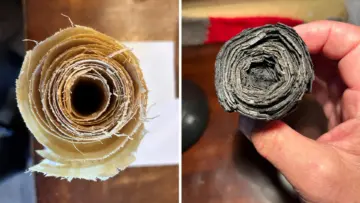
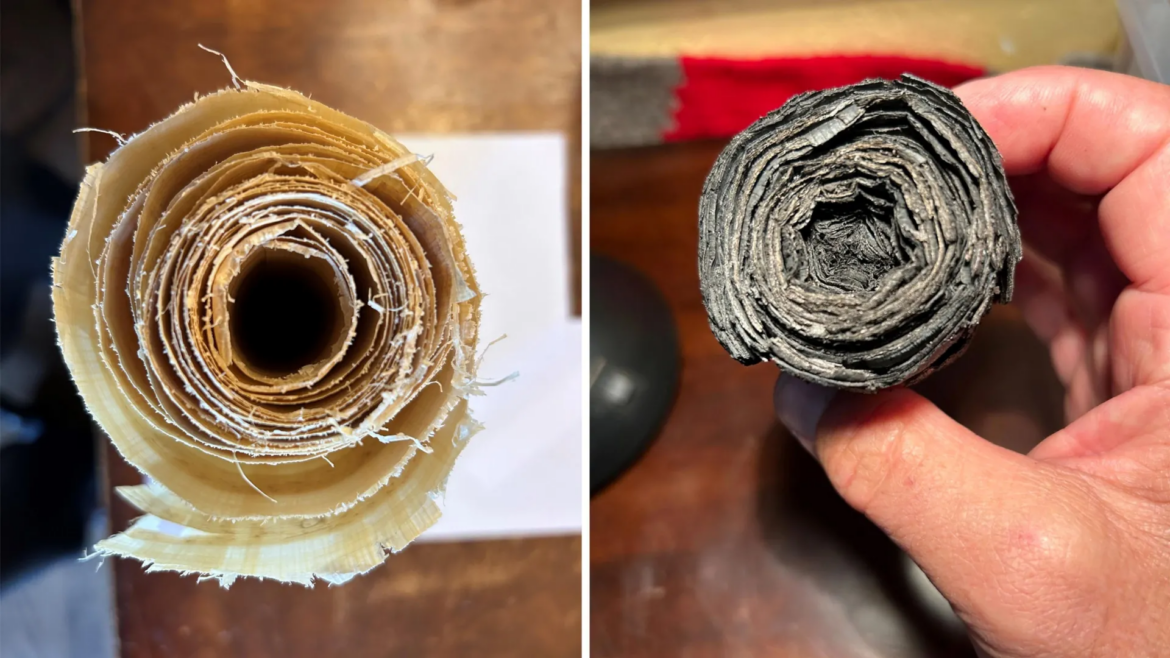
HERCULANEUM, Italy — Nearly two thousand years after the catastrophic eruption of Mount Vesuvius buried a Roman library in searing pyroclastic flows, turning hundreds of papyrus scrolls into brittle cylinders of charcoal, modern science has deliberately burned a manuscript to save the past.
In a novel study published in the open-access journal PLOS ONE, an international team of researchers detailed how they manufactured, inscribed, and carbonized a modern papyrus scroll in a laboratory setting. By deliberately sacrificing this proxy artifact to simulated ancient conditions, the team has unlocked a potential breakthrough in virtual archaeology: a method to identify which of the legendary, unopened Herculaneum scrolls hold the highest promise for yielding legible text before they ever enter an expensive, high-powered imaging facility.
The study, titled "A model carbonized papyrus scroll opens a novel path to identifying readable scrolls of the Herculaneum Library" and led by Douglas Seiler and colleagues, tackles the single greatest obstacle in modern papyrology. For centuries, researchers have faced a heartbreaking catch-22: opening the delicate, carbonized scrolls physically would shatter them into unrecoverable dust, yet reading them while closed required seeing through layers of charred organic matter that resisted conventional imaging.
Now, by understanding the chemical signature of ancient inks—specifically, the strategic presence of lead—scientists may finally have a reliable map to navigate the hidden libraries of the ancient world.
Main Facts
The core of the breakthrough centers on a persistent challenge in reading the Herculaneum papyri: the optical invisibility of ancient ink against a carbonized background.
- The Artifacts: Unearthed in the 18th century from a luxury villa in Herculaneum (often theorized to belong to Lucius Calpurnius Piso Caesoninus, Julius Caesar’s father-in-law), the cache represents the only intact library to survive from classical antiquity. However, the 79 CE eruption of Vesuvius carbonized the papyri, compressing them into dense, fragile logs.
- The Problem: Traditional ancient ink was typically manufactured from "carbon black"—a pigment created from soot, charcoal, or lampblack mixed with a binder. Because papyrus is also an organic, carbon-based material, both the writing surface and the ink share nearly identical X-ray absorption properties after being baked in the volcanic heat. To high-powered X-rays, the writing essentially disappears.
- The Discovery: Previous chemical analyses of surviving fragments revealed that some ancient inks contained trace amounts of lead. Because lead has a vastly different atomic weight and interacts with X-rays far more distinctly than carbon, it creates a high-contrast signature.
- The Solution: To test whether lead could serve as a reliable marker, Seiler’s team created a modern replica scroll, subjected it to controlled oxygen-free carbonization, and successfully proved that portable screening tools could detect the lead signature and dramatically improve virtual unrolling outcomes.
Chronology of a Catastrophe and Recovery
To understand the magnitude of the recent breakthrough, one must trace the timeline of the Herculaneum scrolls from their creation in the early Roman Empire to the cutting-edge digital laboratories of the 21st century.
79 CE: The Eruption of Mount Vesuvius
In late August or October of 79 CE, Mount Vesuvius erupted with cataclysmic force. While nearby Pompeii was buried under meters of pumice and ash, the coastal town of Herculaneum was struck by a hurricane of superheated gas, ash, and pyroclastic surges exceeding 300°C to 500°C. This extreme thermal shock instantly roasted the organic material of the Villa of the Papyri, flash-carbonizing hundreds of scrolls. Paradoxically, this intense heat—which lacked sufficient oxygen to completely incinerate the paper—preserved the texts in a state of suspended animation for nearly two millennia.
1750–1765: Rediscovery and Destructive Unrolling
Workers tunneling through the volcanic strata rediscovered the Villa of the Papyri in the mid-18th century. Early antiquarians, unaware of the fragile chemical state of the scrolls, attempted to read them by physically unrolling them. Mechanical devices invented by Piaggio tore, flaked, and destroyed dozens of priceless Greek and Latin philosophical texts (predominantly works by the Epicurean philosopher Philodemus) in attempts to read them manually. Realizing that physical unrolling was a form of scholarly vandalism, authorities halted the mechanical destruction, leaving the remaining bulk of the collection stored safely in the Naples National Archaeological Museum, virtually untouched.
The Late 20th and Early 21st Centuries: The Digital Turn
For decades, the scrolls sat in archival limbo as technology caught up with the problem. In the late 1990s and 2000s, researchers began applying non-destructive imaging techniques, notably computed tomography (CT scanning). While standard medical CT was too low-resolution, high-resolution X-ray micro-tomography allowed scientists to visualize the tightly wound internal layers of the scrolls without unwinding them.
2023–2024: The Vesuvius Challenge
A massive leap forward occurred with the launch of the open-source Vesuvius Challenge, a machine-learning and computer-vision competition founded by Brent Seales, Nat Friedman, and Daniel Gross. Utilizing high-resolution synchrotron X-ray scans of unopened scrolls, competitors developed AI algorithms that successfully "virtually unwrapped" compressed layers and detected "craquelure"—faint surface disruptions caused by ancient ink. The challenge resulted in the reading of several complete Greek words, proving that machine learning could extract texts invisible to the naked human eye.
2026: The Model Scroll Breakthrough
Building directly on these computational victories, the study led by Douglas Seiler introduced the missing link: a systematic, controlled method of creating and destroying model scrolls to refine both the hardware screening process and the AI algorithms, taking the guesswork out of which ancient scrolls to prioritize.
Supporting Data and Experimental Methodology
The decision to deliberately sacrifice a modern scroll to the flames was driven by the need for a rigorous, controlled testing ground. Researchers could not risk experimenting blindly on the priceless artifacts housed in Naples.
To create an accurate physical proxy, the research team undertook a meticulous reconstruction:
- Inscribing the Papyrus: Modern Egyptian papyrus sheets were inscribed using traditional reed styluses. Instead of relying solely on pure carbon black, the scribes used carbon-based inks spiked with varying, precisely measured concentrations of lead nitrate.
- Controlled Carbonization: The inscribed papyri were tightly rolled, replicating the waviness, structural compression, and physical density of the Vesuvius artifacts. They were then subjected to controlled thermal degradation in an oxygen-free environment, successfully carbonizing the organic material into a brittle, uniform cylinder.
- X-Ray Micro-Tomography: The sacrificial scroll was scanned using high-resolution X-ray micro-tomography. Virtual unrolling algorithms were then applied to peel back the layers digitally. The results were striking: the presence of lead significantly increased the density contrast between the strokes of the letters and the surrounding carbonized papyrus matrix, rendering the text sharply legible.
- Portable Screening (XRF): Crucially, the team tested whether the lead content could be detected before high-resolution scanning using portable X-ray fluorescence (XRF) spectrometry—a non-destructive analytical technique used widely in art conservation. The XRF device successfully mapped the lead signatures through the exterior layers of the mock scroll.
+--------------------------------------------------------------------------+
                    THE EXPERIMENTAL PIPELINE COMPARISON
+------------------------------------+-------------------------------------+
|         ANCIENT REALITY            |          LABORATORY PROXY           |
+------------------------------------+-------------------------------------+
| • Volcanic heat (79 CE)            | • Controlled oxygen-free oven       |
| • Papyrus + Carbon Ink + Lead      | • Papyrus + Carbon Ink + Lead Nitrate|
| • Unknown text and composition     | • Known text, controlled variables  |
| • High risk of destruction         | • Zero risk to cultural heritage    |
| • Synchrotron bottleneck           | • Rapid pre-screening via portable  |
|                                    |   X-ray Fluorescence (XRF)          |
+------------------------------------+-------------------------------------+
Official Responses and Expert Perspectives
The academic community has met the PLOS ONE study with cautious optimism, hailing it as a practical framework that bridges the gap between theoretical computer science and field-level archaeology.
Dr. Federica Gigante, a historian of science and material culture not directly involved in the study, noted the ingenuity of using destructive testing on modern replicas to preserve ancient originals. "Papyrology has always walked a fine line between preservation and discovery," Gigante observed. "By creating a controlled baseline where we know the exact variables—what was written, how much lead was in the ink, and how it reacted to heat—we remove the guesswork from virtual archaeology. It transforms a fishing expedition into a targeted science."
Members of the Vesuvius Challenge consortium have similarly praised the findings. Computer scientists working on algorithmic unrolling have long struggled with false positives, where variations in the density of the charred papyrus fibers themselves mimic the texture of ink.

"When you are training machine learning models to detect ink on carbonized surfaces, your algorithm is only as good as your training data," lead author Douglas Seiler and colleagues emphasized in the study’s discussion notes. "Creating model scrolls with varying, well-documented ink compositions provides a low-risk environment to train and calibrate detection algorithms without endangering irreplaceable cultural treasures."
Conservators at the Naples National Archaeological Museum have also expressed interest in the deployment of portable XRF devices. By establishing a non-invasive diagnostic protocol right in the museum archives, curators can map the chemical footprints of hundreds of unopened scrolls, cataloging them by their likelihood of yielding high-contrast scans.
Implications for Classical Scholarship
The ramifications of this breakthrough extend far beyond the immediate technical victory of reading a few more lines of ancient text. The Villa of the Papyri is unique in the annals of classical archaeology: it is the sole surviving library from the ancient Greco-Roman world.
While Renaissance humanists recovered works by Cicero, Lucretius, and Quintilian through medieval manuscript copies—which were heavily prone to scribal errors, censorship, and omissions—the Herculaneum scrolls are pristine time capsules. They preserve works written by contemporaries of Jesus and Caesar, offering unfiltered access to lost Hellenistic philosophy, poetry, and science.
1. Prioritizing the Archives
With hundreds of unread scrolls languishing in storage boxes because synchrotron beamline time is fiercely competitive, limited, and expensive, the new XRF screening method offers a triage system. Institutions can now rank the scrolls based on chemical viability, ensuring that the most promising artifacts are sent to specialized facilities first.
2. Refining AI and Machine Learning
As algorithms become more sophisticated at recognizing elemental variations like lead through X-ray micro-tomography, the speed at which virtual unrolling can occur will accelerate exponentially. Models trained on the exact physical physics of lead-infused, lab-burnt scrolls will suffer far fewer decoding errors.
3. Rewriting Ancient History
Not all Herculaneum inks contain lead, and challenges remain for texts written with pure carbon black. However, identifying even a fraction of the collection that contains metallic binders could unlock dozens of lost treatises by Epicurean masters, historical accounts, or poetic works previously thought to have vanished into the ash of history.
Nearly two thousand years ago, Mount Vesuvius sought to erase the intellectual achievements of the classical world in a single afternoon of fire and stone. Today, modern researchers are harnessing fire and physics once more—not to destroy, but to finally let those long-buried voices speak.