







Main Facts: Redefining Collectible Design from Türkiye
In the contemporary landscape of furniture design, where mass production frequently flattens aesthetic diversity into algorithmic trends, independent studios that champion slowness, materiality, and architectural rigor stand out as radical departures from the norm. Enter Regen Studio, a Türkiye-based design practice and furniture brand that bridges the often-sundered worlds of architecture and bespoke craftsmanship.
Regen Studio does not operate on a seasonal, high-volume production model. Instead, every piece emerging from its ecosystem is meticulously made to order by skilled local artisans, ensuring that nothing is manufactured at scale. This dedication to low-volume, high-craft output places Regen firmly in the upper echelon of true collectible design. The studio’s creations are functional objects conceived with structural integrity, sculptural presence, and a deep sensitivity to the spatial environments they inhabit.
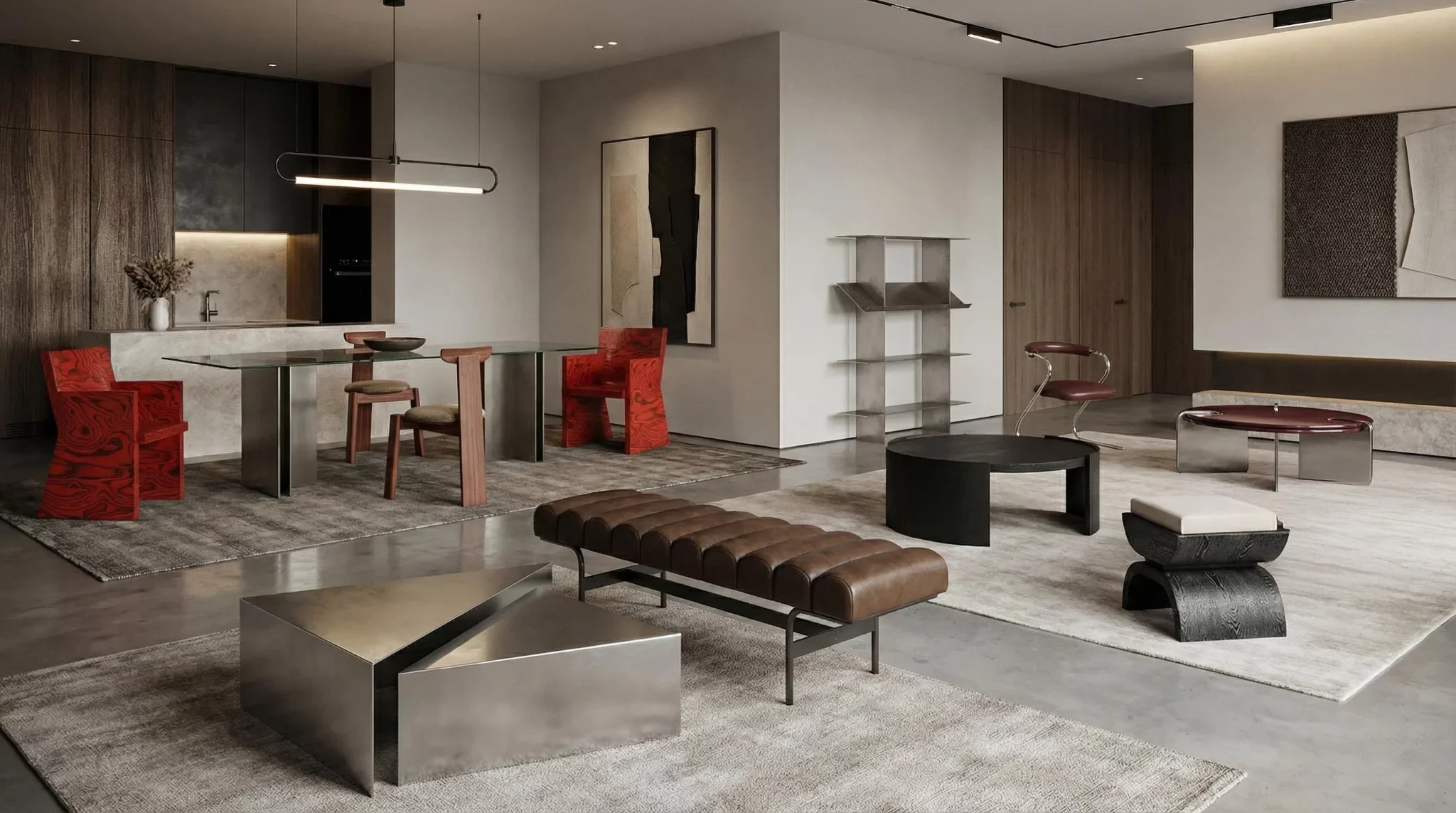
At the core of the brand’s identity is its flagship piece, the Kira Chair. Built from a root veneer surface finished in a bold red polish, the chair measures 88 × 56 × 63 cm. It is fully customizable in a range of polish colors and entirely handcrafted in Türkiye, with delivery windows ranging from two to four weeks. The Kira Chair exemplifies Regen Studio’s overarching philosophy: objects should not merely occupy a room; they should command its atmosphere through quiet confidence, flawless proportions, and uncompromising craftsmanship.
Chronology: From Architectural Problem-Solving to an Independent Practice
The trajectory of Regen Studio offers a compelling case study in organic growth, proving that some of the most enduring design ventures are born not out of ambitious business plans, but out of necessity and persistent creative patterns.
Phase 1: The Accidental Genesis
Regen Studio did not begin with a high-profile launch party or a venture-backed marketing campaign. It began with a pattern. The studio’s founder, trained as an architect, spent years running a traditional architectural practice. In the course of designing bespoke interiors, she frequently encountered spatial puzzles that commercial furniture catalogs could simply not solve.

To bridge these gaps, she began designing custom furniture and spatial elements tailored precisely to the architectural needs of specific rooms. Over time, however, a continuity emerged across these disparate projects. Whether the commission was residential or commercial, a shared logic kept appearing—an underlying philosophy regarding proportion, material honesty, and emotional atmosphere. The distinct design language was unmistakable, and eventually, ignoring it became impossible. Regen Studio was born from the decision to give that continuity an independent name and a dedicated structure.
Phase 2: Decoupling from Client Briefs
With the establishment of Regen Studio, the founder carved out a space independent of client constraints, architectural budgets, and corporate briefs. This freedom allowed the studio to pursue its own evolving design language wherever it organically led. Furniture was no longer treated as a byproduct of interior design; it became the primary medium through which spatial and architectural theories could be explored at a micro scale.
Phase 3: Refining the Handcrafted Model
As the studio matured, it formalized its relationships with traditional local artisans in Türkiye. By turning away from industrialized manufacturing plants and embracing human-scaled workshops, Regen secured a supply chain rooted in heritage and tactile mastery. Today, every piece goes through an iterative, collaborative process between the designer’s drawing board and the artisan’s workbench, cementing the studio’s reputation as a vital voice in modern collectible design.
Supporting Data and Maker Philosophy: The Intersection of Structure and Soul
To truly understand Regen Studio, one must examine the intellectual and material scaffolding that supports its creative output. The studio’s work is underpinned by a distinct philosophy regarding design history, spatial theory, and the value of constraints.
The Architectural Foundation
In the practice of Regen Studio, furniture is not separate from architecture—it is its logical extension. The same questions asked when designing a building—such as how to handle proportion, how light interacts with surfaces, and how an object holds or releases the atmosphere of a room—are answered here through wood, metal, color, and texture.

The studio draws profound inspiration from mid-century modern design, specifically admiring its harmonious balance of organic form, functional clarity, and timeless material use. However, Regen is equally invested in historical amnesia—excavating techniques and materials that were once widely celebrated by master craftsmen but subsequently sidelined by industrialization. The objective is not hollow nostalgia; rather, it is thoughtful reinterpretation. By filtering familiar materials through a contemporary design language, Regen creates a continuous, ongoing dialogue between the past and the present.
The Iterative Process
Every piece begins not with a sketch of an object, but with context. The design team analyzes how an item will live within a given space and what emotional atmosphere it is expected to support.
- Phase A (Architectural Conception): Focus is placed strictly on proportion, function, and spatial relationships.
- Phase B (Material Exploration): Textures, finishes, and color combinations are tested to understand how an object can simultaneously carry physical presence and visual subtlety.
- Phase C (Workshop Collaboration): Drawings are taken to the workshop, where iterative prototyping begins. Craftsmanship is treated not as a final finishing touch, but as an active shaping force that defines the character of the piece from its inception.
Embracing Constraints
Rather than viewing limitations as obstacles, Regen Studio treats constraints as essential catalysts for creativity. Many of the studio’s most iconic forms originated under real-world pressures—such as tight timelines, spatial limitations, and material scarcities encountered during architectural builds. These restrictions forced the studio toward leaner, more exact, and highly thoughtful solutions, proving that limitation breeds precision.
Official Responses and Creator Insights
While Regen Studio speaks primarily through its physical objects, the underlying philosophy articulated by its founder sheds light on why these pieces resonate so deeply in a saturated global market.
Reflecting on the studio’s inception, the founder notes that the brand emerged from a realization that the custom elements designed for architectural projects possessed a collective soul. "At some point, the continuity became impossible to ignore," the studio notes. "The studio emerged from the decision to give that continuity a name."

Regarding the philosophy of object design, the studio emphasizes that furniture must act as a mirror to its owner. Speaking specifically of the Kira chair—with its striking root veneer surface and bold red polish—the studio describes it as an object that "confidently expresses its own style." Yet, this confidence is balanced by deep spatial humility. The Kira chair does not aggressively demand attention through noise or trend-chasing; instead, it possesses a quiet architectural gravity that "simply refuses to be ignored." It is an object designed for a specific room and a specific human life, rather than for the sterile pages of a mass-market catalog.
Implications: The Future of Collectible Craft and Regional Design Hubs
The rise of Regen Studio carries broader implications for the global design economy, pointing toward several significant shifts in how consumers, architects, and collectors view provenance and production.
1. The Decentralization of Design Powerhouse Hubs
Historically, the centers of collectible and high-end furniture design have been tightly clustered around traditional European capitals like Milan, Paris, and London, alongside major North American hubs. Regen Studio’s emergence in Türkiye highlights the growing strength of decentralized, regionally rooted design ecosystems. By leveraging local artisanal networks and deeply embedded craft traditions, Turkish designers are establishing global footprints without relying on industrial manufacturing centers.
2. The Counter-Movement to Fast Furniture
As consumers grow increasingly fatigued by flat-pack culture, disposable home decor, and supply chains marked by overproduction, studios operating on a made-to-order, small-batch model offer a vital corrective. Regen Studio’s refusal to scale production up to industrial levels underscores a growing market appreciation for true longevity. When objects take weeks to craft and are built to withstand generations of daily use, they transition from mere consumer goods into enduring cultural artifacts.
3. Architecture as a Gateway to Object Design
The blurring lines between architectural practice and furniture design—demonstrated so clearly by Regen Studio—suggest a promising future for holistic interior environments. When architects design the furniture inhabiting their spaces, the result is a unified spatial choreography where every chair, table, and surface contributes to a cohesive emotional climate. As more design practices adopt this cross-disciplinary approach, the boundary between building a room and populating it will continue to dissolve, enriching the world of bespoke interiors for decades to come.