





AMSTERDAM — In an era dominated by flat digital screens, algorithmic feeds, and a cultural obsession with accelerated speed, Dutch contemporary artist Sandra Keja Planken is carving out a sensory sanctuary. Operating at the hazy intersection of sculpture, textile, and immersive architecture, Planken creates works that defy easy categorization. They sit somewhere between organism and object: woven structures that pulse with the visual rhythm of living tissue, and glass elements that possess an uncanny, fluid malleability.
Her practice is anchored by a singular, urgent preoccupation: exploring how tactile presence, material vulnerability, and deep sensory engagement can restore emotional and ecological connection in an increasingly detached visual culture.
Main Facts: The Material Universe of Sandra Keja Planken
Based in the Netherlands, Planken works across multiple disciplines—primarily textiles, blown and cast glass, and room-spanning immersive installations. Her recent projects, most notably Weaves of Saltwater Dreams, blur the boundaries between fine art and ecological intervention.
Key Elements of Planken’s Practice:
- Hybrid Mediums: Combining recycled yarns, tactile fibers, and rigid glass to create visual and tactile contradictions (e.g., hard materials that look soft; textiles that mimic organic architecture).
- Ecological Integration: Through her ongoing conceptual framework, Nature’s Visual Sound, Planken collaborates with scientific institutions to design glass and textile structures that double as temporary seabed habitats for heat-resilient algae and corals.
- Sustainable Sourcing: A foundational commitment to utilizing recycled or donated yarns—harvested from discarded wardrobes and forgotten industrial stock—transforming waste into complex marine topographies.
- Philanthropic Impact: Ten percent of the proceeds from every acquisition of her artwork goes directly toward funding underwater reef restoration and marine art projects.
Chronology: From Cultural Duality to Ecological Immersive Art
To understand Planken’s unique artistic vocabulary, one must trace the trajectory of her life and career—a journey defined by an early sensitivity to spatial energy and a relentless desire to push materials beyond their conventional limits.
Formative Years: The Roots of Sensitivity
Planken’s sensitivity to spaces and materials was forged early in life. Growing up caught between the emotional warmth and cultural openness of Spain and the quiet restraint of Northern Europe, she developed a heightened awareness of her surroundings. She noticed that certain environments felt vibrant and alive, while others felt stark, sterile, and emotionally vacant. This early realization—that spatial atmospheres directly impact human psychology—never left her. It became the foundational question she continues to explore through her physical creations.
The Turn to Textile
Initially, Planken gravitated toward textiles because of their inherent tactility and deep emotional presence. Threads, knots, and woven structures carried an almost human vulnerability. Over time, her creative scope naturally expanded: flat textiles evolved into sculptural forms, sculptures grew into room-sized installations, and installations ultimately transformed into fully immersive environments capable of surrounding and enveloping the viewer.
The Introduction of Glass and the Marine World
Glass entered her practice at a later stage, introduced as a medium capable of holding fragility, reflection, and captured light. Planken became fascinated by the structural and conceptual tension between textile and glass—exploring how softness and hardness could begin to dissolve into one another.

As her technical experimentation deepened, marine ecosystems, coral formations, and ecological transformation emerged as defining influences. Her work shifted from abstract spatial design to active ecological commentary, positioning art not merely as a passive object of contemplation, but as an active participant in processes of care, regeneration, and emotional reconnection.
Supporting Data: Inside the Artist’s Process
Planken’s studio methodology rejects rigid blueprints and predetermined outcomes. Instead, it relies heavily on intuition, observation, and material responsiveness.
The Genesis of a Work
Every project begins with observation. Planken gathers fragments from the world around her: shifting light reflections, underwater movements, wildflowers, seaweed, discarded industrial materials, and the intangible emotional tensions present within specific architectural spaces.
Rather than forcing a material to execute a fixed vision, she allows the medium to guide the process. She moves fluidly between drawing, weaving, glassblowing, and sculptural experimentation, allowing forms to grow organically, much like living biological systems.
Material Contradictions and Layering
Tactility remains the cornerstone of her methodology. Textiles invite physical closeness and psychological vulnerability, while glass introduces light, reflection, and a sense of suspension. Planken actively seeks out moments of material contradiction:
- Glass that appears soft and malleable.
- Textiles that behave with the structural integrity of architecture or organic tissue.
The works accumulate layer by layer through a continuous dialogue between creator and material. Light acts as the final, essential collaborator, shifting the atmosphere of the installation dynamically depending on the time of day, the ambient environment, and the positioning of the viewer.
Official Responses and Artist Statements
In an exclusive reflection on her career, the philosophy behind her labor-intensive process, and the role of the artist in modern society, Sandra Keja Planken shares her perspective on the state of contemporary culture:

"I wish more people understood that being an artist is not only about creating objects, but about learning how to remain deeply sensitive within a world that constantly pushes towards speed, distraction, and sameness," Planken explains.
"Most artworks are built through years of experimentation, doubt, observation, and invisible labor. The final piece often carries countless emotional and material decisions that are never immediately visible on the surface."
Addressing the societal function of art, she emphasizes the necessity of slowing down:
"I also believe artists help create emotional and cultural space within society. Art can slow people down, reconnect them to wonder, and allow them to experience the world differently for a moment. In a time where so much becomes flattened into fast images and algorithms, I think sensitivity and imagination become increasingly important."
Spotlight Work: Weaves of Saltwater Dreams
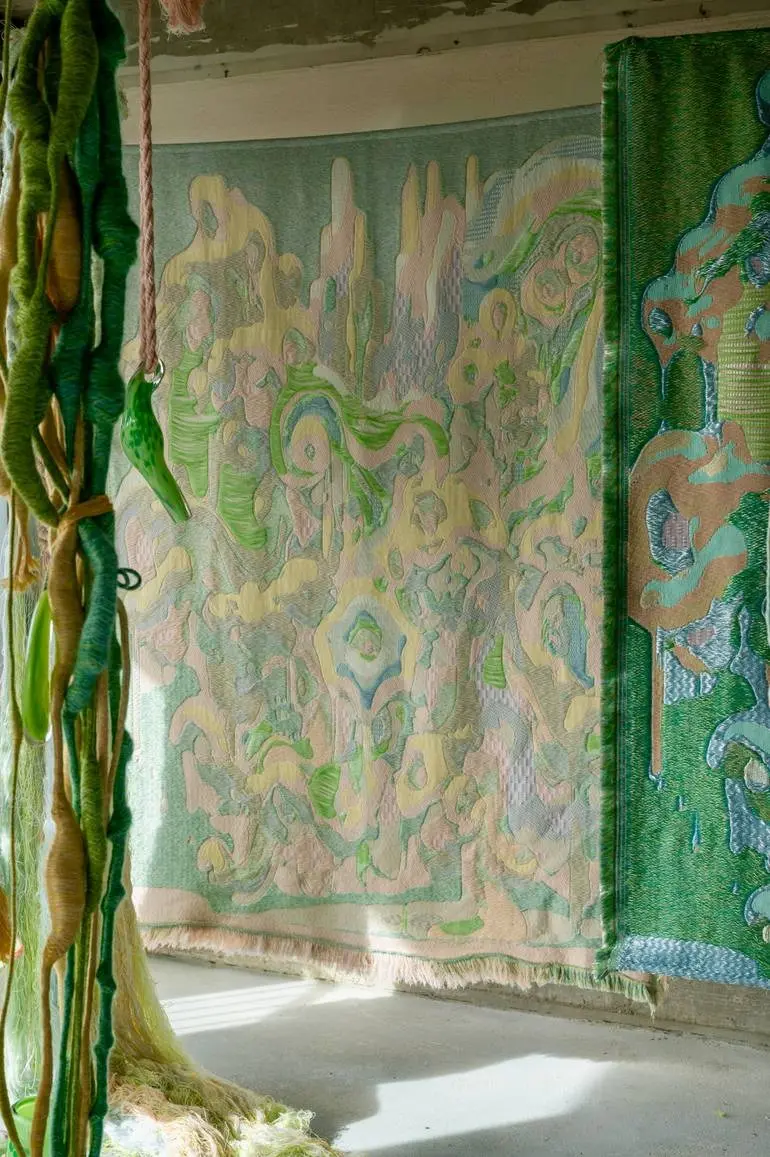
No single piece encapsulates Planken’s multidisciplinary ethos quite like Weaves of Saltwater Dreams. Premiered at BIG ART Amsterdam in collaboration with ValorosaViva, the coral art installation refuses easy classification.
A monumental woven tapestry—featuring a rich palette of deep greens, creamy neutrals, copper, and teal—unfurls across the space like a piece of submarine cartography. It feels simultaneously like a living coral reef and a waking dreamscape. Heavy ropes hang alongside the textile, tapering and elongating into strange, sea-creature-like appendages. The fabrics shimmer and shift, creating the illusion of underwater currents. They do not merely depict the ocean floor; they rehearse a physical and emotional return to it.
Materiality Meets Marine Science
True to Planken’s ecological commitment, every strand of yarn utilized in the installation is recycled or donated—sourced from discarded wardrobes and forgotten industrial stock—reborn as a complex, tactile coral topography.

This is not a purely aesthetic endeavor. Through her ongoing conceptual initiative, Nature’s Visual Sound, Planken is actively partnering with the Branch Foundation and Wageningen University. Together, they are utilizing specialized glass and textile structures designed to function as temporary seabed habitats, aiding in the cultivation of heat-resilient algae and corals.
The artwork avoids heavy-handed lecturing. Instead, it utilizes beauty and visceral tactility to make audiences feel a connection to the marine environment first, allowing ecological stewardship to follow naturally.
Implications: The Future of Eco-Sensory Art
Planken’s work signals a broader, much-needed shift within contemporary art and design. As digital fatigue sets in and environmental crises deepen, audiences are increasingly searching for physical authenticity and emotional resonance.
By bridging the gap between fine art, sustainable material sourcing, and hands-on marine conservation, Planken demonstrates that contemporary artists can transcend traditional gallery walls. Her practice proves that art can be functional, ecological, and deeply emotional all at once.
Acquisition Details & Conservation Impact
For collectors and institutions looking to engage with her work, pieces such as her large-scale wool and mixed-fiber sculptures (measuring roughly 55W x 40H x 2D inches, with variable dimensions) offer a direct link to this philosophy.
True to her core mission, 10% of every acquisition goes directly to funding underwater reef art and marine restoration projects, ensuring that each purchase contributes actively to the ecosystems that inspired them. In Sandra Keja Planken’s hands, art is no longer just something to look at—it is a living, breathing mechanism for healing.