








Main Facts
In the bustling maritime industrial neighborhood of Red Hook, Brooklyn, a 7,000-square-foot former manufacturing space hums with a distinct kind of creative energy. This is the home of Piscina, a multidisciplinary design studio and collaborative workshop founded by Cuban-American artist and fabricator Natalie Shook. Far from a conventional white-cube gallery that occasionally dips its toes into production, Piscina operates as an incubator of tactile art—a bustling ecosystem where woodworkers, ceramicists, and metalsmiths share tools, ideas, and square footage.
The studio’s ethos is built on the friction and harmony of diverse artistic practices coming together under one roof. At the helm is Shook, whose personal journey from a paintbrush-wielding teenager in the Midwest to a master carpenter in New York has directly shaped Piscina’s non-dogmatic, highly collaborative identity. Since making a dramatic splash at the International Contemporary Furniture Fair (ICFF) in 2022—where the collective swept the floor by winning both Best New Designer and Best in Show—Piscina has established itself as one of the most exciting new voices in American contemporary design.
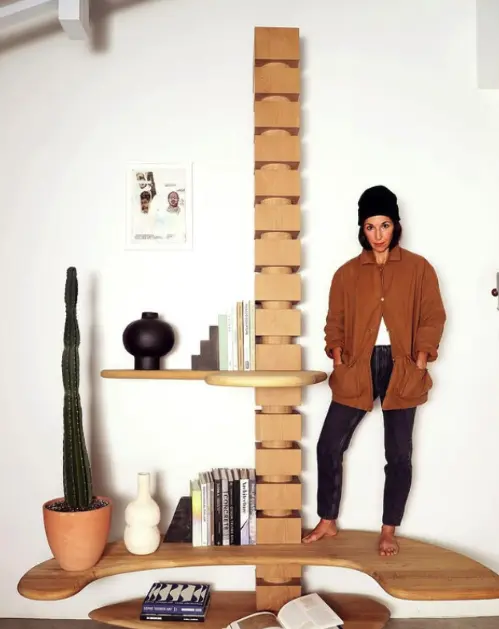
The collective’s output defies easy categorization. Bridging the gap between fine art, architectural intervention, and functional furniture, Piscina’s pieces—ranging from monumental solid-oak shelving towers to intimate, tactile ceramics and heavy cast-iron works—possess a rare physical gravity. They are objects designed not merely to be looked at, but to hold weight, anchor a room, and bear the unmistakable fingerprints of a communal creative process.
Chronology: The Evolution of Piscina
The Formative Years: The Midwest to Cooper Union
Long before she was designing award-winning furniture in Brooklyn, Natalie Shook was defined by an unwavering dedication to artistic practice. Born and raised in the American Midwest within a Cuban-American household, Shook picked up a paintbrush at the age of 14 and never looked back. For over a decade, she operated under the firm assumption that her creative destiny was bound to the two-dimensional surface of the canvas.
Driven by this ambition, she relocated to New York City to study painting at the prestigious Cooper Union. Yet, the high-density creative environment of New York proved to be a crucible that melted away old certainties.
The Material Shift: Discovering Carpentry
During her time at Cooper Union, Shook experienced a profound artistic pivot. She discovered an unexpected, magnetic pull toward carpentry and fabrication. The flat world of paint began to feel limiting; she found herself craving a physical connection to her materials. She wanted to make things that possessed genuine mass—objects you could touch, sit on, lean against, and that held real physical weight.
This realization marked the death of the painter and the birth of the fabricator. Shook immersed herself in woodworking and spatial design, learning the properties of timber, the behaviors of metal, and the structural integrity required to turn abstract ideas into load-bearing reality.
Relocation to Red Hook and the Birth of Piscina
Armed with a newfound technical vocabulary and a desire for community, Shook migrated to Red Hook, Brooklyn—a historic waterfront neighborhood known for its gritty industrial charm, maritime heritage, and vibrant community of independent makers. Recognizing that isolation is often the enemy of great design, she conceptualized Piscina not as a solo vanity project, but as a collective.
The vision was simple yet radical: create a shared workspace where diverse artisans could cross-pollinate their skills. Shook brought together woodworkers, ceramicists, and metalsmiths, establishing a space where individual expertise could be pooled to push the boundaries of what craft can achieve.
The 2022 ICFF Breakthrough
The culmination of these years of behind-the-scenes experimentation, sawdust, and kiln-firing came to a head at the International Contemporary Furniture Fair (ICFF) in 2022. Stepping onto the national stage for their debut collection, Piscina immediately captured the attention of critics, curators, and collectors alike.
The centerpiece of their exhibition—a towering, architecturally inspired solid-oak shelving unit—stunned judges with its monumental scale and meticulous detailing. Backed by an array of thought-provoking ceramic and cast-iron objects, Piscina swept the awards ceremony, taking home both Best New Designer and Best in Show. Overnight, a grassroots Brooklyn workshop transformed into an internationally watched design phenomenon.
Supporting Data: Inside the 7,000-Square-Foot Ecosystem
To truly understand Piscina, one must examine the physical environment that births its creations. The studio’s sprawling 7,000-square-foot footprint in Red Hook is deliberately structured to encourage workflow fluidity and interdisciplinary collaboration.
Spatial Breakdown and Equipment Infrastructure
- The Communal Woodworking Floor: Occupying the largest share of the open-plan layout, this zone is outfitted with heavy-duty machinery—table saws, joiners, planers, and custom-built assembly benches. Here, the air is thick with the scent of freshly cut timber, and the soundtrack is defined by the steady, rhythmic drone of saws.
- The Light-Filled Ceramic Studio: Situated near the building’s large industrial windows to maximize natural light, this area houses professional-grade pottery wheels, slab rollers, and multiple high-fire kilns. It is a space dedicated to the pliable art of earth and fire.
- The Metal and Casting Bay: Equipped for welding, grinding, and metal shaping, this zone allows the collective to seamlessly integrate structural iron and steel components into their wooden and ceramic designs.
Production Methodology: From Sketch to Object
Piscina’s creative philosophy treats the initial design sketch not as a discarded preliminary step, but as a primary, living document of creative intuition. In traditional manufacturing, sketches are translated into blueprints, digitized, and outsourced for mass production. At Piscina, the hand-drawn line is preserved in spirit and carried directly into the object’s physical form.

Every piece manufactured in the Red Hook studio passes through multiple pairs of hands. A single shelving unit or cast-iron vessel might begin with Shook’s conceptual drawing, be refined through structural consultations with a resident carpenter, undergo surface treatment advice from a ceramicist, and receive final metal-finishing touches from an on-site smith. This collaborative feedback loop ensures that no single object is born in a vacuum; instead, every item carries the accumulated problem-solving energy of twenty artists working in tandem.
Official Perspectives: The Philosophy of Collective Making
In interviews and public appearances surrounding the studio’s rise, Natalie Shook has consistently downplayed the notion of the solitary genius artist. Her perspective is shaped by the reality of running a communal workshop where ego takes a back seat to craft.
"She is, it turns out, many people trying to be one person. That’s not a problem. That’s the whole point of Piscina."
This sentiment captures the core operational philosophy of the collective. Shook recognizes that contemporary design challenges—ranging from sustainability and material sourcing to structural innovation—are too complex for a single mind to solve in isolation. By decentralizing the creative process, Piscina harnesses a collective intelligence.
Furthermore, the studio draws a hard line between commercial galleries that merely display finished consumer goods and true production spaces. As members of the collective frequently emphasize:
"This is not a gallery that happens to make things. It is a making space that occasionally shows what it makes. The distinction matters."
This nuance is crucial. In an era dominated by hyper-curated showroom displays that conceal the labor and mess of creation, Piscina wears its sawdust, clay dust, and workshop sweat as badges of honor. The final product is valued precisely because it is tethered to the physical reality of its creation.
Implications: The Future of Craft in Post-Industrial Urban Centers
Piscina’s success in Red Hook carries significant implications for the broader landscape of American design, urban manufacturing, and the future of the maker movement.
1. The Revival of Urban Industrial Spaces
For decades, American cities have witnessed the steady erosion of urban manufacturing zones, as former industrial neighborhoods are rezoned into luxury condominiums and sterile corporate tech hubs. Piscina’s establishment and thriving presence in Red Hook—a waterfront district vulnerable to both gentrification and climate pressures—demonstrates that physical craft can still anchor itself within high-cost metropolitan areas. By proving that high-end, award-winning design can be organically produced within a hyper-local urban ecosystem, Piscina provides a blueprint for preserving industrial culture in cities like New York.
2. Shifting Paradigms from Consumerism to Provenance
Today’s design consumers are increasingly fatigued by mass-produced, anonymous goods shipped from distant, opaque supply chains. The market hunger for work like Piscina’s—where a buyer can trace a solid-oak shelving unit directly back to the exact floor in Brooklyn where it was milled and assembled—signals a profound cultural shift toward provenance. People want to buy stories, human energy, and tangible authenticity. Piscina capitalizes on this demand by offering objects that carry the literal and figurative weight of community collaboration.
3. Redefining the Boundaries of Discipline
By effortlessly straddling the lines between fine art, architectural form, and functional furniture, Piscina challenges academic and commercial silos. When an object can simultaneously read as a minimalist architectural monument and a domestic bookshelf—as seen in their ICFF-winning oak shelving unit—it forces critics and collectors to abandon rigid categorical boxes. This interdisciplinary fluidity is likely to inspire a new generation of designers who refuse to choose between being a sculptor, a carpenter, or an architect.
As Natalie Shook and her collective continue to push the boundaries of what can be dreamt, drawn, and built within their Brooklyn workshop, Piscina stands as a testament to the power of shared vision. In a world increasingly dominated by digital abstraction, Piscina reminds us of the irreplaceable value of things you can touch, sit on, lean against—things that hold weight.