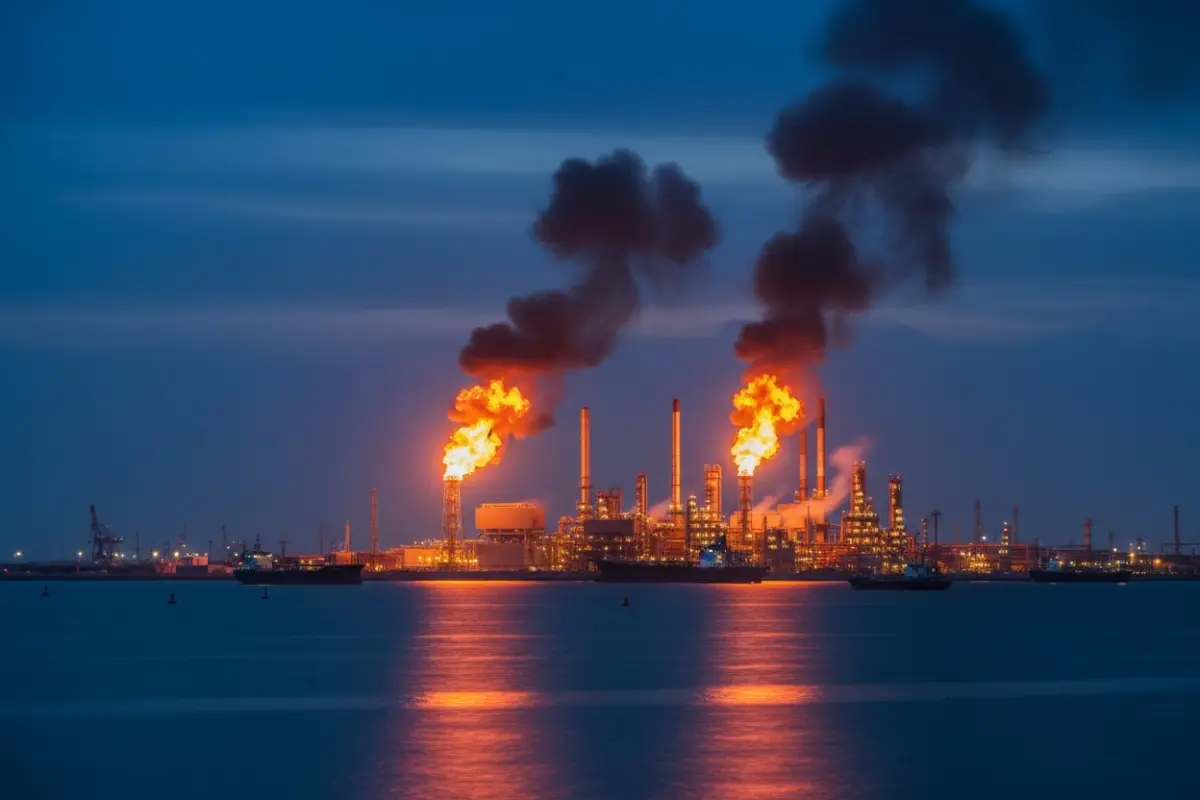
RIYADH / SANAA — In a dramatic escalation of regional hostilities, a coordinated wave of Houthi missile and drone strikes engulfed the strategic Saudi Aramco refinery at Jazan in flames on September 8. The multi-pronged assault, which targeted critical energy and military infrastructure across southwestern Saudi Arabia, has shattered a fragile regional ceasefire, injured dozens of civilians, and pushed international crude oil prices dangerously close to the psychological $100-per-barrel threshold.
With the Persian Gulf’s Strait of Hormuz effectively neutralized by concurrent geopolitical conflicts, the direct targeting of Saudi Arabia’s Red Sea export lifeline has left global energy markets confronting an unprecedented dual-chokepoint crisis.
Main Facts: The September 8 Assault
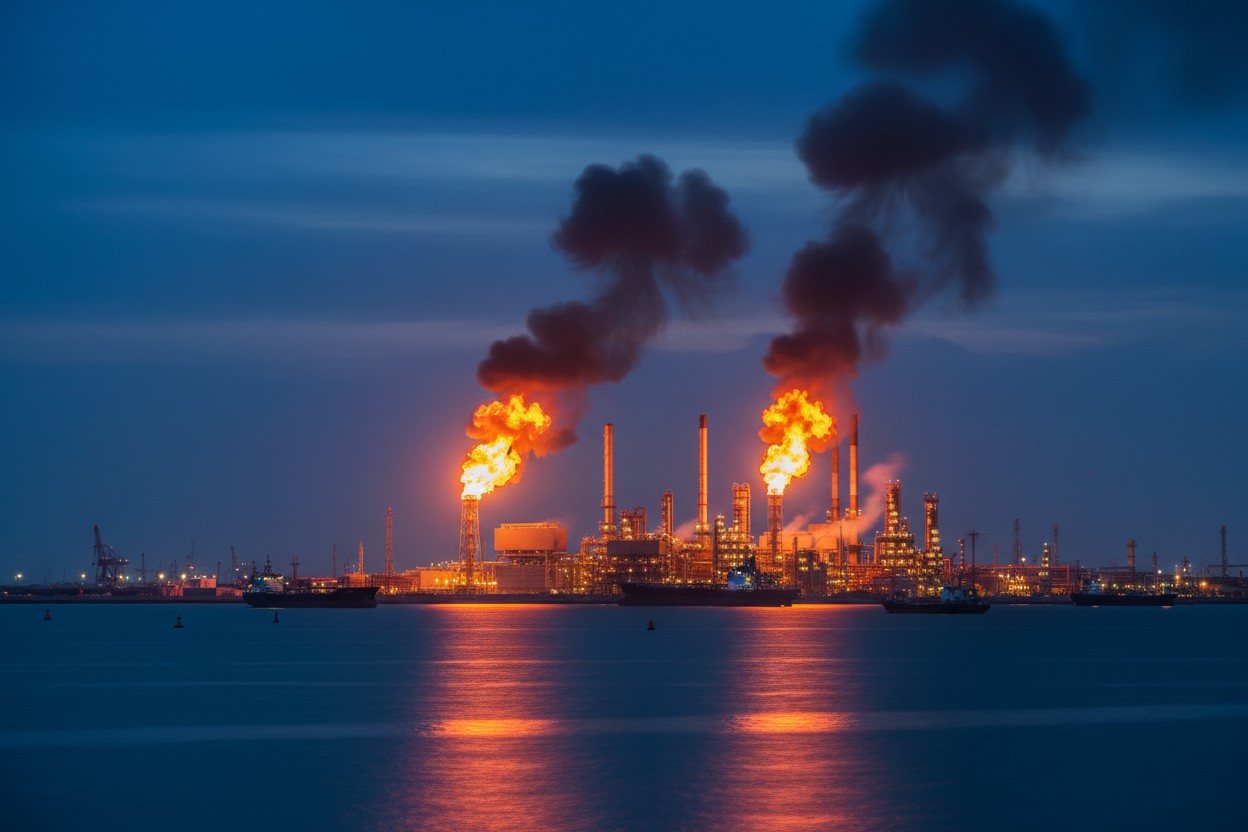
The coordinated offensive struck multiple high-value targets across the kingdom’s southwestern territory. According to regional reports, open-source intelligence from the War Zone, and thermal anomaly data captured by NASA’s Fire Information for Resource Management System (FIRMS), the massive Saudi Aramco refinery at Jazan on the Red Sea coast sustained direct hits.
Witnesses and satellite data confirmed that fires raged at the facility for hours following the initial impact. The facility—situated a mere 44 miles north of the Yemeni border—serves as an indispensable alternative export terminal, allowing Saudi Arabia to bypass the increasingly perilous Persian Gulf waters.
In addition to the Jazan refinery, Houthi strikes and resultant secondary fires impacted energy installations and military footprints in:
- Abha (including civil infrastructure and the airport vicinity)
- Khamis Mushait (targeting the vital Khamis Mushait Air Base)
- Najran (near the southern border)
- The Economic City
Saudi health and civil defense authorities confirmed that 73 civilians, including women and children, sustained injuries across these urban and industrial centers due to falling shrapnel and blast impacts. The Ministry of Energy acknowledged that the strikes caused fires at multiple locations, necessitating a temporary, precautionary halt to operations at several key installations to ensure structural integrity and personnel safety.
Chronology of Escalation: From Ceasefire Collapse to Open Conflict
The catastrophic events of September 8 represent the culmination of a rapidly deteriorating security landscape in the southern Arabian Peninsula.
- 2014–2015: Civil war erupts in Yemen as Houthi forces capture the capital, Sanaa, prompting a hastily formed, Saudi-led coalition to intervene militarily the following year to restore the internationally recognized government.
- 2022: A tenuous, UN-brokered ceasefire takes effect, largely halting cross-border missile exchanges and granting Yemen a period of relative calm that lasted nearly four years.
- July: Citing an alleged "unjust and oppressive siege" imposed by Riyadh over nearly twelve years, the Houthi movement formally declares a maritime embargo against Saudi Arabia, stepping up rhetoric and low-level provocations.
- Late August: Ground combat intensifies sharply across multiple Yemeni provinces between Houthi units and Saudi-backed loyalist troops. The Houthi leadership reports enduring 121 airstrikes by the coalition over a three-day window, setting the stage for retaliatory action.
- September 8: Houthi military forces launch what spokesman Brig. Gen. Yahya Saree describes as a large-scale operation involving "dozens of ballistic missiles and drones," striking Aramco facilities, air bases, and economic zones across southwestern Saudi Arabia, definitively shattering the remnants of the 2022 truce. Concurrently, U.S. Central Command engages Iranian assets in the Persian Gulf, deepening the theater-wide conflagration.
Supporting Data and Market Reactions
The immediate economic fallout from the strikes was swift and severe. International benchmark Brent crude surged toward the $100-per-barrel mark, trading at nearly $98 per barrel by midday on Tuesday—representing a dramatic $10-per-barrel leap in less than two weeks.
Energy market analysts note that this rapid pricing shift reflects the structural reality that traders are no longer viewing Middle Eastern kinetic activity as episodic skirmishes. Instead, markets are actively pricing in prolonged, structural disruptions to maritime and pipeline energy flows.
The crisis is compounded by concurrent actions in maritime corridors:
- The Red Sea Chokepoint: Accounting for a significant share of global maritime trade carrying oil and liquefied natural gas (LNG) from the Gulf to Europe and Asia via the Bab al-Mandeb Strait and the Suez Canal, the Red Sea corridor is now directly contested.
- The Persian Gulf Chokepoint: With the Strait of Hormuz effectively closed due to ongoing kinetic engagements between U.S. forces and Iran, Saudi Arabia had increasingly leaned on its East-West pipelines to divert millions of barrels per day to its Red Sea port of Yanbu and the Jazan terminal.
- The Jazan Vulnerability: By striking Jazan, the Houthis have directly menaced Saudi Arabia’s primary contingency export route, threatening to sever the kingdom’s absolute last high-volume conduit to global consumer markets.
Official Responses and Military Posture
The international and regional diplomatic fallout has been marked by hardline stances and vows of decisive retaliation.
Houthi Leadership
Brig. Gen. Yahya Saree defended the assault in a televised and Telegram-broadcast statement, framing the operation as a legitimate and necessary response to ongoing "Saudi aggression" and airstrikes targeting the Yemeni populace. Saree warned that operations would expand further if the coalition maintains its military posture and economic blockade.
Saudi Arabia and the Coalition
The Saudi Ministry of Energy condemned the attacks as a direct assault on global energy security, confirming temporary shutdowns at targeted southern sites while emphasizing that repair and mitigation efforts were underway.
Maj. Gen. Turki Al-Maliki, spokesman for the Saudi-led Joint Forces Command, categorized the offensive as a "blatant violation" of national sovereignty. Al-Maliki asserted that the coalition "will take all necessary operational measures to deter this Terrorist Militia and resolutely confront its hostile approach," signaling that intensified retaliatory air and ground campaigns inside Yemen are likely imminent.
United States and Wider Regional Dynamics
U.S. Central Command (CENTCOM) reported parallel kinetic engagements on September 8, noting that American forces neutralized five Iranian crude oil carriers in the Persian Gulf after Islamic Revolutionary Guard Corps (IRGC) elements targeted a U.S. Navy warship with ballistic missiles.
Diplomatic channels remain profoundly frozen. U.S. President Donald Trump reiterated a hardline stance, declaring that American forces will decisively defeat Iranian-backed destabilization efforts. In response, Iranian President Masoud Pezeshkian maintained that Tehran and its regional "Axis of Resistance" allies—including the Houthis—will continue their posture "with full strength until the aggressors are brought to complete regret."
Implications for Global Security and Energy Architecture
The successful Houthi strike on the Jazan refinery carries profound, long-term implications that stretch far beyond the Arabian Peninsula:
- Erosion of Energy Infrastructure Infallibility: For decades, major energy producers relied on the physical separation of inland and coastal refineries from active conflict zones as a baseline security guarantee. The proven capability of non-state actors utilizing long-range drones and precision ballistic missiles to penetrate sophisticated air-defense perimeters exposes coastal facilities to persistent vulnerability.
- The Fragility of Global Supply Chains: With both the Strait of Hormuz and the Bab al-Mandeb / Red Sea corridors simultaneously compromised, the foundational arteries of international energy logistics are under unprecedented stress. Refiners in Europe and Asia face immediate feedstock risks and potential supply rationing if alternative routing options fail.
- Macroeconomic Pressure: Sustained crude prices hovering near or above $100 per barrel threaten to reignite global inflationary pressures, complicating central bank monetary policies worldwide and acting as a persistent drag on post-pandemic economic recovery.
- The Death of Diplomatic Norms: The definitive collapse of the Yemeni ceasefire closes a window of regional de-escalation that had offered hope for a negotiated political settlement. As military options once again supersede diplomacy, the risk of miscalculation between regional heavyweights—Saudi Arabia, Iran, and their respective proxies—remains dangerously elevated.
As smoke continues to clear over the Red Sea coastline, the events of September 8 serve as a stark reminder: the security of the global economy remains inextricably shackled to the fragile and increasingly volatile geopolitical stability of the Middle East.