WASHINGTON — As the federal Religious Liberty Commission moves into its final review phases, a quiet yet profound battle over institutional inclusion is playing out in the nation’s capital. Established by presidential executive order under the Department of Justice (DOJ), the Commission was ostensibly created to study, promote, and strengthen protections for religious freedom across public life, education, healthcare, and the military. However, its methods, composition, and underlying philosophy have faced intense scrutiny from day one.
While legal challenges and public outcries from major multifaith coalitions have targeted the Commission’s perceived "Judeo-Christian" bias, a less visible but equally critical oversight has emerged: the relative absence of modern Pagan, Wiccan, Druid, and Heathen voices in federal policy records. Into this administrative vacuum stepped the Pagan Solidarity Alliance (PSA), offering a rare institutional policy brief to ensure that America’s minority and polytheistic faiths are not rendered invisible by government bureaucracy.
Main Facts
The controversy centers on the Religious Liberty Commission, a body tasked with assessing the state of religious freedom in the United States following its inception in 2025. The Commission’s mandate spans a wide array of public sectors, but its work has been dogged by accusations that it caters almost exclusively to mainstream religious traditions while sidelining religious minorities.
In response to a draft of the Commission’s recommendations released in June 2026, the DOJ opened a public-comment period. This window resulted in thousands of pages of submissions from legal scholars, advocacy groups, and religious organizations. Among them, Policy Brief No. 2026-01—submitted by the Pagan Solidarity Alliance and authored by Rev. Dr. Davron Michaels—secured a place in the official federal record under DOJ-RLC Comment-009205.
The PSA’s intervention was not a plea for special treatment, but rather a structural critique of how government agencies classify, track, and accommodate minority religions. The brief arrived amid concurrent controversies, including the Department of Defense’s controversial restructuring of its religious-affiliation tracking codes, which reduced more than 200 faith identifiers down to just 31.
Chronology of Events
The trajectory of the Religious Liberty Commission and the subsequent pushback from minority-faith advocates unfolded across a tightly compressed timeline:
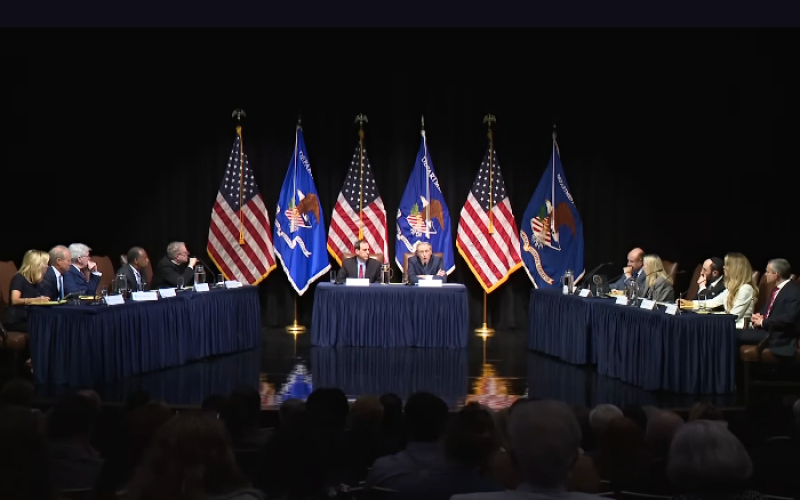
- June 16, 2025: The Commission holds its inaugural meeting at the Museum of the Bible in Washington, D.C., setting off a series of hearings and panel discussions that would run through the spring of 2026.
- April 13, 2026: The Commission concludes its final scheduled public hearing, wrapping up nearly a year of testimony from legal scholars, religious leaders, and public advocates.
- Spring/Summer 2026: The Department of Defense rolls out a sweeping restructuring of its Faith and Belief Codes, shrinking the number of recognized religious and philosophical categories from over 200 down to a drastically curtailed list.
- June 2026: The Religious Liberty Commission releases a draft of its final report containing twelve broad recommendations targeting education, healthcare, military service, and government enforcement. The DOJ simultaneously opens a public-comment period.
- Summer 2026: Advocacy organizations review the draft and submit public comments. The Pagan Solidarity Alliance submits its policy brief, focusing on administrative neutrality and religious classification systems.
- August 17, 2026: The Commission schedules a virtual public meeting to review the public comments, debate the draft framework, and prepare its final report.
Supporting Data and Administrative Context
The debate over religious liberty in the United States is increasingly tied to the unglamorous mechanics of public administration: database classifications, chaplaincy programs, demographic surveys, and recordkeeping.
When the Department of Defense expanded its Faith and Belief Codes in 2017 to include more than 200 specific categories, the move was defended as a vital operational tool. Specificity allowed military planners to assess chaplain capabilities, forecast religious support needs, and ensure that service members from smaller traditions received adequate accommodations. The 2026 reversal—slashing those categories to just 31—sparked immediate alarm among secular and minority-faith groups alike.
In its review of the DOJ’s released public-comment records, the PSA noted that it was far from alone in identifying structural blind spots in the Commission’s approach. Organizations such as the Sikh American Legal Defense and Education Fund (SALDEF) and the Interfaith Alliance submitted detailed critiques pointing out that the Commission’s frameworks relied heavily on majoritarian norms.
However, while organizations representing Muslims, Sikhs, Hindus, Buddhists, Jews, and humanists frequently appeared in these critiques, explicit references to Pagans, Wiccans, Druids, and Heathens were glaringly sparse. Despite thorough reviews of the submitted comments, the PSA identified few, if any, peer institutional policy briefs originating from other modern polytheistic organizations.

Official Responses and Perspectives
The public-comment record reveals a deep philosophical split over the very definition of religious freedom in America.
The Pluralistic versus Preferential Divide
Critics of the Commission, including major civil liberties groups like Americans United for Separation of Church and State, argue that true religious liberty requires strict government neutrality. Interestingly, this viewpoint was echoed by numerous Christian commenters who argued—on theological grounds—that state preference corrupts both the government and religion itself.
The resulting ideological divide separates those who view religious liberty as a mechanism to protect a preferred cultural baseline from those who champion a pluralistic framework. As the PSA argued in its brief: "Religious liberty is often tested not when government serves the religious majority, but when it encounters communities that are unfamiliar, numerically small, or imperfectly understood."
The Risk of Administrative Invisibility
For minority faiths, the threat of marginalization rarely manifests as explicit persecution. Instead, it occurs quietly through administrative erasure: a form missing a relevant checkbox, a census or military database combining distinct traditions under vague headings, or an advisory board assembled without recognizing the existence of entire theological communities.
The PSA emphasizes that its decision to engage the federal government through formal channels was a deliberate strategic choice. By entering a substantive policy analysis into the permanent federal record, the organization sought to demonstrate that administrative mechanics—such as how the government categorizes belief—directly impact the constitutional rights of everyday citizens.

Implications for the Future of Religious Pluralism
As the Religious Liberty Commission prepares to issue its final findings, the implications for American religious minorities remain uncertain.
- The Shape of Federal Policy: It remains to be seen whether the Commission will adjust its final recommendations to address the structural concerns raised by SALDEF, the Interfaith Alliance, and the Pagan Solidarity Alliance regarding minority-faith visibility in institutions like the military and public education.
- The Maturation of Pagan Advocacy: The inclusion of the PSA’s policy brief marks a milestone for modern Paganism in the United States. For decades, Pagan advocacy has often been reactive, focusing on legal defense or public relations after an infringement occurs. The PSA’s proactive policy submission signals a shift toward institutional engagement, positioning Paganism not just as a culture or belief system, but as an organized stakeholder capable of contributing to public administration discourse.
- The Necessity of Continued Vigilance: The relative absence of other Pagan institutional voices in the federal record highlights an ongoing challenge for the broader community: the need for sustained, professionalized advocacy in the dull, bureaucratic spaces where long-term policy is actually written.
As the federal government continues to grapple with the complexities of a diversifying nation, the lesson for Pagans and other minority faiths is clear. Religious freedom is not merely preserved in courtrooms; it is shaped in hearing rooms, administrative databases, and policy comment periods. When the state asks who its citizens are, someone must ensure that Pagans are at the table to answer.