Introduction: A Common Story That Reappears Throughout Time
History is frequently whispered through fragments—shards of pottery, faded inscriptions, and tiny, unassuming artifacts left behind by civilizations long turned to dust. In the vast tapestry of human storytelling, few motifs are as enduring, terrifying, and universally captivating as the battle between a mortal or divine champion and a monstrous, multi-headed serpent. From the ancient Near East to classical Greece and sacred scriptural texts, the narrative of the hero subduing the chaotic sea monster has captured the collective imagination of humanity for millennia.
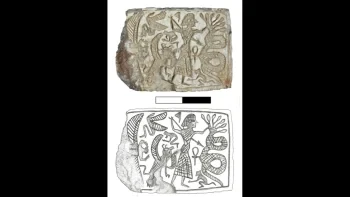
Now, a remarkable archaeological discovery from the heart of the Levant has added a tangible, breathtaking piece to this historical puzzle. Unearthed in Israel and dating back approximately 2,800 years, a rare ancient seal bearing the depiction of a fierce combat between a brave hero and a seven-headed serpent has sent ripples through the archaeological and mythological communities. Far from being a mere artistic doodle or a localized fable, this tiny relic bridges the gap between disparate ancient cultures, offering startling insights into how foundational myths were transmitted, shared, and transformed across the ancient world.
Main Facts: The Discovery of the Seven-Headed Serpent Seal
At the center of this burgeoning academic excitement is an ancient stamp seal, meticulously carved and preserved through the centuries. Measuring only a fraction of an inch, the artifact packs a monumental narrative into its minuscule surface.
- The Artifact: A stone or composition stamp seal featuring an intaglio carving.
- The Imagery: A dynamic scene depicting a human-like hero engaged in mortal combat with a formidable serpent possessing seven distinct heads.
- Age: Approximately 2,800 years old, placing it firmly within the Iron Age II period of the Levant.
- Location of Discovery: Unearthed in archaeological excavations within modern-day Israel, a region historically situated at the volatile and culturally rich crossroads of the ancient Near East.
- Significance: Experts view the artifact as a crucial missing link connecting ancient Canaanite, Mesopotamian, Hebrew, and Greek mythological traditions regarding cosmic combat and the subjugation of chaos.
Despite its diminutive physical stature, the seal commands massive historical weight. The detailed depiction of a seven-headed beast immediately draws comparisons to some of the most enduring literature and folklore in human history, suggesting that the archetype of the multi-headed dragon was deeply rooted in the ideological and religious frameworks of the Iron Age Southern Levant.
Chronology: Tracing the Evolution of the Multi-Headed Monster
To understand the true weight of this 2,800-year-old discovery, one must trace the evolutionary timeline of the multi-headed serpent motif across ancient civilizations. The narrative did not emerge in a vacuum; rather, it evolved through centuries of cross-cultural exchange, religious syncretism, and oral tradition.
1. The Bronze Age Roots: Mesopotamian and Canaanite Precursors (Third to Second Millennium BCE)
Long before the creation of the Israeli seal, the concept of the chaos monster terrorizing the gods and mortals was well-established in the Fertile Crescent. In ancient Mesopotamian mythology, tales of deities like Ninurta or Marduk battling multi-headed dragons—such as the fierce Bashmu or Tiamat—set a precedent. Similarly, in Ugaritic texts discovered in modern-day Syria, the Canaanite god Baal battles Lotan (a twisting, fleeing serpent with seven heads), a direct linguistic and thematic ancestor of the biblical Leviathan.
2. The Iron Age Context: The Israeli Seal (c. 8th Century BCE)
Dating to roughly 2,800 years ago (the Iron Age II period), the newly publicized seal emerges during a time of intense geopolitical shifting, trade networks, and cultural blending among the Israelites, Phoenicians, Arameans, and Neo-Assyrians. During this era, artistic motifs traveled rapidly along trade routes. The creation of a seal depicting a seven-headed serpent in the Levant demonstrates that the local populace was not only familiar with these epic cosmological battles but was actively incorporating them into their material culture, personal items, or administrative tools.
3. Classical Antiquity: The Greek Adaptation (First Millennium BCE)
Centuries after the creation of the Levant seal, the motif found fertile ground in the classical world. Most notably, the Twelve Labors of Hercules feature the hero’s legendary battle against the Lernaean Hydra—a multi-headed water serpent that grew two new heads for every one severed. While Greek mythology developed its own distinct flavor, the structural parallels between Near Eastern chaoskampf (chaos combat) myths and Greek heroic tales are undeniable, with artifacts like the Israeli seal serving as chronological and geographical stepping stones.
4. Later Religious and Literary Traditions (Common Era)
The imagery eventually trickled down into later religious texts and apocalyptic literature, most notably in the Hebrew Bible (where references to Leviathan persist) and the New Testament (specifically the Book of Revelation, which vividly describes a red dragon with seven heads and ten horns). The longevity of the symbol highlights a human psychological fixation on order versus chaos, a theme as relevant today as it was 2,800 years ago.
Supporting Data: Archaeological Context and Iconography
To validate the authenticity and historical importance of the seal, researchers have analyzed its iconography against contemporary artifacts found throughout the Levant and Mesopotamia.
Comparative iconographical studies reveal that seals of this nature were frequently used as administrative signets, amulets, or markers of elite status. The inclusion of a mythological scene rather than a standard geometric pattern or royal portrait indicates that the owner placed significant personal or religious value on the protective and symbolic power of the hero-serpent dynamic.
Furthermore, epigraphic and archaeological data from Iron Age II sites in Israel point to a sophisticated symbolic language shared among regional elites.
- Material Composition: Crafted from durable stone, allowing the fine lines of the seven heads and the hero’s weapon to survive nearly three millennia underground.
- Stylistic Influences: Exhibiting a hybrid style characteristic of Iron Age Levantine glyptic art, blending Egyptian, Mesopotamian, and local Canaanite artistic tropes.
- Geographical Distribution: Similar motifs have occasionally surfaced in Phoenician and Syrian contexts, but a well-provenanced find within modern Israel provides localized anchor data that strengthens theories of regional myth-making.
Official Responses: What the Experts Are Saying
The unearthing and subsequent analysis of the seal have generated considerable dialogue among archaeologists, biblical scholars, and historians specializing in ancient Near Eastern religions.
Prominent Near Eastern epigraphers and archaeologists have emphasized that the artifact offers rare physical evidence of popular mythologies that were otherwise known to us primarily through texts.
"When we look at texts like the Ugaritic Baal cycle or biblical passages mentioning multi-headed sea monsters, we are reading literature," noted one leading Near Eastern archaeologist familiar with Iron Age glyptic art. "What this seal gives us is the visual vernacular of those exact myths. It tells us that everyday people, or at least the administrative class utilizing seals, were surrounded by these stories of cosmic warfare and heroics."
Other scholars point out the fascinating intersection between iconography and theology. The battle against the serpent is universally recognized as a metaphor for the triumph of cosmic order over the primordial chaos of the deep. By capturing this moment on a small stamp seal, the ancient craftsman was arguably invoking a protective talisman—inviting the victorious energy of the hero to guard the owner’s goods, documents, or personal space against chaotic forces.
Museum curators and heritage authorities have also lauded the discovery, noting that it reinforces the importance of meticulous excavation and artifact preservation in understanding the complex cultural mosaic of ancient Israel and the broader Levant.
Implications: Rewriting the Narrative of Cultural Transmission
The discovery of the 2,800-year-old seven-headed serpent seal carries profound implications for how we understand the flow of ideas, literature, and religion in the ancient world. For generations, scholars debated the direction of cultural influence—did Greek myths flow east, or did Near Eastern motifs migrate west?
Artifacts like this seal provide a concrete answer: the ancient Mediterranean and Near East were deeply interconnected webs of shared motifs long before the classical Greek era reached its zenith. The story of the multi-headed serpent was a shared cultural currency circulating among diverse linguistic and ethnic groups in the Levant, Mesopotamia, and Anatolia.
1. Bridging Text and Image
For biblical scholars and historians of religion, the artifact serves as a visual commentary on ancient cosmologies. It validates that the conceptual framework behind figures like the Canaanite Lotan or the biblical Leviathan was not an isolated literary anomaly but part of a widespread visual and narrative tradition.
2. The Psychology of the Hero’s Journey
On a broader human level, the seal speaks to the timeless appeal of the underdog—or the divine champion—confronting insurmountable odds. Whether viewed as Hercules battling the Hydra, Marduk slaying Tiamat, or a nameless Levantine hero subduing a seven-headed beast, the narrative fulfills a deep-seated human desire to see order conquer chaos, light overcome darkness, and courage prevail over terror.
Conclusion
As researchers continue to clean, analyze, and contextualize this extraordinary Iron Age relic, it stands as a testament to the power of storytelling across the ages. The next time humanity looks back at its mythological foundations—whether through the pages of ancient epics, classical mythology, or sacred texts—we now have one more physical witness from 2,800 years ago reminding us that the battle against the seven-headed serpent has always been, and will always be, a fundamental part of our shared human story.