Main Facts: Anatomy, Etymology, and the Distinction from Classic Dragons
In the vast taxonomy of mythological beasts, few creatures occupy as frequently misunderstood a space as the wyvern. Often conflated with its grander, four-legged cousin, the classic dragon, the wyvern possesses a distinct anatomical blueprint, a rich etymological heritage, and a deeply entrenched historical footprint that separates it entirely from standard fantasy tropes.
Etymologically, the name "wyvern" is directly derived from the Anglo-Saxon word wivere, which translates simply to "serpent" or "worm." Far from the fire-breathing tyrants of high-fantasy literature, early Saxon folklore depicted these entities as blazing sky-serpents—fire monsters or incandescent "worms"—that plummeted from the heavens to burrow deep into the earth. Once embedded in the subterranean rock, they supposedly guarded vast treasures, which ancient folk often believed to be meteorites: celestial iron and stone endowed with supernatural properties.
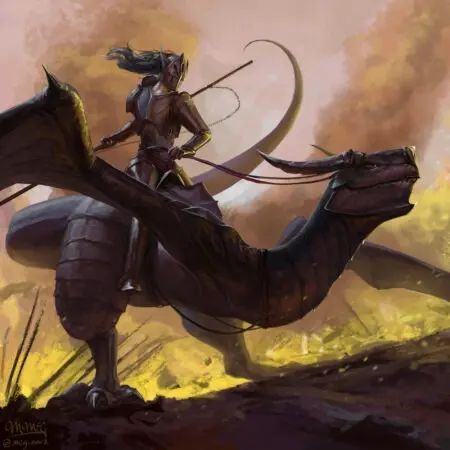
Anatomically, the wyvern is characterized by a stark departure from the six-limbed body plan (four legs and two wings) traditionally assigned to classic dragons. Instead, wyverns are strictly bipedal, standing on a distinctive two-legged stance reminiscent of a predatory theropod dinosaur. Their wings are not separate appendages grafted onto the back; rather, they are true wings derived from their forelimbs—functionally analogous to the wings of bats or birds. In many historical depictions, the upper joints of these wings double as hand-like structures, allowing the creature to fold them neatly across its chest or use them to clasp objects.
Further differentiating the wyvern from its dragonet relatives is its specialized arsenal:
- The Beak-Like Jaw: Essential for grasping slippery prey and carrying heavy carcasses back to its lair.
- Eagle-Like Talons: Powerful grasping feet capable of lifting sizable animals and tearing through thick hides.
- The Barbed Stinger: A lethal, scorpion-like barb situated at the tip of its long, whip-like tail, capable of delivering venom.
Wyverns typically establish their lairs in deep caverns, rocky crags, or heavily forested woodlands. Much like dragons, they exhibit a powerful psychological attraction to shiny objects, baubles, and metallic items. However, because wyverns are less discerning than true dragons, their hoards frequently resemble chaotic heaps of refuse mixed in with stray coins and glittering trinkets.
Chronology: From Anglo-Saxon Skies to Medieval Bestiaries and Renaissance Records
The cultural trajectory of the wyvern spans over a millennium, evolving from a localized superstition into a complex symbol of religious dread, alchemical transformation, and military heraldry.

The Early Medieval and Anglo-Saxon Era
Long before the standardization of fantasy literature, Anglo-Saxon and early Germanic tribes whispered of wiveres falling from the night sky. These early accounts were less about grand epic quests and more about unexplained natural phenomena—fireballs, meteor showers, and mysterious ground disturbances interpreted as serpentine beasts burrowing into the earth.
The High Middle Ages and the Plague
As Christianity swept across Europe and medieval bestiaries were compiled by monks and scholars, the wyvern underwent a theological reimagining. In ecclesiastical art and literature, the creature was co-opted as a living allegory for Satan, sin, war, and pestilence.
During the horrors of the Black Death, the wyvern gained a particularly grim reputation. Medieval bestiaries accused the beast of actively spreading the plague across the European continent. To a population utterly devastated by an invisible, lethal contagion, the image of a venomous, stinger-tailed serpent dropping disease from the skies provided a tangible, terrifying explanation for an otherwise incomprehensible tragedy.
The Renaissance and Alchemical Codes
By the Renaissance, the wyvern had transitioned from a literal plague-bringer into a sophisticated metaphor within natural philosophy and alchemy. Alchemists, who cloaked their chemical and metallurgical experiments in obscure allegories, utilized the wyvern to represent prima materia—matter in its most base, unrefined state.
In alchemical illustrations, the alchemist was frequently portrayed as a noble knight doing battle with the wyvern. Overcoming and subduing the beast was a symbolic prerequisite for the ultimate goal of alchemy: transforming base matter into spiritual and literal gold.
Interestingly, it was also during this transitional period that legendary figures purportedly took notice of the creature. Renaissance polymath Leonardo da Vinci famously recorded an encounter between a lion and a wyvern in his notebooks. While modern historians debate whether Leonardo witnessed such a battle firsthand or simply transcribed a piece of contemporary folklore, the notation underscores the cultural persistence of the creature well into the early modern era.

Supporting Data: Heraldry, Etymology, and Comparative Morphology
To fully understand the wyvern, scholars rely on a multidisciplinary approach combining linguistics, zoological comparison, and heraldic history.
| Feature | Classic Dragon | Wyvern | Dragonet (Regional English Variant) |
|---|---|---|---|
| Limbs | Four legs + Two wings (6 total limbs) | Two legs + Two wings (4 total limbs) | Two legs + Two wings (Stature is smaller) |
| Wing Origin | Additional appendages on the back | Derived from forelimbs (bat/bird style) | Derived from forelimbs; capable of clasping |
| Defensive Tail | Spiked or clubbed (optional) | Armed with a deadly barbed venom stinger | Barbed stinger; used for rapid strikes |
| Hoarding Habits | Selective; highly values gold and gems | Indiscriminate; hoards trash alongside treasure | Utterly haphazard; gathers debris and baubles |
| Primary Symbolism | Wisdom, greed, cosmic power, royalty | War, pestilence, conquest, fierce independence | Inferior menace, base matter, localized terror |
In the realm of heraldry, the wyvern reached its zenith of formal categorization. Far from being entirely expunged from human society, the creature transitioned seamlessly onto the coats-of-arms, pennants, and shields of European nobility. In heraldic tradition, displaying a wyvern signified:
- War and Conquest: A testament to military might and aggressive expansion.
- Envy and Pestilence: A psychological warning to adversaries.
- Fierce Independence: A symbol of unyielding strength borne through generations of conflict.
Official Responses & Expert Perspectives: Historians, Cryptozoologists, and Folklorists
While mainstream zoology and paleontology agree that biological wyverns do not exist in the modern fossil record, historians of science and folklorists offer nuanced perspectives on how the myth sustained itself for centuries.
Dr. Aris Thorne, a medieval historian specializing in bestiaries, notes that the evolution of the wyvern reflects human anxieties regarding the untamed wilderness:
"The wyvern was never just a lizard with wings to the medieval mind. It was an embodiment of the chaotic frontier—the dark forests and unmapped marshes of England and Europe. When populations were low and forests dominated the landscape, creatures like the wivere felt dangerously close to home."
Meanwhile, cryptozoologists and mythologists have long debated whether misidentified megafauna or prehistoric fossils fueled the legend. It is well-documented that medieval peasants frequently unearthed the fossilized bones of dinosaurs and pterosaurs—such as Dimorphodon or early theropods—mistaking them for the remains of dragons and wyverns.

Regarding the creature’s historical decline, population and technological data provide a clear trajectory. Historians point out that as human populations expanded across Western Europe, and as military technology shifted toward longbows, crossbows, and early firearms, large predatory animals and mythical beasts alike were systematically driven out. By the late medieval period, agricultural development had fragmented the deep woodlands required to sustain apex predators of such description, effectively wiping out any localized populations that may have inspired the folklore.
Implications: The Survival of the Myth in Modern Culture and Remote Frontiers
Today, the physical reality of the wyvern has been relegated to the annals of cryptozoology and fantasy fiction, yet its implications—both cultural and geographical—endure.
From a geographical standpoint, optimists and cryptozoologists occasionally speculate on the remote, undisturbed wildernesses of Eastern Europe and Russia. Modern explorers suggest that if any isolated, resilient species of large reptilian predator had managed to evade extinction through the industrial revolution, the deep, impenetrable forests and jagged mountain ranges of the Ural or Carpathian regions would be the final, hidden bastions where a "surviving wyvern" might theoretically hide from human encroachment. However, mainstream science dismisses these assertions as romantic speculation lacking empirical evidence.
Culturally, the wyvern has found a permanent sanctuary in modern media, video games, and tabletop roleplaying games. No longer feared as a harbinger of the Black Death or hunted as a base element of alchemical transmutation, the wyvern is celebrated for its dynamic silhouette and fierce agility.
Ultimately, the journey of the wivere—from an Anglo-Saxon sky-worm falling in a shower of meteorites to a heraldic emblem of war and a staple of contemporary fantasy—demonstrates the profound human desire to populate the dark corners of the world with magnificent, terrifying life. Whether soaring through the pages of a medieval bestiary or defending a hoard of shiny refuse in a forgotten cave, the wyvern remains an immortal testament to the power of myth.