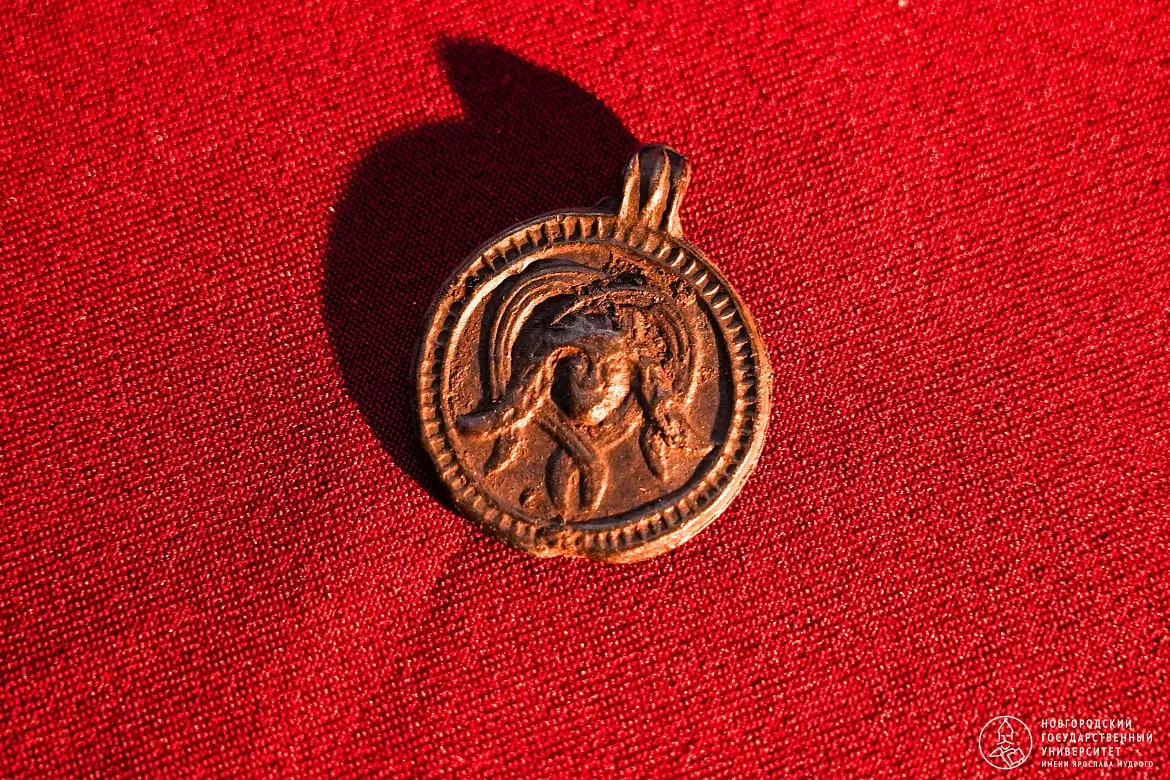
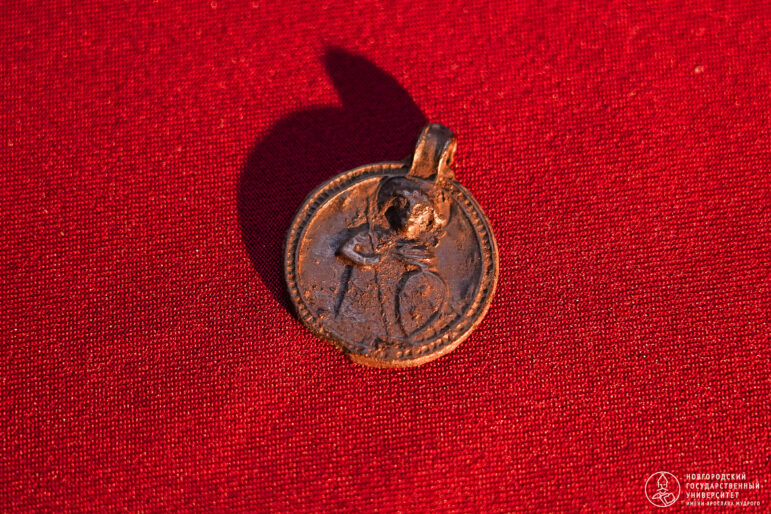
STARAYA RUSSA, RUSSIA — Deep in the damp earth of northwestern Russia, archaeologists have unearthed a rare and evocative artifact that offers a profound window into the religious syncretism of the medieval world. The object, an 11th-century copper-alloy pendant discovered at the Pyatnitsky excavation site in the ancient city of Staraya Russa, features a striking visual juxtaposition: a canonical Christian warrior saint on one side, and a serpentine, Gorgon-like female figure on the other.
Announced by researchers at Novgorod State University, the double-sided amulet—known scientifically and historically as a serpent pendant, or zmeevik—pushed back the timeline of this unique artifact class in the region by at least a century. While Staraya Russa had previously yielded four other zmeeviki, those specimens dated from the 12th through the 14th centuries. This newly recovered piece, belonging to the foundational era of urban settlement in Kievan Rus’, provides unprecedented physical evidence of how deeply ingrained older, pre-Christian protective traditions were among populations newly navigating the structures of medieval Christianity.
Experts emphasize that the pendant is far more than a mere historical curiosity; it is a physical manifestation of a cultural negotiation. In a world where the boundaries between orthodox dogma and folk apotropaic practices were porous, items like the Staraya Russa pendant served as tangible shields against malevolent forces, disease, and misfortune, fusing classical Mediterranean mythology with Byzantine Christian iconography on the Slavic frontier.
Main Facts: Anatomy of an 11th-Century Amulet
The artifact recovered by the Novgorod State University Center for Archaeological Research is a masterpiece of early medieval metallurgy and ideological blending. Cast from a copper alloy—likely produced locally in an urban workshop rather than imported directly from Byzantine metropolitan centers—the pendant measures a portable, wearable scale typical of personal protective talismans.
The obverse, or "front" side of the pendant, features a sharp, raised relief of a Christian warrior saint. Armed with a spear and a protective shield, the figure is tentatively identified by lead archaeologists as Saint Theodore Stratelates, a revered military martyr in the Orthodox tradition. In the visual language of medieval Christendom, such figures stood as celestial champions, warding off spiritual and physical harm through martial grace and divine backing.
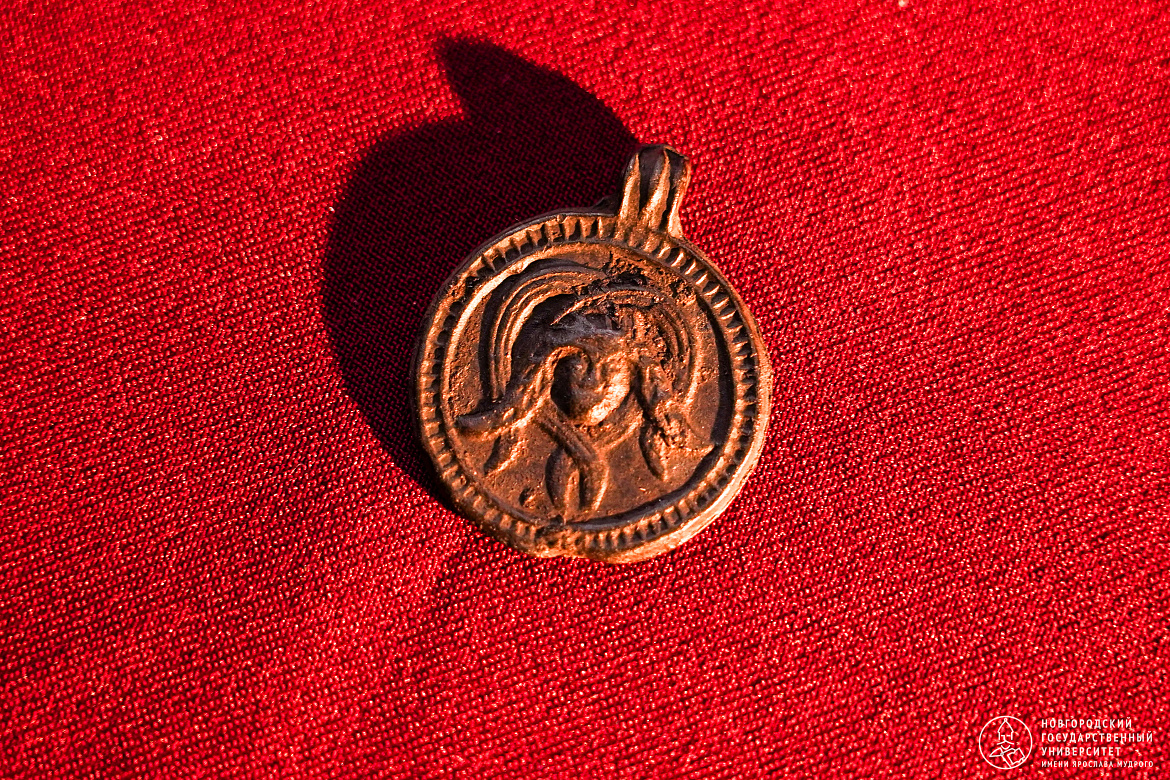
In stark contrast, the reverse side flips the theological script. It depicts a female head crowned and framed by writhing, snake-like forms. The imagery is unmistakable in its lineage, tracing a direct line back to the ancient Greek myth of Medusa and the Gorgon tradition. Yet, historians and archaeologists caution against reading the image as a sign of lingering, literal Hellenic pagan worship in northern Russia. Instead, by the 11th century, the Gorgon motif had undergone a semantic evolution. It had transformed from a specific mythological monster into a generalized, archetypal symbol for chaos, darkness, and malevolent spiritual forces.
The juxtaposition of these two faces creates a powerful theological dialogue. By placing the Christian warrior saint opposite the serpentine female figure, the creator and wearer of the amulet engaged in a visual exorcism—a permanent, wearable reenactment of the victory of divine light over chaotic darkness.
Chronology: From the Mediterranean to the Volkhov River
To understand how a Mediterranean myth transformed into a protective amulet in medieval Russia, archaeologists trace a vast trajectory across centuries and geography:
Antiquity: The visual tradition of the Gorgon emerges in ancient Greece and Rome, where the face of Medusa is utilized as an apotropaic device—an image meant to ward off evil by terrifying it with an even more terrifying visage.
The Byzantine Era: As the Byzantine Empire Christianizes, classical motifs are reinterpreted. Apotropaic traditions are absorbed into Eastern Orthodox culture, where amulets begin pairing orthodox holy figures with apotropaic symbols to satisfy popular desires for physical protection against illness and catastrophe.
Late 10th Century: Following the Christianization of Kievan Rus’ by Prince Vladimir in 988 AD, Byzantine cultural, religious, and artistic influences flood northward along major trade routes, including the famous "Route from the Varangians to the Greeks."
11th Century (The Staraya Russa Find): Local metalworkers in growing urban centers like Staraya Russa begin adapting Byzantine amulet prototypes. The newly discovered Pyatnitsky site pendant is cast during this foundational century, marking the earliest known local appearance of a zmeevik in the region.
12th–14th Centuries:Zmeeviki production continues sporadically across medieval Rus’, with previously discovered examples in Staraya Russa dating to this later window.
September 2026: Novgorod State University formally announces the unearthing of the Pyatnitsky pendant, updating the archaeological timeline for the region and renewing scholarly interest in medieval Russian folk religion.
Supporting Data: The Archaeological Context of Staraya Russa
Staraya Russa is one of the oldest and most historically rich urban centers in northwestern Russia. Situated south of Veliky Novgorod, the city grew around salt-boiling industries and strategic river networks. The Pyatnitsky excavation site, where the pendant was discovered, has long been a fertile ground for medieval archaeology, yielding layers of organic preservation due to waterlogged soil conditions.
Before this discovery, Staraya Russa’s catalog of serpent pendants was limited to four artifacts, all securely dated to the High-to-Late Middle Ages (12th through 14th centuries). These later pieces demonstrated that the zmeevik tradition had a sustained presence in the region. However, the 11th-century date of the new find changes the historical baseline. It proves that the fusion of Christian iconography and apotropaic pagan tropes occurred almost concurrently with, or immediately following, the institutional Christianization of the region, rather than developing as a much later folk aberration.
Metallurgical analysis of the copper-alloy pendant also challenges assumptions about trade dependencies. While earlier zmeeviki in Rus’ were frequently imported luxury goods from Byzantine workshops, stylistic and material markers on the Staraya Russa specimen strongly point to local production. Craftsmen operating within the nascent urban estates of Staraya Russa possessed the technical skill and the ideological demand required to cast complex, double-sided amulets locally, adapting imported Mediterranean concepts to fit the spiritual needs of a frontier Slavic community.
Official Responses and Expert Commentary
The unearthing of the pendant has generated considerable excitement within the Russian academic community, shedding light on the everyday lived experiences of medieval populations whose inner lives are rarely captured in official, state-sanctioned chronicles.
Sergei Toropov, director of the Novgorod State University Center for Archaeological Research, highlighted the inherent ideological contradiction of the artifact in the university’s official announcement, while noting that this contradiction made perfect sense to its medieval user.
"The main characteristic of the serpentine pendant is its combination of images that are incompatible, from a strictly dogmatic standpoint," Toropov explained.
"The obverse always features a canonical Christian image: Jesus Christ, the Virgin Mary, Archangel Michael, or serpent-fighting saints, such as St. George the Victorious. The reverse features a non-Christian serpentine composition, which harks back to Medusa the Gorgon, a character from ancient Greek mythology."
Toropov further elaborated on the functional purpose of these dual-faced talismans, noting that archaeological parallels across Eastern Europe frequently feature accompanying Greek inscriptions or protective incantations. These textual clues confirm that zmeeviki were fundamentally utilitarian objects—wearable medicine meant to fend off physical ailments and plagues.
"Some of these pendants bear incantations in Greek, suggesting that the serpentine pendants were likely worn as a talisman against illness," Toropov noted. "And the ‘incompatible’ images in this case could symbolize the victory of the forces of light over the forces of darkness."
Addressing the specific artistic choices on the Staraya Russa artifact, Toropov added: "On its front is a relief image of a warrior saint with a spear and shield—presumably Saint Theodore Stratelates. On the back is a woman’s head with snake-like hair. This likely represents not a specific mythological creature, but a collective image of dark forces."
Implications: Syncretism, Gender, and the Medieval Mindset
The discovery of the 11th-century Staraya Russa pendant resonates far beyond regional archaeology, offering deep implications for historians studying religion, folklore, and cultural psychology in the European Middle Ages.
1. The Reality of Religious Syncretism
Modern secular and orthodox theological frameworks often try to draw hard lines between "Christian" and "pagan" behaviors during the conversion period. Artifacts like the zmeevik shatter this binary. They demonstrate that ordinary medieval Christians felt no cognitive dissonance in utilizing pre-Christian apotropaic strategies alongside orthodox devotional practices. To the medieval mind, survival required every available tool—prayer to a saint and the warding power of an ancient monster.
2. The Evolution of Folk Apotropaism
The transformation of Medusa from a specific Greek mythological antagonist into a generalized, anonymous embodiment of "dark forces" illustrates the elasticity of folk symbols. As classical education faded or mutated in the Slavic north, the visual potency of the snake-haired head was stripped of its specific narrative context (the hero Perseus, the gaze that turns men to stone) and repurposed as a universal shield against disease and misfortune.
3. Gendered Imagery and Power Dynamics
Cultural analysts have also pointed out the striking gendered dichotomy present on the pendant’s two faces. One side projects patriarchal, institutional protection through the armored male Christian warrior saint. The opposite side projects fear, subversion, and primeval threat onto a female-coded, monstrous figure. This dynamic reflects enduring cultural associations within Mediterranean and European traditions that link female monstrosity with chaos, danger, and the untamed forces of nature—forces that must be actively contained, defeated, or harnessed by divine masculine authority.
Conclusion
As conservation and analysis of the Staraya Russa pendant continue at Novgorod State University, the artifact stands as a brilliant testament to the complex cultural synthesis that built medieval Europe. Far from a uniform religious landscape, the world of 11th-century Rus’ was one of energetic negotiation—where pagan resilience met Christian expansion in the palm of a hand, cast in copper and worn close to the heart.