By Global Workplace Insights
Published: October 24, 2023
Main Facts
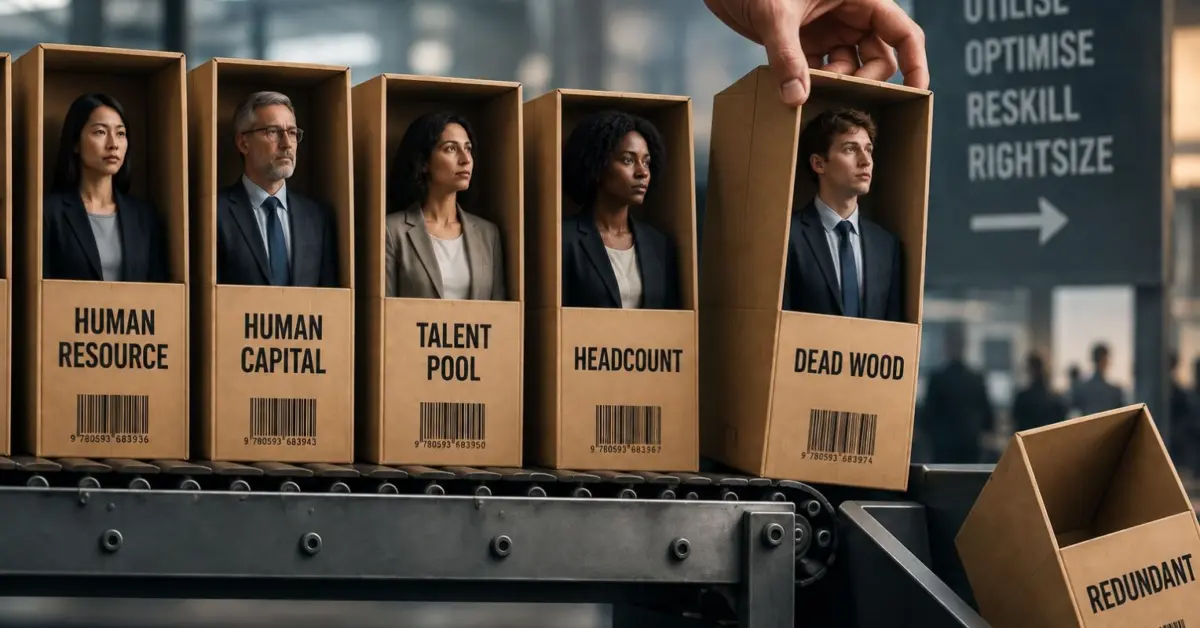
Modern corporate vocabulary has deeply normalized the use of industrial, mechanistic, and martial terminology to describe human beings within organizational structures. Terms like "human resources," "headcount," "talent pipelines," and "dead weight" have transitioned from metaphoric convenience into accepted business standards.
Compounding this linguistic shift is the rise of the artificial intelligence revolution, which has popularized the term "human skills" to differentiate human capabilities from automated systems. However, organizational psychologists and cultural critics argue that applying business-case logic—such as measuring empathy, creativity, and emotional intelligence solely by their economic utility against AI—perpetuates a deep cycle of self-alienation. Rather than simply describing organizational efficiency, these linguistic frameworks act as psychological shields against empathy, masking the human costs of layoffs, restructuring, and performance optimization.
Chronology: The Evolution of Industrial Lexicon
The integration of mechanistic language into the daily workflow did not happen overnight; it is the product of centuries of shifting labor dynamics:
- The Early Industrial Era (Late 18th to 19th Century): As labor shifted from agrarian fields to factories, workers were explicitly categorized as operational components of machinery. The focus centered on output, operating hours, and physical endurance.
- The Rise of Scientific Management (Early 20th Century): Pioneered by figures like Frederick Winslow Taylor, "Taylorism" sought to optimize and streamline industrial workflows. Workers were systematically studied as mechanical units, marking the formal conceptualization of labor as an operational variable.
- The Post-WWII Corporate Expansion (Mid-20th Century): The emergence of massive bureaucratic organizations birthed the department of "Personnel," which eventually rebranded into "Human Resources." This linguistic pivot reframed humans not just as workers, but as corporate assets to be managed, deployed, and leveraged.
- The Neoliberal and Tech Eras (Late 20th Century to Present): Globalization, agile frameworks, and the dot-com boom introduced a fresh vocabulary of disruption. Employees became "capital," "headcount," and "talent pools" moving through "pipelines."
- The AI Work Revolution (Present Day): With generative artificial intelligence automating complex cognitive tasks, organizations have begun utilizing the term "human skills" to isolate and market the residual capabilities that technology cannot yet replicate.
Supporting Data and Psychological Implications
Organizational research reveals that the language used in the workplace is far from benign. It actively alters psychological wellbeing, self-perception, and organizational culture.
The Arsenal of Workplace Metaphors
Linguists and sociologists categorize corporate language into four primary metaphoric domains:
- Mechanistic Metaphors: Organizations are treated as machines. People are "cogs," "assets to be sweated," and "resources" that experience "glitches" or require "optimization."
- Medical Metaphors: Organizations are treated as biological bodies. Layoffs are framed as trimming "fat," removing "diseased tissue," or executing "rightsizing" to restore organizational "health."
- Horticultural Metaphors: Workplaces are gardens. Terminations and performance management are cast as "pruning," weeding out "dead wood," and fostering "cultivation."
- Military Metaphors: Business is warfare. Companies execute "campaigns," "hostile takeovers," and face "front lines," making employee displacement acceptable as "collateral damage."
The Psychological Toll
Studies on organizational dehumanization—the phenomenon wherein employees feel treated as instruments rather than human beings—demonstrate clear, negative outcomes:
- Lower Wellbeing and Dignity: Workers subjected to instrumentalized frameworks report chronic stress, diminished self-worth, and persistent anxiety.
- Loss of Engagement: Alienation from the core purpose of work directly correlates with quiet quitting, presenteeism, and lower discretionary effort.
- Higher Turnover Intentions: Employees who perceive themselves merely as "headcount" are statistically far more likely to seek alternative employment.
Perhaps most insidiously, workers have internalized this language. Modern professionals no longer just hear these terms from management; they direct them inward. Rather than asking fundamental human questions—such as "How am I?" or "What do I need?"—individuals increasingly interrogate their own worth through corporate filters: "How am I performing?" or "What value am I adding?"
Official Perspectives and Expert Responses
Linguistic analysts, organizational psychologists, and leadership experts have increasingly spoken out against the linguistic erosion of empathy in the workplace.
Dr. Anna Katharina Schaffner, a cultural historian and author specializing in exhaustion and modern working life, points out the profound irony in how organizations attempt to defend humanity in the digital age.
"Even while trying to define and defend our humanity, we translate it into the language of economic utility," Schaffner observes. "Empathy becomes valuable because AI cannot do it as well. Creativity becomes a competitive differentiator. Curiosity becomes a future-ready capability. Here is the sad irony: Essentially, we defend our humanity by writing a business case for it."
Management theorists emphasize that the widespread adoption of corporate euphemisms serves a psychological function for leadership as well: distance.
"Nobody ever has to report that they terminated a mortgage-paying father of three who has dedicated fifteen years of loyal service to the firm," notes a leading organizational behaviorist. "Instead, leadership reports a successful ‘headcount reduction’ or ‘strategic realignment.’ Euphemism acts as a psychological shield, insulating decision-makers from the visceral grief, fear, and anger of their workforce."
Furthermore, HR and ethics specialists argue that appending the word "human" to "resources" or "skills" fails to address the root pathology. Without fundamentally interrogating the stories organizations tell about value, labor, and human worth, superficial linguistic tweaks amount to little more than corporate window dressing.
Implications: Changing the Metaphor to Change the Story
The linguistic structures governing the modern enterprise dictate more than mere communication protocols—they define reality. If language frames thought, and thought drives action, then preserving human dignity at work requires a radical linguistic audit.
1. Moving Beyond the Business Case for Humanity
Organizations must learn to value human attributes—empathy, creativity, moral reasoning, and emotional intelligence—for their intrinsic worth rather than their capacity to outperform algorithms. When a skill is only valued because an AI cannot replicate it, humanity is reduced to a temporary competitive advantage rather than an inviolable moral status.
2. Cultivating Story Intelligence
Leaders must develop what experts term Story Intelligence: the conscious capacity to notice, interrogate, and reshape the hidden narratives and metaphors driving organizational behavior. Leaders must routinely ask:
- Do we view our workplace as an army, a machine, or an ecosystem?
- What human realities do our current metaphors obscure?
- What psychological impact does our internal vocabulary have on our teams?
3. Reclaiming the Self
For individual workers, the path forward involves recognizing internal alienation. Breaking the habit of measuring personal worth through output, efficiency, and optimization metrics is essential for mental health. Asking “What kind of life do I want?” must replace the relentless internal pressure of “How can I remain competitive?”
Conclusion
Language does not merely describe organizational life; repeated often enough, it creates it. If the modern workplace aspires to be genuinely human-centric, it must abandon the linguistic legacy of the factory floor and the battlefield. True reform cannot begin with cosmetic vocabulary updates, but with a foundational reckoning: questioning why we ever agreed to call living, breathing humans "resources" in the first place.