








By Special Investigations Desk
The mist rolls in thick and low across the rugged expanse of Exmoor, swallowing the ancient stone walls and obscuring the sheep tracks that crisscross the borderlands of Devon and Somerset. For over half a century, this dramatic landscape—a designated National Park characterized by sweeping heather-clad moorland, deep wooded valleys, and treacherous bogs—has shared its remote terrain with something extraordinary.
It is a phantom that haunts the local folklore and terrifies livestock farmers: the Beast of Exmoor.
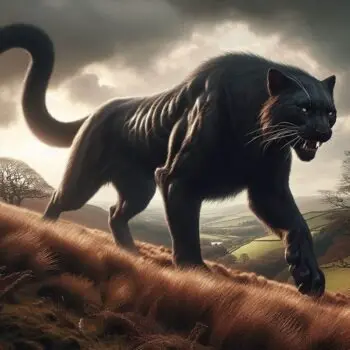
Described by awestruck and terrified witnesses as a massive, dark feline resembling a cross between a panther and a puma, this elusive apex predator has defied conventional zoological explanation since the 1970s. While skeptics point to escaped exotic pets, misidentified domestic animals, or the exaggerations of local myth, those who live and work in the shadow of the moor remain convinced that an untamed, non-native predator continues to roam the British countryside.
Main Facts: Anatomy of a Phantom
To understand the Beast of Exmoor, one must examine the consistent profile constructed from decades of eyewitness testimony. Unlike fleeting glimpses of traditional British wildlife, descriptions of the Beast possess a striking uniformity that sets it apart from standard folklore.
Physical Characteristics
- Size and Build: Witnesses frequently describe a creature measuring upwards of seven feet from nose to tail tip. It is built with the muscular power of a big cat, featuring a low-slung body that stays remarkably close to the ground while stalking or hunting.
- Coloration: The vast majority of reports depict a sleek, jet-black coat, though occasional sightings mention dark brown or tawny hues reminiscent of a cougar.
- Behavior: Observers note an extraordinary athletic ability, with reports of the creature clearing high stone walls and livestock fences effortlessly. Its movement is described as fluid, silent, and characteristically feline.
The Epicenter of Activity
The phenomenon is most intensely concentrated around South Molton in Devonshire and the surrounding moorlands that spill into Somerset. This topography—vast, sparsely populated, and rich in wild red deer and domestic livestock—provides an ideal habitat for a large territorial predator. Yet, the sheer scale of the reports suggests an animal capable of navigating miles of rugged terrain undetected, feeding opportunistically on local farms.
Chronology of Terror: A History of Sightings
The legend of the Beast of Exmoor is not a static myth; it is built upon a documented timeline of escalating panic, high-profile livestock losses, and concerted, albeit unsuccessful, government interventions.
1970s: The Whispers Begin
While isolated tales of strange large cats roaming rural Britain date back to the early 20th century—and even the Victorian era—the modern legend of the Beast of Exmoor crystallized in the 1970s. Local farmers and hikers began reporting fleeting glimpses of a large black creature moving swiftly through the gorse. Initially dismissed as rural folklore, these accounts were largely localized and treated with polite skepticism by authorities.
1983: The South Molton Massacre
The turning point for the legend occurred in the winter of 1983. Over a span of just two and a half months, a farmer near South Molton, Devonshire, suffered an unprecedented catastrophe: more than 100 sheep were found dead.
Unlike typical attacks by foxes or feral dogs, which usually result in scattered scavenging and torn carcasses, these sheep exhibited clinical, surgical precision in their deaths. Many bore deep, puncture wounds to the throat, consistent with the kill technique of a large felid, while others showed signs of having their carcasses neatly hidden or dragged. The sheer volume of livestock lost in such a short window sparked national media interest, transforming the "Beast of Exmoor" from a local rumor into a national obsession.
1990s: Government Intervention and the Royal Marines
As sightings mounted and public concern reached a fever pitch, the pressure on local authorities became untenable. In 1995, following another wave of livestock mutilations and credible civilian sightings, the British government took the extraordinary step of deploying a detachment of Royal Marines to Exmoor.
Armed with thermal imaging equipment and specialized tracking gear, the elite soldiers scoured the bleak landscape. Despite their tactical expertise and thorough sweeps of the moor, the Marines found no conclusive physical evidence of the beast. The official military operation concluded empty-handed, leaving the mystery unresolved and feeding conspiracy theories that the creature was either too clever for the troops or had found refuge in abandoned mine shafts.
2000s to Present: Modern Encounters and Digital Lore
Entering the 21st century, the nature of the sightings evolved alongside technology. While grainy photographs and blurry video footage became common, none provided the definitive proof researchers desperately sought. Nevertheless, farmers continued to report unexplained livestock deaths, and motorists occasionally slammed on their brakes as a massive feline shape darted across rural B-roads in the dead of night.
Despite the passage of decades—long past the natural lifespan of any single escaped exotic pet from the 1970s or 1980s—new generations of locals continue to report encounters, ensuring the legend remains as vibrant today as it was fifty years ago.
Supporting Data and Evidence: What Lies Beneath the Myth?
When investigating the Beast of Exmoor, researchers are sharply divided between anecdotal testimony and hard scientific data. The chasm between what people experience and what science can verify forms the core of the ongoing debate.
Livestock Autopsy Anomalies
Veterinary reports from the height of the panic in the 1980s and subsequent decades reveal puzzling forensic evidence. Several independent veterinarians examined sheep carcasses recovered from Exmoor and noted bite radiometry inconsistent with domestic dogs. The distance between canine puncture wounds often exceeded two inches—a measurement that strongly suggested an animal significantly larger than a fox, badger, or domestic canine.
The Dangerous Pet Trade Context
To understand the plausibility of the Beast of Exmoor, one must look at the legal landscape of exotic animal ownership in the United Kingdom prior to the implementation of the Dangerous Wild Animals Act of 1976.
Before this legislation took effect, it was surprisingly easy for British citizens to legally purchase and keep exotic predators, including pumas, leopards, and jaguars, as status symbols or private zoo attractions. Following the passage of the 1976 Act—which imposed stringent licensing, enclosure standards, and high fees—many owners found themselves unable or unwilling to comply with the new laws.
Historians and cryptozoologists have long maintained that rather than surrendering their dangerous pets to authorities or euthanizing them, a number of owners quietly released their animals into the wild, specifically into remote wilderness areas like Exmoor and the Scottish Highlands.
The Longevity Problem
While the release of exotic pets in the 1970s explains the initial emergence of large cat sightings, it introduces a major biological hurdle: life expectancy. Pumas and leopards typically live for 10 to 15 years in the wild, though exceptional specimens may reach 20.
For the Beast of Exmoor to be a continuous presence for over fifty years, one of two scenarios must be true:
- A Breeding Population: The original escaped pets successfully found mates, establishing a clandestine, self-sustaining breeding population of non-native apex predators in the British countryside.
- Continued Illegal Releases: Unscrupulous owners have periodically released new generations of illegal exotic pets into the region over the decades.
Zoologists remain deeply skeptical of the breeding population theory, noting that a colony of large cats would leave behind undeniable physical evidence—such as scat, hair samples, kills, and clear tracks—that would eventually be discovered by gamekeepers, foresters, or scientists.
Official Responses: Government, Science, and Law Enforcement
The official stance of the British government and mainstream scientific institutions regarding the Beast of Exmoor has remained largely consistent: skepticism tempered by administrative caution.
Ministry of Agriculture, Fisheries and Food (MAFF)
Historically, agencies such as MAFF (now integrated into the Department for Environment, Food and Rural Affairs, or DEFRA) investigated numerous claims of livestock predation on Exmoor. While government officials frequently acknowledged the severe financial losses suffered by farmers, their official conclusions consistently attributed the attacks to large feral dogs, particularly wolf-crosses or escaped mastiffs, rather than big cats.
In official parliamentary inquiries and departmental briefs, representatives have repeatedly stated that no conclusive, verifiable physical evidence—such as DNA, clear casts of paw prints, or captured specimens—has ever been presented to substantiate the presence of a wild breeding population of foreign felines in the UK.
The Scientific Community
Zoologists and ecologists approach the Beast of Exmoor through the lens of evolutionary biology and habitat carrying capacity. Mainstream science argues that the British landscape, while rich in deer and small mammals, lacks the undisturbed, continuous wild corridors required to support a hidden population of large felines without frequent human contact.
Furthermore, Britain’s extensive network of public footpaths, ramblers, hunters, and agricultural workers means that virtually every square mile of the countryside is regularly traversed by humans. In such a densely populated island, experts argue, a 150-pound carnivorous predator could not remain entirely invisible for half a century.
Implications: Folklore, Tourism, and the Rural Psyche
Regardless of whether the Beast of Exmoor is flesh-and-blood predator, a misidentified domestic animal, or a collective hallucination born of rural isolation, its cultural and economic footprint is undeniable.
The Tourism Economy
In the modern era, cryptids and local legends serve as powerful economic drivers for rural communities. The towns and villages surrounding Exmoor National Park have embraced their shadowy resident. Pubs display whimsical paintings of black panthers, local gift shops sell themed merchandise, and tourism boards frequently lean into the mystery to attract travelers looking for a taste of the uncanny. Ghost tours, cryptid-hunting excursions, and documentary crews routinely visit the region, injecting much-needed revenue into the local economy.
The Psychology of the Rural Frontier
Beyond commerce, the enduring belief in the Beast of Exmoor speaks to a deeper human psychological need for wilderness and the unknown. In a hyper-connected, thoroughly mapped, and heavily regulated modern world, the idea that untamed nature still holds secrets—that a dangerous, wild predator can carve out an existence right under the nose of civilization—provides a thrilling counter-narrative to human dominance over the planet.
For the farmer checking his fences on a freezing dawn, however, the implications are far less romantic. To them, the Beast is a very real, very costly threat to their livelihood, representing an unpredictable danger lurking just beyond the edge of the firelight.
Conclusion: The Mystery Endures
As dusk settles over the rolling hills of Somerset and Devon, casting long shadows across the heather, the debate over the Beast of Exmoor continues unabated. Skeptics will continue to demand hard scientific data, DNA samples, and clear photographic evidence before acknowledging the existence of a British big cat. Meanwhile, locals will continue to scan the tree line, listening for the snapping of a twig or the phantom cry of an unseen hunter in the mist.
Whether it is a clever cat, a ghost of folklore, or a testament to the resilience of nature in the face of human encroachment, the Beast of Exmoor remains securely enshrined in the public imagination—a haunting reminder that some mysteries refuse to be tamed.