








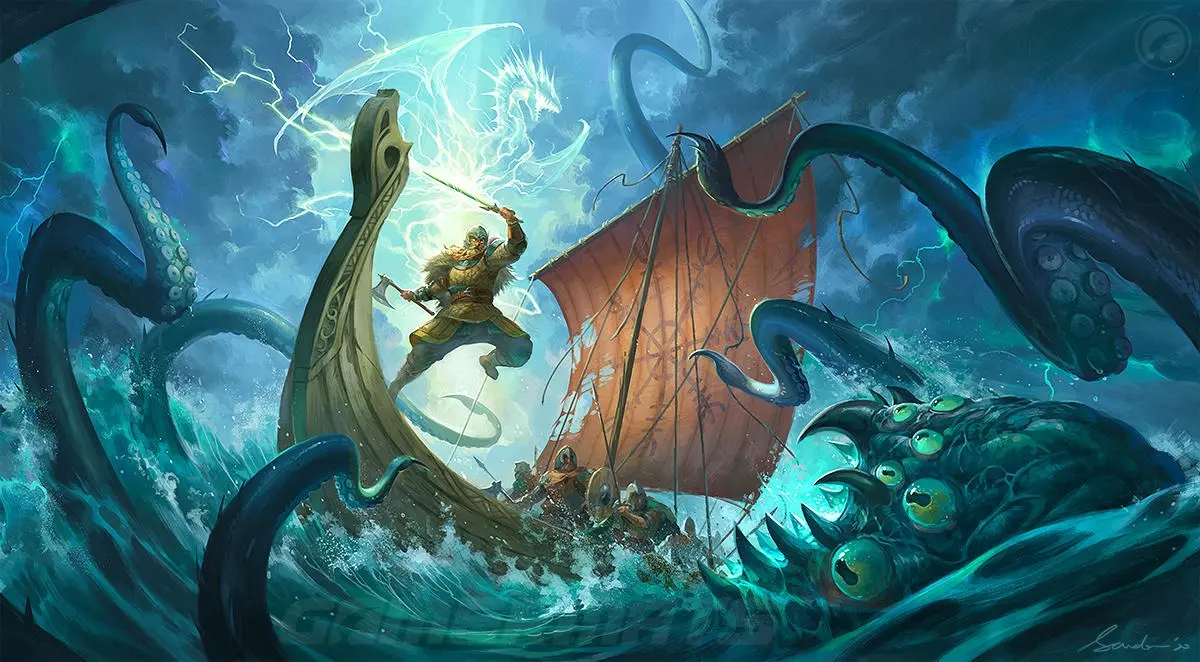
Long before sonar, submersibles, or modern oceanography mapped the abyssal plains, the open ocean was a realm of absolute terror. To the seafaring cultures of medieval Scandinavia—particularly Norway and Iceland—the deep sea was not merely a physical barrier to be crossed, but an unpredictable, hostile abyss hiding unfathomable horrors. Out of this primal fear emerged one of the most enduring and terrifying monsters in human mythology: the Kraken.
Described as a colossal cephalopod-like beast capable of dragging entire galleons into the freezing depths, the Kraken has evolved from a terrifying 18th-century nautical legend into a pop-culture icon. But beneath the layers of folklore lies a fascinating intersection of ancient maritime superstition, historical exaggeration, and real-world marine biology that continues to capture the human imagination.
Main Facts: Deconstructing the Mythical Leviathan
At its core, the Kraken is the ultimate personification of maritime peril. Rooted in the oral traditions of Nordic fishermen and traders, the creature was invoked to explain sudden shipwrecks, vanishing crews, and the unpredictable, violent behavior of the North Atlantic.
What Does a Kraken Do?
According to historical texts and folklore, the Kraken did not merely attack ships; it dominated the marine ecosystem with apocalyptic force. Its signature behaviors include:
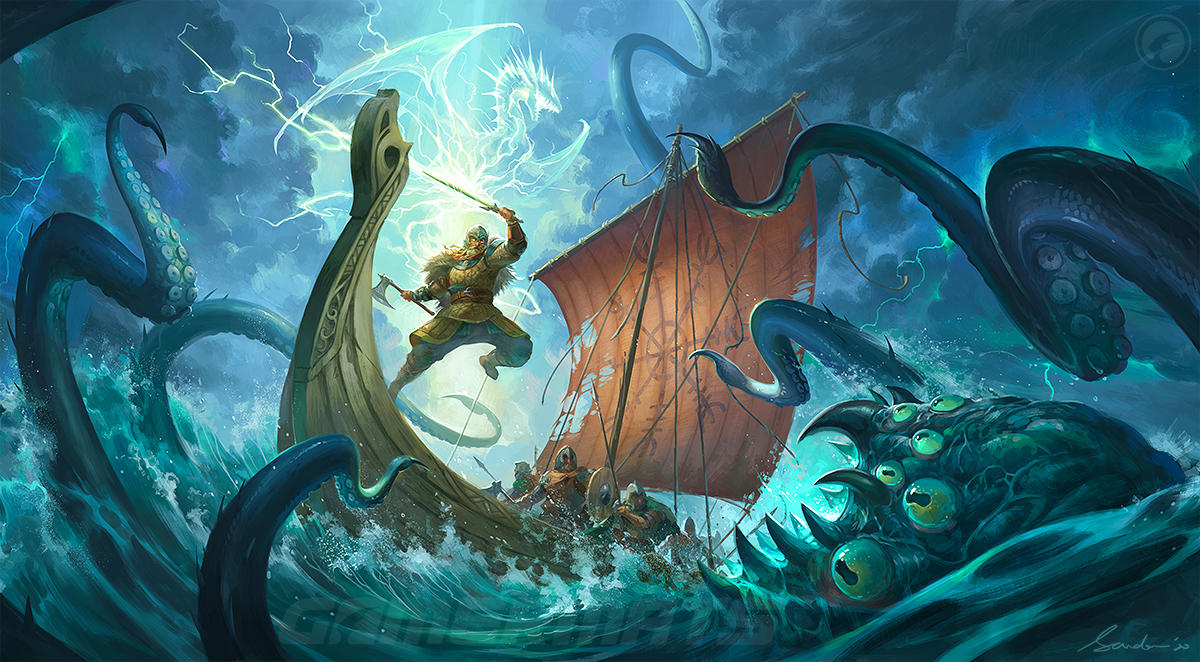
- The Creation of Deadly Whirlpools: When the Kraken submerged or prepared to dive, it was said to displace such massive volumes of water that it created colossal vortexes. These whirlpools could suck nearby vessels down into the abyss, making escape nearly impossible even without direct contact from the beast.
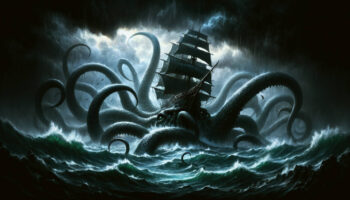
- Vessel Envelopment: Tales recount the creature throwing massive, muscular tentacles over the sides of sailing ships, anchoring them in place, and dragging them beneath the waves.
- Creating False Islands: Due to its incomprehensible scale, sailors occasionally mistook the resting back of a Kraken for a small, uncharted island. Crews would anchor, disembark, or attempt to set up camp, only for the "island" to suddenly sink into the ocean as the beast awakened.
- The Release of Black Waters: Some accounts suggest the Kraken could expel vast quantities of thick, dark fluid—resembling a giant squid’s ink cloud—that not only blinded prey and pursuers but muddied the surrounding ocean, turning navigable waters into toxic-looking bogs.
The Physical Anatomy of the Beast
While artistic interpretations vary, historical descriptions consistently paint the Kraken as an invertebrate behemoth. It combined the features of giant squids and octopuses on a mythic scale:
- Colossal Mass: Unlike ordinary marine life, the Kraken possessed a body so wide and heavy that its mere movement could cause seismic disturbances in coastal waters.
- Imposing Tentacles: The limbs were described as thick as the masts of large warships, equipped with powerful suction cups and hooks capable of splintering oak hulls.
- Overwhelming Presence: Sailors often emphasized the creature’s immense, unblinking eyes, which glowed or reflected a dull, eerie light from beneath the surface.
Chronology: The Evolution of the Kraken in History
The legend of the Kraken did not appear overnight. It was carefully cataloged, exaggerated, and debated by historians, naturalists, and sailors over several centuries.
The Norse Beginnings (13th Century)
The earliest written hints of the Kraken-like beasts appear in Old Norse sagas and historical documents. The Örvar-Odds saga, dating back to the 13th century, mentions two massive sea monsters—the Hafgufa (sea mist) and the Lyngbakr (heather-back). The Hafgufa, in particular, matches later descriptions of the Kraken, noted for swallowing entire whales, ships, and men.
Pontoppidan’s Natural History (1755)
The definitive codification of the Kraken occurred in the 18th century, largely thanks to Erik Pontoppidan, the Bishop of Bergen and a fellow of the Royal Academy of Sciences in Copenhagen. In his seminal work, The Natural History of Norway (1755), Pontoppidan provided the most detailed and widely read account of the creature.
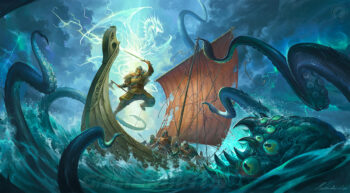
Pontoppidan described the Kraken not as a malicious demon, but as a legitimate animal of staggering proportions. He wrote that the creature was "floating on the surface of the water, with its numerous arms… and if they were to lay hold of the largest man of war, they would pull it down to the bottom." Pontoppidan also recorded the danger of the whirlpools generated by its descent, warning fishermen of the sudden loss of depth and currents.
Scientific Skepticism and Reclassification (19th Century)
As the Age of Enlightenment progressed, naturalists began to demand empirical evidence for legendary beasts. By the 19th century, mainstream science largely dismissed the Kraken as a sailor’s myth, born of optical illusions, giant jellyfish, or exaggerated accounts of normal marine life.
However, this skepticism was dramatically challenged in 1857 when Danish naturalist Japetus Steenstrup formally described the Giant Squid (Architeuthis dux). Analyzing a massive beak washed ashore in Denmark, Steenstrup realized that the ancient Norse tales were not entirely fabricated; they were heavily embellished accounts of real, deeply elusive cephalopods that occasionally breached the surface or washed ashore.
Supporting Data: Dimensions of Myth vs. Reality
To understand why the Kraken terrified generations of sailors, it is helpful to compare the dimensions reported in historical accounts against modern scientific discoveries regarding deep-sea cephalopods.

| Metric | Historical Kraken Lore | Modern Science (Architeuthis dux / Mesonychoteuthis hamiltoni) |
|---|---|---|
| Length | Up to 1 mile (often described as island-sized) | Up to 43 feet (Giant Squid) / 33–46 feet (Colossal Squid) |
| Weight | Hundreds of tons; could displace coastal seas | Up to 600 lbs (Giant Squid) / Up to 1,100 lbs (Colossal Squid) |
| Habitat | Surface waters, lurking near coastlines and shipping lanes | Deep-sea bathypelagic zone (3,000+ feet below surface) |
| Behavior | Active hunter of human ships and whole fleets | Ambush predator of fish, deep-sea crustaceans, and other squids |
While a 43-foot giant squid cannot swallow a warship or impersonate an island, it is nonetheless a formidable predator. The sheer shock of encountering a Mesonychoteuthis hamiltoni (Colossal Squid) with eyes the size of dinner plates in the middle of a dark, stormy sea is more than enough to inspire centuries of terrifying folklore.
Official Responses and Historical Records
During the height of the sailing era, governments and naval authorities took the threat of marine hazards seriously—though their official logs usually attributed disasters to uncharted reefs, violent storms, or rogue waves rather than mythical beasts.
However, archival records from Scandinavian maritime courts and shipping registries occasionally documented bizarre maritime anomalies. For instance, Norwegian captains in the 17th and 18th centuries submitted sworn affidavits detailing sudden, unexplainable shifts in sea level and the appearance of massive, floating organic masses that emitted a powerful, musky odor.
In 1802, French malacologist Pierre Denys de Montfort attempted to legitimize the Kraken within the scientific community. He categorized two types of giant octopuses: the Kraken octopus (which allegedly attacked ships in Norway) and the colossal Colossal Octopus reported to have dragged a French ship down off the coast of Angola. While Montfort’s later career suffered due to his sensationalized claims, his work highlighted the persistent blurry line between zoological discovery and maritime myth.
Implications: Why the Kraken Endures Today
The legacy of the Kraken extends far beyond historical trivia; it serves as a profound psychological and cultural symbol.
1. The Psychological Need to Explain the Unexplained
Before oceanography mapped the continental shelves, the ocean was a blank space filled with existential dread. The Kraken provided a narrative framework for tragedy. When a ship set sail and never returned, blaming a colossal monster was psychologically comforting compared to accepting the indifferent, random cruelty of nature. It transformed a faceless, terrifying void into a tangible antagonist.
2. The Influence on Modern Media and Literature
The Kraken remains a titan of modern fantasy. From Jules Verne’s Twenty Thousand Leagues Under the Sea (featuring a battle with giant squids) to H.P. Lovecraft’s Cthulhu mythos and blockbuster film franchises like Pirates of the Caribbean, the archetype of the deep-sea monster continues to thrive. In sports, teams like the Seattle Kraken professional hockey franchise prove that the beast retains its aura of fierce, intimidating power.
3. A Catalyst for Marine Exploration
Ironically, the myth of the Kraken helped pave the way for modern marine biology. The desire to prove or disprove the existence of the beast drove early naturalists to study strandings, whale stomach contents, and deep-sea currents. Today, as marine biologists use advanced submersibles to film living giant and colossal squids in their natural, lightless habitats, they are finally bringing the elusive ghost of the Kraken out of the shadows of myth and into the light of scientific reality.