By Manny Tejeda y Moreno Published: September 14, 2026
Main Facts
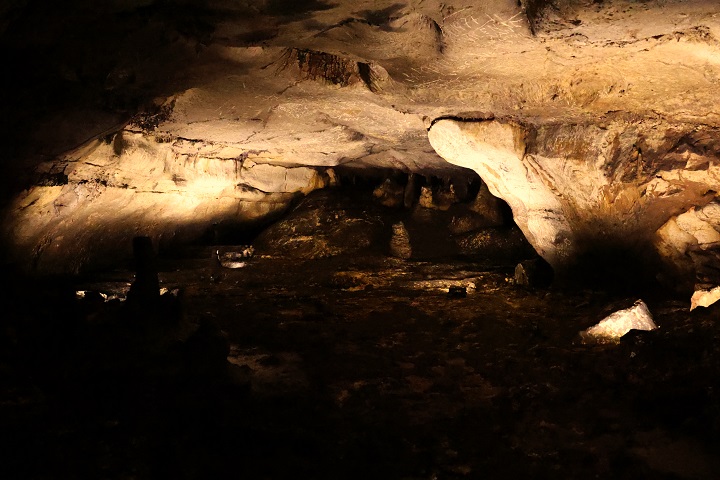
Deep within the subterranean labyrinth of Cova Dones in eastern Spain, archaeologists have made a discovery that is reshaping our understanding of religious life and gender roles in the Roman Empire. Roughly 200 meters underground, hidden far from the Mediterranean sun, researchers have uncovered an organized Roman-era cult dedicated to a mysterious, anonymous goddess. Worshippers in the first and second centuries C.E. knew her by a single, commanding Domina—"The Lady."
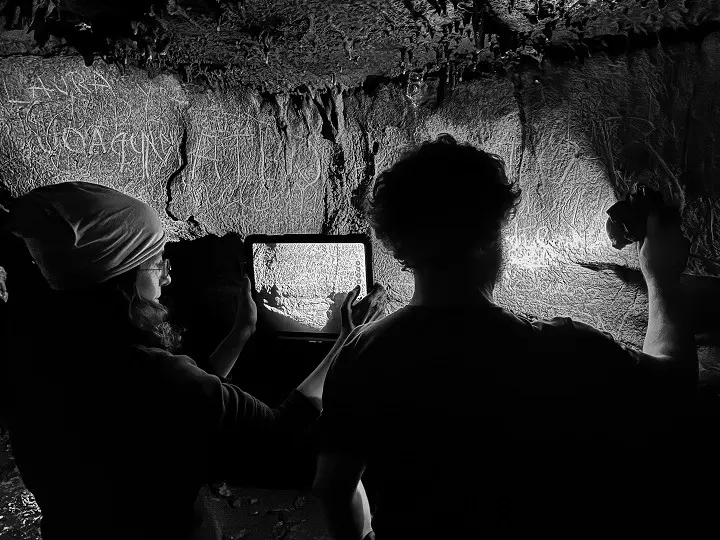
The site, located near the municipality of Millares in Valencia, has yielded at least 120 Latin inscriptions, making it the largest known collection of its kind inside any Roman cave sanctuary throughout the former empire. The sanctuary, first identified in preliminary surveys in 2024 and significantly expanded during excavations in May and June of 2026, points to a thriving, female-centric devotional network.
Far from a casual shrine for weary travelers, the concentration of votive inscriptions, deliberate material offerings, and personal items underscores an institutionalized religious practice. Within the damp, stalactite-studded chamber, worshippers interacted with natural pools of groundwater (gours) to honor a deity whose authority was recognized not through a personal name, but through a title denoting ultimate command, hierarchy, and sacred sovereignty.
Chronology of Discovery
The story of Cova Dones spans tens of thousands of years, but the revelation of its Roman-era sanctuary is a thoroughly modern endeavor characterized by rapid technological and archaeological milestones:
Prehistoric Beginnings (Over 24,000 Years Ago): Long before the arrival of Roman worshippers, Paleolithic humans utilized Cova Dones. The cave system accumulated more than 100 Paleolithic paintings and engravings, alongside intentionally modified stalagmite formations, proving its long-standing status as a landscape of human significance.
2023: The launch of the DONARQ project—financed by the Generalitat Valenciana and the British Academy, and led by Virginia Barciela (University of Alicante) and Aitor Ruiz-Redondo (University of Zaragoza)—begins a multidisciplinary investigation of the cave’s deep history.
2024: Researchers breakthrough to the remote inner chamber over 200 meters underground, identifying the first 15 Latin inscriptions and a single Roman coin dating to the reign of Emperor Claudius (41–54 C.E.). The coin, wedged into a crevice between the ceiling and a stalactite, signals an intentional ritual deposit.
May–June 2026: Comprehensive archaeological excavations dramatically scale up the footprint of the site. The team documents at least 120 Latin inscriptions, solidifying Cova Dones as the richest Roman cave sanctuary for epigraphy in the empire. Furthermore, researchers unearth a cache of personal artifacts, including spindle whorls, rings, bracelets, and chalice-shaped ceramic vessels, which firmly tether the site to active participation by women.
Supporting Data and Archaeological Evidence
The material culture recovered from Cova Dones provides an exceptionally clear window into ancient ritual behaviors. The data highlights a convergence of epigraphy, domestic symbolism, and hydrological features:
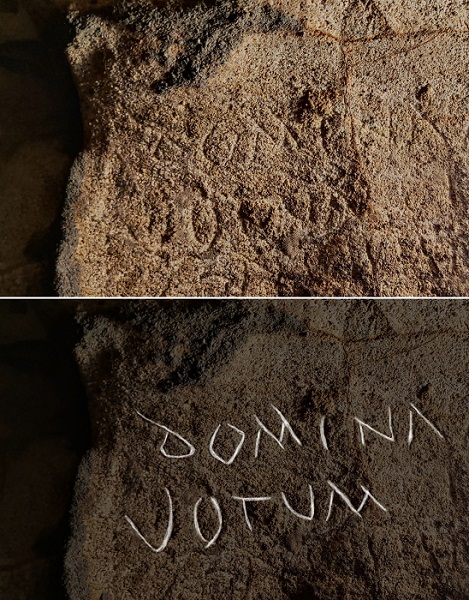
Epigraphic Abundance: The sanctuary features at least 120 Latin inscriptions, mostly concentrated within the first and second centuries C.E. Among these, five specific votive inscriptions explicitly name the goddess Domina. Three of these inscriptions include the term Malaci, believed to be an epithet or invocation describing an aspect of the goddess—potentially linked to water.
The Domina Designation: While Domina translates conventionally to "The Lady," linguists and historians note its true weight in Roman society. As the feminine counterpart to dominus ("master" or "lord"), it denoted the head of a household with positions of command and authority over estates and enslaved persons. Applying this title to a deity framed her as a figure of absolute divine power.
Material Offerings: Excavators recovered a variety of votive objects from the cave floor and its natural water pools (gours). These include two rings, a bracelet, chalice-shaped vessels, various ceramic fragments, animal remains, and—crucially—multiple spindle whorls.
The Gendered Artifacts: Spindle whorls were indispensable tools in the ancient world for spinning thread and manufacturing textiles. Because textile production was fundamentally tied to women’s daily labor and societal roles in Roman culture, these objects were likely brought into the deep cave as personal offerings to Domina.
Geographical Concentration: Unlike sites marked by random, scattered graffiti, the tight concentration of the dedications in a defined inner chamber strongly suggests a planned, communal sanctuary utilized by organized groups rather than isolated individuals.
Official Responses and Expert Analysis
The significance of the Cova Dones sanctuary has drawn commentary from leading specialists across multiple disciplines, emphasizing its rarity and historical weight.
Silvia Alfayé, Professor of Ancient History at the University of Zaragoza and a core member of the epigraphic research team, highlighted the unmistakable presence of women in the cult:
"Thanks to a quintet of votive inscriptions, we know for certain that in Roman times a goddess was worshipped in the cave whom they reverentially called Domina, ‘the Lady,’ and that women actively participated in her cult."
Alfayé also addressed the mysterious secondary term found alongside the primary dedications:
"The term [Malaci] appears to describe a particular aspect of the otherwise unknown deity, perhaps one associated with water, although researchers are still working on its definitive reading and interpretation."
Sergio García-Dils, Professor at UNED-Sevilla and Director of the Spanish School of Speleology, underscored the structural nature of the findings:
"The evidence indicates a specific cult to a particular deity, rather than sporadic visits for general religious purposes. Their concentration in a particular area of the cave supports the interpretation of an organized cult."
Reflecting on the continuity of the landscape across millennia, the DONARQ project coordinators noted:
"Each new finding points to the fact that Cova Dones has been a place of reference for the human groups that inhabited this territory for millennia, perhaps due to the permanent presence of water, the characteristics of the underground landscape, or its easy access."
Virginia Barciela of the University of Alicante also pointed to the cave’s modern Catalan-Valencian name—Cova de les Dones ("Cave of the Women")—raising the tantalizing possibility that cultural memory of the ancient female-centric sanctuary may have subtly persisted across generations, though direct historical continuity has yet to be proven.
Implications for Ancient History and Modern Studies
The unearthing of the Domina sanctuary at Cova Dones carries profound implications for several fields of historical and archaeological inquiry:
1. Re-evaluating Underground Roman Religion
While subterranean sanctuaries (such as Mithraic mithraea or shrines to chthonic deities) are well-documented in the Roman world, finding a dedicated epigraphic site deep within a natural cave system—let alone one dominated by female participants and an unnamed supreme authority—is remarkably rare. It demonstrates that Roman religion was flexible enough to adapt local landscapes into formal ritual spaces far beyond urban centers.
2. Amplifying the Religious Agency of Roman Women
Ancient Roman history is frequently dominated by male-centric political, military, and religious narratives. Vestal Virgins and elite priestesses notwithstanding, tracking the organic, grassroots religious lives of ordinary Roman women remains a challenge for archaeologists. The combination of female names in the inscriptions, spindle whorl offerings, and the cult of a powerful female sovereign (Domina) offers rare, tangible proof of women organizing, journeying deep into dangerous subterranean environments, and actively patronizing a divine protector.
3. The Power of Namelessness
The deliberate use of Domina rather than a traditional Roman or indigenous Hispanic pantheon name (such as Juno, Diana, or local Iberian deities) suggests a shift in how worshippers related to the divine. By addressing the goddess through her title of absolute authority rather than a personal moniker, the worshippers engaged in a relationship defined by submission to a higher power, hierarchical respect, and intimate domestic or cosmic governance.
4. Future Directions in Hispanic Archaeology
With the DONARQ project continuing its multi-year analysis, much of Cova Dones remains unexcavated. Epigraphers are still deciphering eroded Latin texts, and geomorphologists are mapping the complex relationship between the cave’s permanent water sources and the placement of artifacts. Future excavation campaigns promise to shed further light on who these women were—whether they hailed from local indigenous Hispano-Roman communities, nearby Roman villas, or regional settlements—and how Domina fit into the broader tapestry of Iberian religious syncretism.
For now, the goddess’s personal name remains lost to the mists of antiquity. Yet, through the stone walls and pooling waters of Cova Dones, her enduring command echoes clearly across two millennia: she remains Domina, The Lady.