









Introduction and Main Facts
In the vast and storied pantheon of mythical creatures, few beasts occupy as distinct and frequently misunderstood a niche as the wyvern. Often conflated with its more famous, four-legged relative—the classic dragon—the wyvern possesses a unique anatomical and historical profile that sets it apart in both folklore and heraldry.
Etymologically, the name "wyvern" is derived from the Anglo-Saxon word wivere, which translates directly to "serpent" or "worm." While modern fantasy media has popularized the creature as a staple of cinematic battles and role-playing games, historical records paint a far more complex picture of a beast deeply embedded in European medieval consciousness.
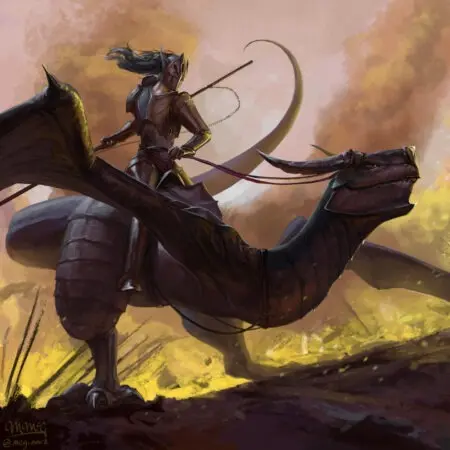
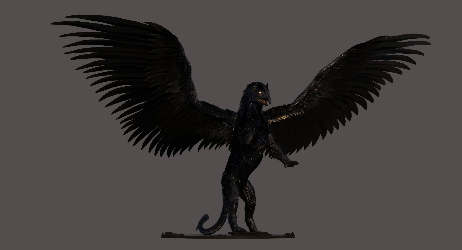
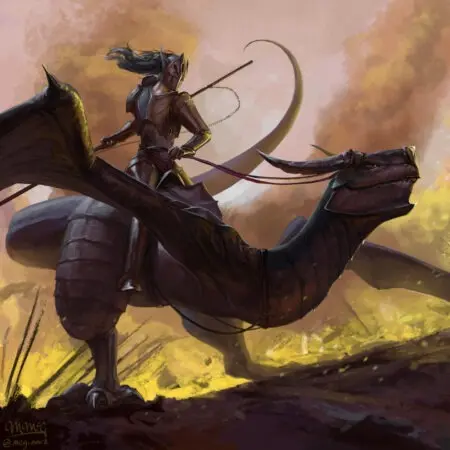
Unlike the classic dragon, which typically features four legs alongside a pair of wings, the true wyvern is strictly bipedal. It relies on a two-legged stance reminiscent of a predatory theropod dinosaur. Its wings are not separate limbs added to a quadrupedal body; rather, they are true forelimbs—functionally and anatomically similar to the wings of bats or birds. These specialized limbs often double as "hands," allowing the creature to clasp objects when its wings are folded. Furthermore, the wyvern is characterized by:
- A predatory build: Armed with eagle-like talons and a rigid, beak-like jaw designed for capturing and carrying heavy prey.
- Offensive weaponry: A deadly, barbed stinger at the tip of its long, serpentine tail, setting it apart from standard fire-breathing dragons.
- Behavioral traits: A notorious attraction to shiny objects, precious metals, and general debris, which they accumulate within heavily guarded, forest-dwelling cavern lairs.
- Temperament: Historically recorded as far more aggressive and less timid than traditional dragons, leading to frequent confrontations with human populations in antiquity and the Middle Ages.
Chronology: From Ancient Myth to Medieval Symbolism
The evolutionary timeline of the wyvern in human culture spans millennia, evolving from ancient sky-fall myths into sophisticated allegorical tools during the medieval period.
Ancient Origins and Sky Serpents
Long before heraldic knights embroidered wyverns onto their tunics, Old Saxon folklore warned of terrifying fire monsters and "worms" plummeting from the night sky. According to ancient oral traditions, these celestial serpents would burrow deep into the earth, sealing themselves away forever to guard hoarded treasures. Intriguingly, historians suggest these early myths may have originated from ancient humans discovering meteorites—space rocks containing valuable metals that fell from the heavens and were subsequently buried in impact craters.

The Middle Ages: Omens of Pestilence and Sin
As European civilization entered the medieval era, the cultural perception of the wyvern shifted dramatically. Medieval bestiaries frequently utilized the creature as a living allegory for Satan, war, pestilence, and moral corruption. During the devastating outbreaks of the Black Death, popular superstition blamed the wyvern for spreading the plague across towns and villages.
Concurrently, medieval alchemists incorporated the beast into their esoteric practices. In alchemical texts, the wyvern represented prima materia—matter in its basest, most unrefined state. The alchemist was cast in the role of the valiant knight, tasked with subduing and transforming the base beast (representing the transmutation of lead into gold or the spiritual elevation of the soul).
Renaissance Observations and the Decline
By the Renaissance, reported encounters with wyverns began to dwindle as human populations expanded and firearms revolutionized hunting and warfare. Even so, towering intellects of the era took note of the creatures. Notably, Renaissance polymath Leonardo da Vinci recorded a detailed description of an observed encounter between a lion and a wyvern—though modern historians debate whether da Vinci witnessed the event firsthand or merely synthesized contemporary travelers’ tales.
Supporting Data: Anatomy, Habitat, and Heraldry
Understanding the wyvern requires a closer look at its physical mechanics, nesting habits, and its enduring legacy in modern design.
Anatomical Distinction: Dragon vs. Wyvern
In 19th-century England, wyverns were frequently referred to as "dragonets" due to their relatively modest stature. Misinformed observers often assumed they were adolescent dragons. However, biologists of folklore emphasize that their skeletal structure is fundamentally different. While a classic dragon’s wings are an anatomical "bonus" attached to a four-legged lizard-like body, the wyvern’s anatomical design mirrors vertebrate flight evolution seen in pterosaurs and bats, utilizing modified upper limbs for aerodynamic lift.

Lair Ecology and Hoarding Behavior
Wyverns prefer protected, secluded environments, most commonly establishing their lairs in deep caverns nestled within dense forests and old-growth woods. Field research into historical folklore indicates that these lairs are easily identifiable by the grim accumulation of skeletal debris and scavenged valuables. Unlike fastidious dragons that selectively hoard gold and jewels, lesser "dragonets" are far less discerning. Their subterranean hoards often consist of a chaotic mixture of precious artifacts, domestic livestock bones, and absolute rubbish.
Heraldic Legacy
While the biological existence of the wyvern remains a matter of fantasy, its cultural footprint remains robust through heraldry. On coats-of-arms, pennants, and family crests, the wyvern has traditionally symbolized:
- War and military might
- Conquest and territorial dominance
- Envy and fierce vigilance
Official Perspectives and Scholarly Consensus
Historians, folklorists, and cryptozoologists have long debated the origins of the wyvern myth. Mainstream academic consensus views the creature as a composite mythological construct, born from human encounters with large predatory birds, apex mammalian carnivores, and the fossilized remains of prehistoric reptiles (such as pterosaurs and dinosaurs) discovered in European stone quarries.
However, fringe researchers and cryptozoologists have occasionally entertained alternative theories. Given the historical accounts placing wyverns in the dense, untamed wildernesses of medieval Europe, some proponents of cryptozoology suggest that small populations of large, aggressive, flying reptiles may have survived well into the historical era before succumbing to habitat loss and human eradication campaigns.
Furthermore, speculative modern expeditions—though entirely lacking in empirical proof—frequently point to the remote, relatively undisturbed mountain ranges and old-growth forests of Eastern Europe and Russia as plausible, albeit highly improbable, final refuges for undocumented megafauna of this description.

Implications: The Enduring Cultural Impact of the Wyvern
The transition of the wyvern from a feared harbinger of plague to a stylized emblem of strength carries significant implications for how modern society interacts with mythology.
Today, the wyvern survives primarily as a design motif in fantasy literature, cinema, video games, and corporate branding. Its fierce silhouette continues to evoke a sense of ancient power, danger, and unbridled wildness. By examining the cultural trajectory of the wyvern—from Anglo-Saxon sky-worms and alchemical metaphors to heraldic badges and pop-culture icons—we gain valuable insight into humanity’s enduring fascination with the monsters that haunt the borders of our imagination.
Whether viewed through the lens of medieval psychology, evolutionary fantasy, or heraldic tradition, the wyvern remains one of mythology’s most compelling creations: a testament to a time when the skies above Europe were believed to harbor forces far beyond human comprehension.