






Main Facts: Unveiling the Cinematic Griffin of the Veldt
In the expansive, cross-genre universe of Zack Snyder’s Rebel Moon saga, the boundaries separating science fiction, ancient mythology, and high fantasy frequently dissolve. Among the myriad alien ecologies, biomechanical horrors, and interstellar empires introduced across Part I: A Child of Fire and Part II: The Scargiver, few creatures have captured the imaginations of audiences quite like the bennu.
To answer the most common question posed by fans: Yes, the bennu is a griffin.
However, unlike the traditional, European folklore-inspired griffins found in standard fantasy literature—or the majestic beasts of classical mythology—the bennu is a wholly unique creature indigenous to the Rebel Moon universe. Specifically, these majestic lion-eagle hybrids hail from Samandrai, the lush, untamed homeworld of the high-born warrior turned captive, Tarak Decimus (played by Staz Nair).
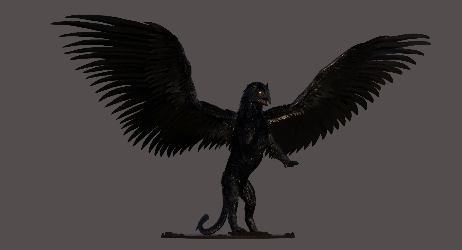
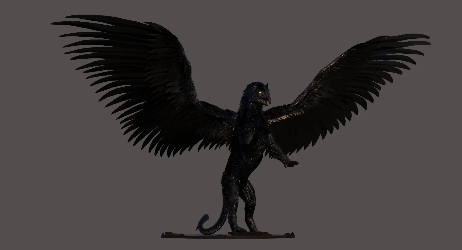
In the lore of the films, bennus serve a vital role on their native planet, functioning as high-performance mounts akin to horses, albeit with the devastating aerial agility, razor-sharp talons, and apex predator instincts of a mythical beast. Their introduction into the narrative culminates in one of the most memorable sequences of the first film: the arduous, highly visual taming of a coal-black bennu named Beatrice on the distant, arid frontier world of Neu-Wodi.
Brought to life by the world-class visual effects artists at Framestore, the creation of the bennu represents a masterclass in modern creature design, blending historical folklore with cutting-edge computer-generated imagery (CGI) to ground an otherworldly beast in visceral, believable reality.
Chronology: From Concept to Screen – The Genesis of the Bennu
The journey of the bennu from a writer’s room concept to a fully realized, photorealistic cinematic creature involved years of collaborative world-building, design iteration, and technical execution.
Phase 1: Conceptualization and World-Building (2018–2021)
Zack Snyder, alongside co-writers Kurt Johnstad and Shay Hatten, spent decades developing the universe of Rebel Moon, initially pitching it as a mature Star Wars spin-off before transforming it into an independent, original intellectual property. Within this foundational lore, Samandrai was designed as a planet of breathtaking natural beauty, requiring native fauna that reflected both nobility and wild danger. The bennu was conceived not merely as a monster, but as an intelligent, sentient-adjacent partner capable of forming profound, emotional bonds with worthy riders.
Phase 2: Visual Development with Framestore (2021)
Production art and early design phases relied heavily on the visual effects powerhouse Framestore. Tasked with materializing the creature seen in set pieces like the Griffin Pass sequences (filmed heavily in late 2021), artists looked to a wide array of historical griffin interpretations. They balanced the muscular, feline power of a big cat with the razor-beaked, feathered majesty of a bird of prey.
Phase 3: Principal Photography and Practical Integration (2022)
During the physical shoot of Rebel Moon – Part I: A Child of Fire, actors like Staz Nair had to interact with dynamic physical stand-ins, motion-capture rigs, and specialized blue-screen apparatuses to simulate the erratic, powerful movements of a penned-in, "unrideable" beast. The emotional core of these scenes rested on physical stunt work and intimate dialogue exchanges between Tarak and the creature.
Phase 4: Post-Production and Visual Effects Breakdown (2023–2024)
Framestore’s post-production pipeline focused heavily on feather simulation, muscle dynamics, and lighting integration. Every single feather on Beatrice’s coat was algorithmically rendered to react realistically to wind currents, dust, and physical contact. The release of the film in late 2023, followed by Snyder’s Director’s Cuts in mid-2024, cemented the bennu as a standout fan-favorite element of the franchise’s visual lexicon.
Supporting Data: The Anatomy and Physiology of a Cinematic Apex Predator
To understand why the bennu is such a formidable presence in the Rebel Moon universe, one must examine the meticulous thought process Framestore’s design team poured into its biological makeup. The creature is an evolutionary marvel engineered for both terrestrial dominance and aerial supremacy.

Comparative Morphology: Lion vs. Eagle
- The Avian Half: The upper body, head, neck, and wings of the bennu draw heavy inspiration from earth’s largest raptors—specifically golden eagles and harpy eagles. The hooked, keratinous beak is powerful enough to crush bone, while the binocular vision provides elite targeting capabilities while in flight.
- The Feline Half: The lower torso, hindquarters, and powerful legs are modeled after African lions. This grants the creature massive explosive acceleration on the ground, allowing it to leap massive distances into the air before its wings fully catch the updraft.
- The Plumage and Coat: While standard mythical griffins are often depicted with golden or brown coats, the bennu featured in the primary narrative—Beatrice—boasts a striking, light-absorbing obsidian-black plumage. This coloration provides camouflage within Samandrai’s dense forest canopies and rocky shadows.
| Feature Attribute | Biological Specification (In-Universe) | Visual Effects Implementation |
|---|---|---|
| Wingspan | Estimated 24–30 feet | Dynamic cloth/feather rigs with secondary skin-sliding simulations |
| Locomotion | Quadrupedal ground running; high-speed soaring | Motion-capture blending of feline pacing and avian gliding physics |
| Temperament | Highly territorial, proud, resistant to forced subjugation | Procedural facial rigging to convey nuanced emotional states (fear, trust, anger) |
| Habitat Origin | Open plains, dense forests, and mountainous passes of Samandrai | Integrated matte paintings and fully digital environment extensions |
Official Responses and Behind-the-Scenes Insights
The creation of Beatrice the Bennu was heavily documented by the production team, offering deep insights into how Zack Snyder and Framestore achieved such seamless synergy between actor and digital asset.
In official behind-the-scenes breakdowns released by Framestore, animation supervisors noted the immense technical challenge of making a fantastical hybrid look biological and grounded. Because audiences instantly recognize when CGI weight or gravity feels "off," every landing, wing flap, and muscle twitch of the bennu was subjected to rigorous physical simulation.
Staz Nair, who brought Tarak Decimus to life, spoke extensively about the physical demands and emotional resonance of the "breaking of Beatrice" sequence. Tarak’s journey mirrors the creature’s own background: both are high-born entities displaced from their majestic homes, reduced to captivity, and forced to face their inner demons.
The emotional thesis of their relationship is distilled in Tarak’s quiet, pivotal dialogue to the cornered beast:
“I’m not going to hurt you. You’re far from home and so am I. You and I, we are alike. We’ve been hurt. Betrayed. Our trust has been broken. We both know fear. Yet, the biggest fear we both face is the fear of ourselves.”
This quote elevates the bennu from a mere fantasy mount to a psychological mirror for Tarak, establishing that true dominion over a bennu cannot be achieved through whips, chains, or brute force, but only through mutual vulnerability, shared trauma, and earned respect.
Implications: The Future of the Bennu in the Rebel Moon Universe
As the Rebel Moon franchise continues to expand across streaming media, graphic novels, and potential future cinematic installments, the introduction of the bennu opens up thrilling narrative and world-building possibilities.
1. Expanding the Lore of Samandrai
Thus far, audiences have only caught glimpses of Samandrai through Tarak’s tragic backstory and the confinement of a single bennu on Neu-Wodi. Should the narrative lead characters back to Tarak’s homeworld, filmmakers will have a massive sandbox to explore. Imagine sweeping cinematic vistas featuring wild herds of bennus soaring across Samandrai’s untamed plains, or aerial cavalry units engaging in dogfights using these majestic creatures as living fighter jets.
2. Setting a New Standard for Sci-Fi/Fantasy Hybrids
By refusing to rely solely on generic fantasy tropes, Snyder and Framestore proved that classic mythical creatures can be successfully recontextualized within hard-edged science fiction universes. The bennu bridges the gap between ancient terrestrial mythology and futuristic space opera, showing that even in a galaxy dominated by dreadnoughts, robotic knights, and faster-than-light travel, nature—and the mythic beasts born of it—still commands ultimate respect.
3. Merging Practical Acting with Digital Spectacle
The success of the Tarak-Beatrice dynamic serves as a triumph for modern hybrid filmmaking. By anchoring heavy digital creature work with grounded, emotionally resonant performances from actors like Staz Nair, productions can achieve a level of empathy for CGI characters that purely spectacle-driven blockbusters often fail to secure.
As fans eagerly await further extensions of the Rebel Moon universe, Beatrice and her kin stand as a testament to the power of imaginative world-building. The bennu is much more than a sci-fi griffin; it is a symbol of resilience, a masterpiece of modern visual effects, and a soaring reminder that no matter how far we travel into the stars, our myths—and the wild creatures that inspire them—will always follow us home.