











WASHINGTON/TEHRAN — Six months into a devastating regional conflict that has reshaped Middle Eastern geopolitics, new intelligence assessments indicate that Iran has successfully resumed the production of ballistic missiles. Operating deep within reinforced underground facilities and utilizing stockpiled components, Tehran’s ability to reconstitute its missile arsenal directly challenges repeated assertions by the Trump administration that the country’s military-industrial complex had been thoroughly neutralized.
The revelations, first detailed in a comprehensive Wall Street Journal report citing U.S., Israeli, and Middle Eastern officials, underscore the profound limits of air power alone in dismantling deeply entrenched, decentralized military infrastructure. As Washington evaluates the long-term costs of the campaign—ranging from billions in munitions expenditures to damaged regional installations—the conflict highlights the resilience of a state-backed weapons program designed specifically to withstand prolonged aerial bombardment.
Main Facts: The Resurgence of Iran’s Missile Program
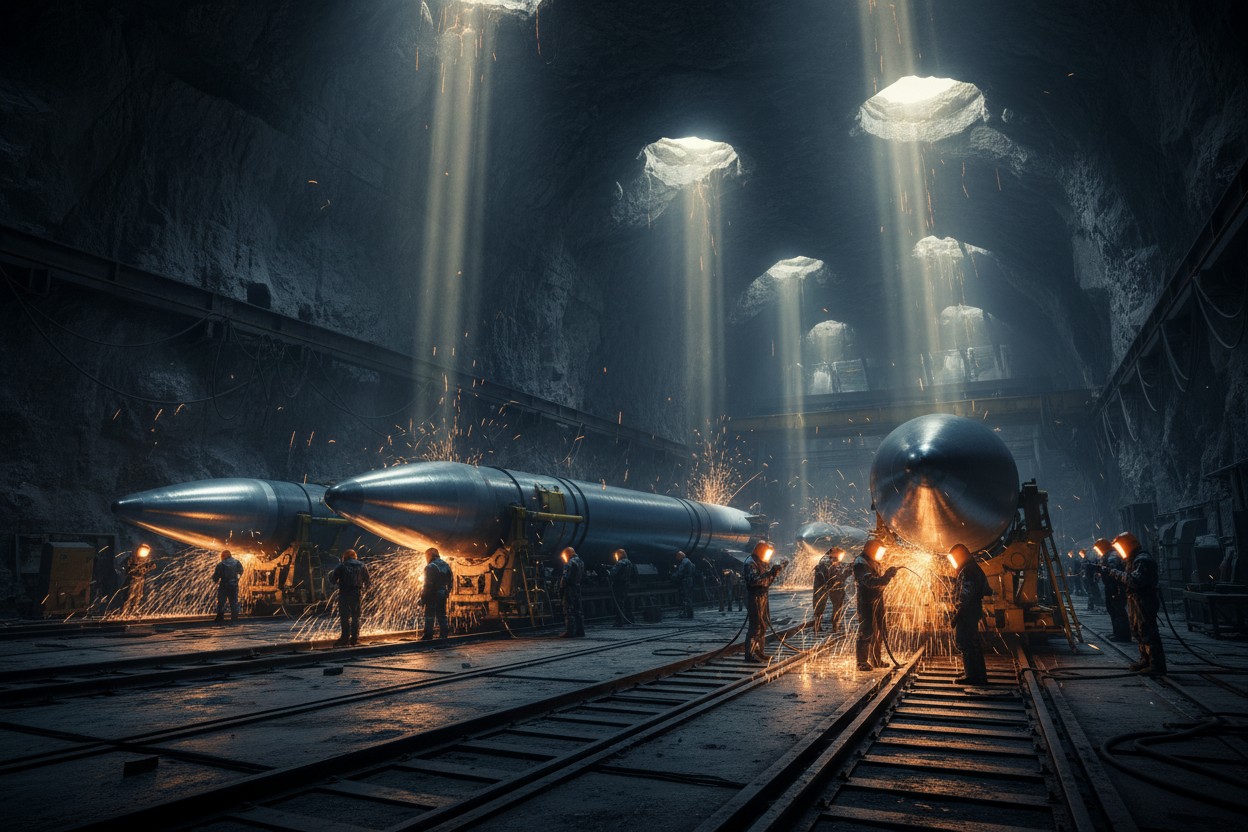
According to the latest intelligence, Iranian military engineers and technicians have restarted the assembly of both liquid-propellant missiles, which require fueling immediately prior to launch, and solid-propellant missiles, which can be stored ready to fire. This manufacturing activity is concentrated in heavily fortified subterranean sites designed to evade satellite detection and bunker-busting munitions.
Primary intelligence points to renewed operations at the Khojir missile production facility in southeastern Iran, alongside construction efforts at newly established, clandestine underground assembly points. While U.S. and Israeli airstrikes heavily damaged surface-level industrial plants and created acute shortages for raw ingredients used in solid rocket fuel—further exacerbated by a stringent naval blockade—Iran has managed to circumvent these obstacles. By relying on pre-war stockpiles of components, technicians are maintaining a steady, albeit scaled-down, rate of production.
This industrial recovery fundamentally erodes what U.S. and Israeli officials initially hailed as one of the primary strategic achievements of the six-month war. Despite tens of thousands of sorties and strikes on thousands of targets inside Iran, the core capability to manufacture and deploy ballistic missiles remains operational.
Chronology of the Conflict and Escalation
The current hostilities trace back to late winter 2026, marking a violent escalation in regional warfare:
- February 28, 2026: U.S. and Israeli forces launch a massive coordinated air campaign against military targets across Iran, initiating a conflict that would stretch past its six-month mark.
- March 9, 2026: President Donald Trump declares that the U.S. campaign has successfully destroyed the vast majority of Iranian missile launch platforms, claiming that "only 20% [are] remaining."
- April 1, 2026: In a national address, President Trump asserts that Iran’s missile program is "just about used up or beaten." Concurrently, battlefield tracking indicates Iran’s daily launch rates drop from roughly 80 missiles on day one to an average of 10 to 20 per day.
- June 5, 2026: In an interview with NBC News, President Trump states that "most of the missile manufacturing areas have been knocked out," estimating that only 21 to 22 percent of Iran’s missile inventory remains.
- June–July 2026: Photogrammetry analysis of satellite imagery reveals new structures and ongoing equipment movement at previously targeted ballistic missile and drone facilities, signaling early reconstruction efforts.
- August 2026: Recognizing severe depletion in domestic missile stores due to high expenditure rates during the conflict, the Pentagon awards Raytheon a $22.9 billion contract to ramp up production of Tomahawk cruise missiles to over 1,000 units annually.
- September 2026: The Wall Street Journal publishes findings from U.S. and Middle Eastern officials confirming that Iran has actively resumed ballistic missile production in underground networks.
Supporting Data and Military Metrics
The sheer scale of the military engagement since February reveals the immense expenditure of resources by both sides:
- Airstrikes and Sorties: U.S. Central Command (CENTCOM) reports that coalition forces have flown over 8,000 combat sorties and struck more than 13,000 targets within Iranian territory since the outbreak of hostilities.
- Missile Volleys and Defense: Iranian forces have responded with extensive ballistic missile, cruise missile, and drone salvos targeting Gulf states, Israel, and U.S. installations. Notable incidents include a barrage of 165 ballistic missiles, 2 cruise missiles, and 541 drones aimed at the UAE—causing structural damage to Al Dafra Air Base, Abu Dhabi, and Dubai International Airport. Additional strikes targeted Kuwait’s Al Ali Al Salem Air Base and Saudi Arabia’s Prince Sultan Air Base.
- Regional Interceptions: In Jordan, the military successfully intercepted 18 out of 20 inbound ballistic missiles, though two impacted unpopulated areas, and two U.S. officials confirmed that a base in Azraq, Jordan, sustained a direct hit.
- Naval and Munitions Costs: The U.S. Navy is currently evaluating the future of its Middle East headquarters in Bahrain after the installation was heavily damaged by Iranian fire early in the campaign. Acting Secretary of the Navy Hung Cao remarked that adversaries "blew the hell out of Bahrain." Meanwhile, the U.S. expended roughly one-third of its pre-war Tomahawk inventory—over 1,000 missiles—during the conflict, necessitating massive multi-billion-dollar defense contracts to replenish strategic reserves.
Official Responses and Conflicting Assessments
The widening gap between public administration claims and intelligence realities has become a central point of contention.
Throughout the campaign, President Trump’s characterization of Iran’s military capacity remained consistently optimistic. From asserting in March that 80% of launch platforms were destroyed to stating in June that manufacturing hubs had been "knocked out," the White House sought to project the near-total collapse of Tehran’s offensive potential.
Conversely, Iranian military leadership has painted a vastly different picture. Brigadier General Alireza Elhami, commander of Iran’s Khatam al-Anbiya Joint Air Defense Headquarters, stated that domestically produced military equipment successfully passed battlefield trials and is currently undergoing "rapid mass-production" for widespread deployment. Mohammad Reza Naqdi, Senior Advisor to the IRGC Commander-in-Chief, echoed these sentiments, asserting that all of Iran’s current weaponry is domestically manufactured and that production rates now exceed operational expenditure.
U.S. intelligence analysts acknowledge that while the initial bombardment severely disrupted supply chains and destroyed surface infrastructure, the decentralized and subterranean nature of Iran’s defense architecture allowed core manufacturing capabilities to survive intact, resuming operations as soon as the immediate intensity of the air campaign subsided.
Strategic Implications and Future Outlook
The resumption of Iranian missile manufacturing carries profound strategic ramifications for the Middle East and U.S. defense policy:
- The Limits of Air Power: The conflict demonstrates that aerial campaigns, absent a boots-on-the-ground invasion or comprehensive occupation, struggle to permanently eradicate deeply buried, dispersed missile facilities. Underground construction allows states under siege to reconstitute capabilities even amid active hostilities.
- Asymmetric Deterrence: By maintaining a steady pipeline of solid- and liquid-propellant missiles, Tehran preserves its primary mechanism for asymmetric deterrence against the United States and its regional allies, ensuring it retains strike capabilities despite severe economic and military pressure.
- Long-Term Defense Spending: The high expenditure of advanced interceptors and cruise missiles has forced Western powers to rethink defense industrial capacity. Long-term fiscal commitments—such as the Pentagon’s multi-billion-dollar munitions replenishment contracts and broader discussions regarding multi-layered homeland and regional missile defense systems (such as proposals modeled on domestic "Iron Dome" architectures)—highlight the staggering financial burden of modern missile warfare.
As the conflict passes its six-month milestone, the enduring reality on the ground is one of stubborn resilience. Despite the unprecedented weight of American and allied firepower, Iran’s missile program has adapted, dug deeper, and emerged from the rubble, proving that degrading a determined adversary’s military core remains an extraordinarily elusive objective.