








WASHINGTON — In a landmark shift that promises to democratize physical fitness, the American College of Sports Medicine (ACSM) has officially updated its resistance training guidelines for the first time in 17 years. The new recommendations shatter a long-standing fitness myth: that heavy irons, pricey gym memberships, and complex machinery are prerequisites for building significant muscle mass.
According to the updated guidelines—which draw from an exhaustive meta-analysis of 137 systematic reviews encompassing data on more than 30,000 participants—bodyweight exercises are just as scientifically proven to build muscle size, strength, and power as traditional weightlifting.
For millions of home exercisers, travelers, and those intimidated by traditional weight rooms, the message is both liberating and scientifically validated. Consistency, practicality, and progressive challenge matter far more in the pursuit of physical health than adhering to an elusive, high-barrier workout regimen.
Main Facts: The 2026 ACSM Guidelines at a Glance
The updated framework represents a generational pivot in exercise science. For nearly two decades, the fitness industry has operated under guidelines that prioritized external loads—dumbbells, barbells, and selectorized machines—as the gold standard for hypertrophy (muscle growth) and strength development.
The 2026 update repositions calisthenics and bodyweight movements as equal partners in muscle development, provided they are paired with proper execution and progressive overload.
- The Core Finding: All forms of structured resistance training—including bodyweight movements, resistance bands, and free weights—are equally effective at improving muscle strength, size, and power when variables like volume and intensity are controlled.
- The Frequency Mandate: Healthy adults are now advised to train each major muscle group at least twice per week to optimize growth and functional capacity.
- The 8–12 Repetition Rule: Exercise science literature embedded in the guidelines notes that working within the traditional mid-repetition range of 8 to 12 repetitions remains highly effective for muscle accumulation, though higher repetition schemes become viable and necessary at advanced stages.
- The Practicality Shift: The guidelines explicitly devalue the pursuit of a "perfect workout regimen," favoring a sustainable, accessible routine practiced consistently over sporadic, high-intensity efforts.
Chronology: How Fitness Science Evolved Over 17 Years
To understand the weight of this new announcement, one must look back at how fitness guidelines have developed over the decades.
2009–2015: The Era of External Load Dominance
When the ACSM last released comprehensive resistance training guidelines in 2009, the fitness landscape was dominated by commercial gym expansion. The prevailing literature heavily emphasized percentages of one-rep maximums (1RM) using external weights. While bodyweight exercises were acknowledged as useful for beginners or endurance, they were largely categorized as a "stepping stone" to real weight training.
2016–2023: The Rise of Functional Training and Calisthenics
Over the next decade, a cultural shift occurred. Fueled by the rise of outdoor fitness parks, calisthenics communities, and global disruptions that forced millions to exercise at home, sports scientists began closely studying how bodyweight movements impact neuromuscular adaptation. Researchers noticed that muscle tissue cannot inherently differentiate between a metal barbell and the load of one’s own body weight; it only responds to mechanical tension.
2024–2025: The Meta-Analysis and Data Synthesis
A massive collaborative research effort began synthesizing 137 systematic reviews, tracking more than 30,000 diverse participants across various age groups and fitness levels. The data revealed that mechanical tension, metabolic stress, and progressive overload could be achieved just as effectively through bodyweight manipulation as through external loading.
September 2026: The Official ACSM Release
The ACSM officially published its updated guidelines, retiring the 2009 standards and cementing bodyweight training as a standalone, scientifically validated pathway to robust musculoskeletal health.
Supporting Data: The Anatomy of Equipment-Free Muscle Growth
Fitness experts and exercise physiologists point out that bodyweight movements provide more than enough resistance for muscle growth—provided they are executed with strict form and progressively scaled difficulty.
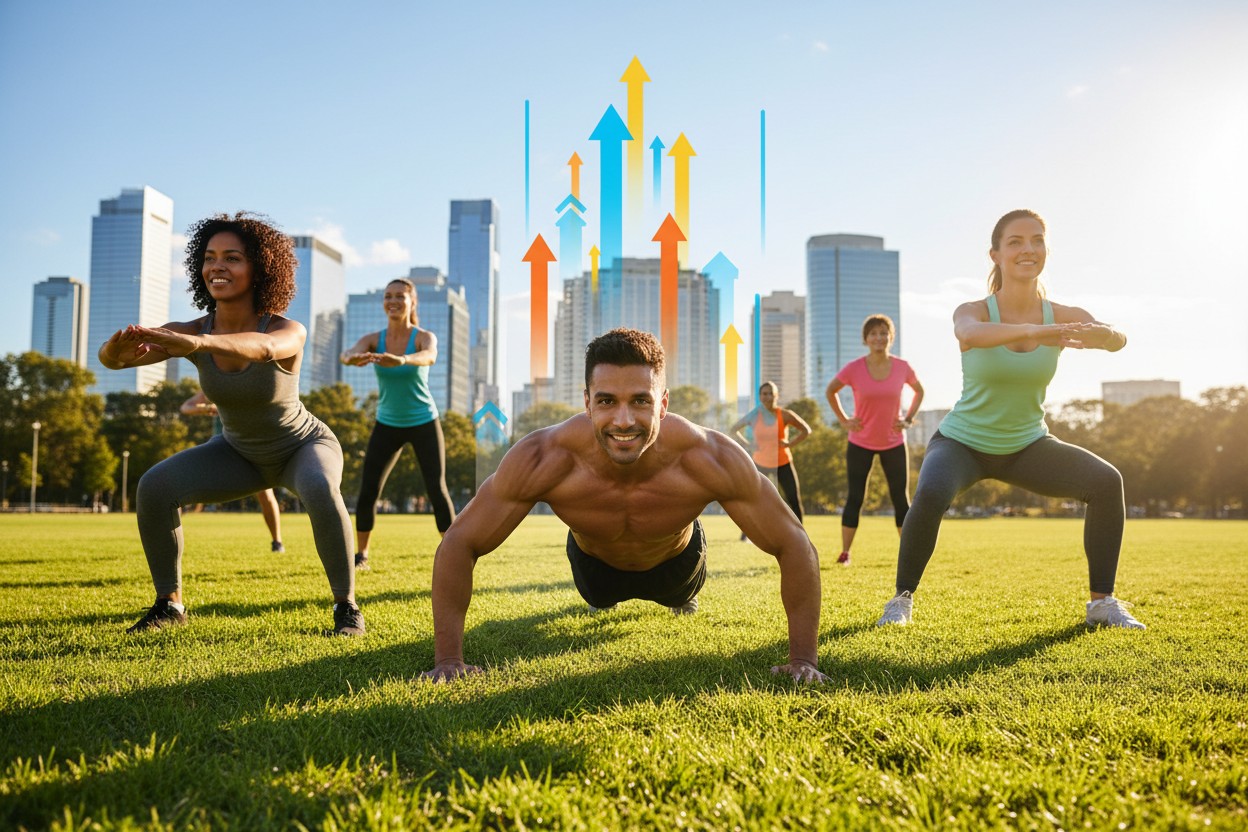
To make this actionable, exercise scientists have categorized five fundamental, equipment-free movement patterns that target the entire body: the chest, back, legs, and glutes.
1. Upper Body Push: Push-ups
- Muscles Targeted: Chest (pectoralis major), anterior shoulders, triceps, and trunk stabilizers.
- Proper Execution: Begin in a high plank position with hands slightly wider than shoulder-width apart. Lower the chest under control until it hovers just above the floor, then press explosively back to the starting position.
- Physiological Classification: A compound movement that works multiple upper-body joints and muscle groups simultaneously.
2. Upper Body Pull: Pull-ups
- Muscles Targeted: Latissimus dorsi, upper back, rear deltoids, and biceps.
- Proper Execution: Grasp an overhead bar with an overhand grip. Pull the chin cleanly over or up to the bar using a controlled, deliberate motion without swinging.
- Scaling and Regression: Beginners who cannot yet perform a standard pull-up can utilize resistance bands for assistance or perform incline push-ups and inverted bodyweight rows. As strength improves, progression can be achieved via slow "negative" (eccentric) pull-ups.
3. Lower Body Push: Squats
- Muscles Targeted: Quadriceps, gluteus maximus, hamstrings, lower back, and calves.
- Proper Execution: Place feet shoulder-width apart, keep the chest up, and lower the hips backward and downward as far as comfortable.
- Functional Impact: Classified as a cornerstone movement for functional strength and balance, bodyweight squats directly correlate with a reduced risk of falls and improved mobility, particularly in aging populations.
4. Single-Leg Lower Body: Lunges
- Muscles Targeted: Quadriceps, glutes, hamstrings, and deep stabilizers required for single-leg balance.
- Proper Execution: Step forward with one leg and lower both knees toward the ground at 90-degree angles before returning to the start.
- Progression: Advanced trainees can transition to split squats, Bulgarian split squats, or reverse lunges to continuously challenge the neuromuscular system.
5. Posterior Chain Activation: Glute Bridges
- Muscles Targeted: Glutes, hamstrings, and core stabilizers.
- Proper Execution: Lie flat on the back with knees bent and feet flat on the floor. Drive through the heels to lift the hips until a straight line forms from the shoulders to the knees. Hold briefly before lowering with control.
- Modifications: This exercise can be performed in minimal space and is easily scaled; single-leg bridge variations ramp up the difficulty for advanced athletes, while a reduced range of motion aids beginners or those managing heavier body weights.
Progressive Overload: The Non-Negotiable Engine of Growth
While the updated ACSM guidelines confirm what movements work, exercise physiologists emphasize that muscles will only adapt and grow if subjected to progressive overload.
Human muscle tissue is remarkably adaptable. If a person performs the exact same number of push-ups and squats every week without increasing the demand, growth stalls. Progressive overload can be achieved through several distinct methods without ever picking up a dumbbell:
- Increasing Repetitions: Gradually working up within the 8–12 (or higher) repetition range.
- Decreasing Rest Times: Shortening recovery intervals between sets to increase metabolic stress.
- Altering Leverage and Variation: Transitioning to harder mechanical variations—such as elevating the feet during push-ups, moving from standard bridges to single-leg bridges, or slowing down the eccentric (lowering) phase of a movement.
"Consistency in training frequency and effort is far more critical than extreme workout intensity," notes the ACSM data summary. Maintaining a simple, repeatable routine executed twice a week yields drastically superior long-term results compared to sporadic, overly complex workout plans that lead to burnout or injury.
Official Responses and Expert Commentary
The fitness community has overwhelmingly welcomed the updated guidelines, viewing them as a long-overdue alignment between academic science and the realities of modern lifestyle constraints.
"For years, everyday individuals felt that if they didn’t have a gym membership or a rack of dumbbells, their efforts were second-tier," said a spokesperson for a national fitness organization during a media briefing on the release. "These updated guidelines prove what calisthenics practitioners have known for decades: your body is a complete, highly scalable gym. If an exercise becomes difficult to control, switch to an easier variation rather than forcing the movement. Mastery of the basics always precedes advanced progression."
Health advocates have also praised the guidelines for emphasizing bodily autonomy and safety. The updated protocols explicitly state that while muscle fatigue is an expected and necessary byproduct of resistance training, sharp or persistent joint pain, dizziness, or concerning symptoms are red flags.
"Individuals bear responsibility for their own well-being and must listen to their bodies," notes the safety advisory accompanying the guidelines. "Sudden, sharp pain is never a normal response to resistance training. If discomfort persists, stop the activity and seek professional medical evaluation."
Implications: What This Means for the Future of Fitness
The release of the 2009 ACSM standards shaped an entire generation of fitness culture, commercial gym design, and personal training curricula. The 2026 update is expected to have an equally profound ripple effect across multiple sectors:
- Public Health and Accessibility: By validating bodyweight training as a premier method for muscle growth, public health initiatives can now prescribe strength routines to lower-income communities, rural populations, and senior centers without the financial barrier of gym memberships or equipment purchases.
- Personal Training and Digital Fitness: Fitness apps, home workout programs, and personal trainers are shifting their curriculum away from machine-centric routines toward movement-pattern mastery, focusing heavily on calisthenics progressions and functional longevity.
- Aging and Longevity: With the recommendation to train major muscle groups twice weekly using scalable movements, older adults now have a clear, injury-mitigating blueprint to combat sarcopenia (age-related muscle loss) safely from their own living rooms.
Ultimately, the 17-year wait for these guidelines has culminated in a message of empowerment: fitness is no longer locked behind gym doors. With a commitment to consistency, proper form, and progressive overload, anyone can build a stronger, healthier body using the most accessible tool available—the body itself.