







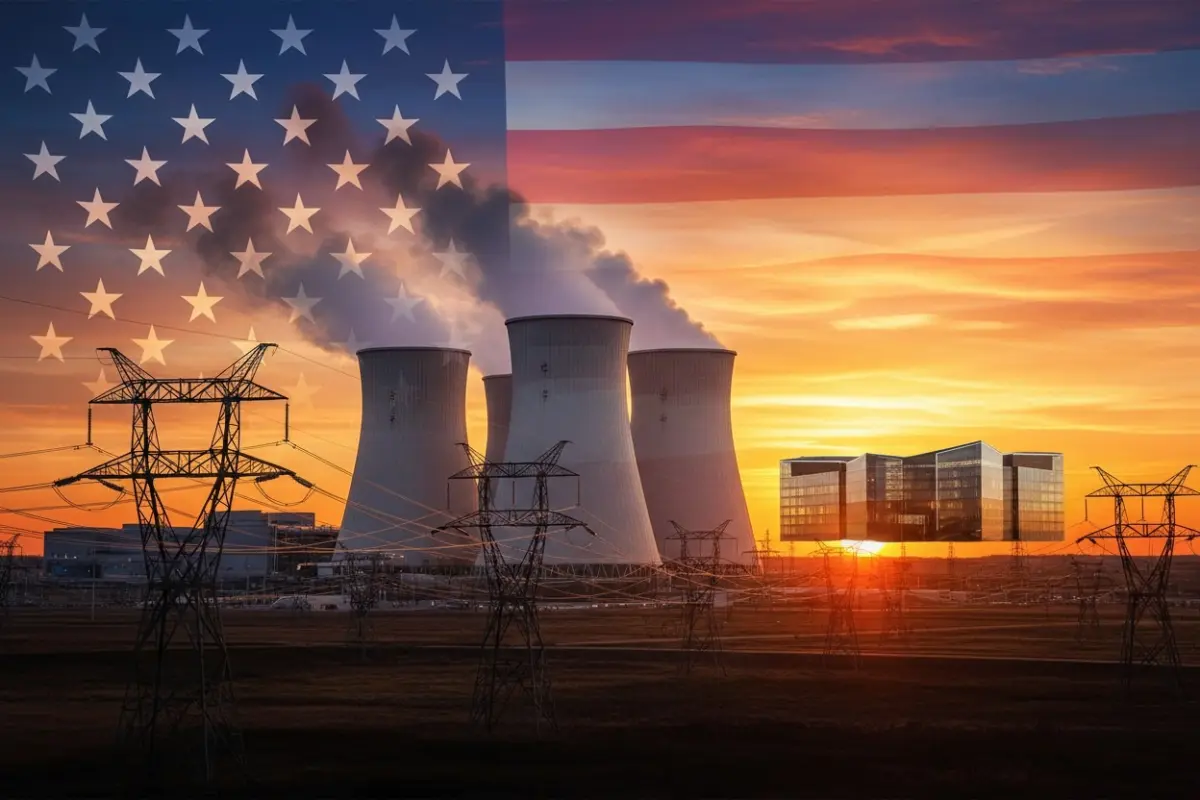
WASHINGTON — In a landmark move signaling a dramatic renaissance for American atomic energy, the U.S. Department of Energy (DOE) officially closed on a $1.9 billion federal loan to NextEra Energy on Tuesday. The substantial capital infusion is earmarked to fully refurbish and restart the shuttered 615-megawatt Duane Arnold Energy Center located in Linn County, Iowa.
Originally taken offline in 2020 following severe storm damage and decades of economic pressures, the facility is now slated to roar back to life by 2029. The multi-billion-dollar federal backing is designed to significantly lower borrowing and financing costs for NextEra Energy, serving as a cornerstone in a broader, aggressive federal push to rapidly expand the nation’s zero-carbon, baseload nuclear power capacity.
The resurrected plant already has a guaranteed economic engine: tech giant Google. Under a landmark power purchase agreement initially struck in late 2024, Google will serve as the primary off-taker, harnessing the facility’s massive electrical output to feed its rapidly expanding network of cloud computing and energy-intensive artificial intelligence (AI) data centers across Iowa.
This strategic maneuver represents the second high-profile nuclear revival loan issued through the Energy Department’s Loan Programs Office (LPO). It directly follows a similar $1 billion federal loan extended last year to Constellation Energy to jumpstart the revitalization of a reactor unit at the historic Three Mile Island facility in Pennsylvania—a project that likewise locked in a long-term contract with Microsoft to power its next-generation computational infrastructure.
Chronology: From 1974 Operations to the 2029 Revival
The trajectory of the Duane Arnold Energy Center mirrors the turbulent history of America’s nuclear energy sector over the past half-century—a narrative marked by pioneering engineering, premature closures driven by economic headwinds, and a sudden, high-stakes resurrection fueled by the digital age.
- 1974: The Duane Arnold Energy Center officially achieves initial criticality and commences commercial operations, supplying reliable, carbon-free electricity to the Iowa grid for nearly five decades.
- August 2020: A devastating "derecho" windstorm rips through Linn County, inflicting severe structural damage to the plant’s non-nuclear infrastructure. Combined with prolonged low natural gas prices and a stagnant regional electricity demand, plant owner NextEra Energy makes the corporate decision to permanently retire the facility ahead of schedule.
- Late 2024: Driven by an unprecedented surge in power demand from generative AI workloads, negotiations accelerate. Google signs a transformative preliminary agreement with NextEra Energy to purchase electricity from a hypothetical plant restart.
- July 2025: The White House hosts a high-level nuclear innovation summit. President Trump celebrates a series of civilian nuclear milestones, announcing that domestic energy companies have successfully pushed multiple dormant or experimental reactors toward criticality ahead of the nation’s 250th anniversary.
- December 2025: A coalition of more than 230 environmental and conservation organizations delivers an urgent letter to Capitol Hill, petitioning Congress for a nationwide moratorium on new data center construction due to soaring demands on local power and water grids.
- Tuesday (Current Announcement): The U.S. Department of Energy officially finalizes and closes the $1.9 billion LPO loan with NextEra Energy, locking in a target operational restart date of 2029 for Duane Arnold.
Supporting Data: The Mechanics of the Refurbishment and Tech Demands
NextEra Energy’s ambitious engineering blueprint calls for a complete overhaul of Duane Arnold’s remaining nuclear reactor vessel, turbine systems, electrical switchyards, and safety infrastructure. While NextEra has declined to publicly disclose the exact total price tag of the entire private-public venture, the $1.9 billion federal loan provides the critical financial scaffolding required to make the capital-intensive project viable in a shifting macroeconomic climate.
The economic imperative behind the project is starkly underscored by surging energy demands across the technology sector. According to a comprehensive infrastructure report published by artificial intelligence pioneer OpenAI, the next generation of AI data centers will require a staggering 100 gigawatts of new energy capacity per year—an amount roughly equivalent to the electricity consumed by 80 million American households.
Furthermore, the OpenAI report characterizes clean electricity as "the new oil" dictating geopolitical and technological dominance in the 21st century. The study highlights a widening infrastructural gap between the United States and its primary global competitors, noting that China rapidly outpaced U.S. generation buildouts in 2024 by constructing 429 gigawatts of new capacity compared to just 51 gigawatts domestically.
The Duane Arnold loan also reflects a broader legislative pipeline. Utilizing substantial capital reserves originally authorized under landmark legislation from the previous administration—including hundreds of billions allocated to the Department of Energy via the $1.9 trillion Inflation Reduction Act—the current federal administration has aggressively pivoted funds toward revitalizing foundational baseload generation, prominently featuring nuclear and advanced fossil fuel initiatives.
Official Responses and Stakeholder Perspectives
The federal investment has drawn sharp praise from administration officials who view atomic energy as indispensable to national security, grid reliability, and technological supremacy. However, the sweeping policy shift has also provoked pushback from environmental advocates worried about resource depletion.
Greg Beard, director of the Energy Department’s Loan Programs Office, emphasized the strategic necessity of the investment during a press briefing on Tuesday:
"Duane Arnold is exactly the kind of investment that will help restore American nuclear leadership, strengthen our energy security, and deliver the affordable, reliable power Americans need to fuel our nation’s future."
This sentiment echoes the broader administrative vision laid out by President Trump earlier at a White House Oval Office ceremony honoring American nuclear innovation. Surrounded by utility executives and industry leaders, the president lauded the shift:
"Today we’re celebrating an historic milestone for civilian nuclear energy and the renaissance of nuclear power in America."
While NextEra Energy officials have remained tight-lipped regarding the granular financial terms of the federal loan agreement, industry analysts point out the striking similarities between the Iowa project and the ongoing revival of Pennsylvania’s Three Mile Island Unit 1. In that project, Constellation Energy budgeted $1.6 billion for a 2028 restart, anchored entirely by a 20-year commitment from Microsoft to absorb its 835-megawatt output.
Conversely, the rapid pivot toward nuclear-powered data centers has triggered intense scrutiny from environmental watchdogs. The December letter signed by over 230 environmental groups imploring Congress to enact a national data center moratorium highlights deep-seated community anxieties over water scarcity, thermal pollution, and the potential for tech-driven energy demands to slow down broader economy-wide decarbonization goals.
Geopolitical and Domestic Implications
The resuscitation of the Duane Arnold Energy Center is far more than a localized infrastructural project for rural Iowa; it represents a fundamental stress test for American energy policy in the age of artificial intelligence.
1. The Baseload Energy Deficit
Intermittent renewable sources such as solar and wind remain vital to long-term climate strategies, but technology titans scaling up AI server farms require 24/7/365 uninterrupted power. Nuclear energy is uniquely positioned to fill this gap, offering high-density, carbon-free baseload generation that wind and solar cannot guarantee without massive, unproven grid-scale battery storage arrays.
2. Regulatory and Financial Hurdles
While federal loans significantly de-risk these multi-billion-dollar undertakings, nuclear restarts still face formidable hurdles. Strict Nuclear Regulatory Commission (NRC) oversight, long supply chains for specialized reactor components, and local zoning disputes mean that hitting a 2029 target date for Duane Arnold will require flawless project execution.
3. The Big Tech Monopoly on Power
The direct pairing of shuttered nuclear facilities with single corporate buyers—Google in Iowa and Microsoft in Pennsylvania—signals a new corporate era where multinational tech conglomerates effectively bypass traditional utility retail models. By directly underwriting the revival of nuclear power plants, companies like Google are securing proprietary access to green energy, raising complex questions about equity, regional grid pricing, and the future allocation of America’s electrical supply.
As construction and engineering teams prepare to break ground on the Duane Arnold site, all eyes will be on Iowa. Success or failure here could dictate whether America’s nascent nuclear renaissance becomes a permanent fixture of the 21st-century power grid or a cautionary tale of regulatory and financial overreach.